Fabric over foam gaskets
- Technology
- EMI shielding materials
- Partner
- MTC
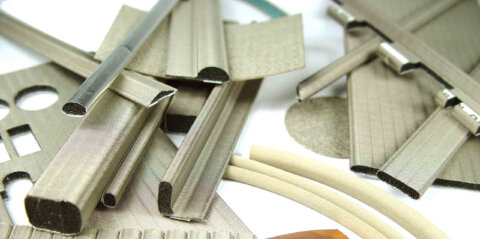
Fabric over foam EMI shielding gaskets are flexible seal components designed to block radio-frequency interference in electronic housings and equipment. Each gasket uses a low-density polyurethane foam core wrapped in conductive copper-nickel plated fabric, combining electrical conductivity with resilient compression. When compressed between metal surfaces such as cabinet doors, panel seams, or PCB covers, the gasket creates a reliable RF-tight seal and grounding path. The range includes many profile shapes, from rectangular strips to D-sections, C-shapes, L-shapes, P-shapes, and other specialist forms to match enclosure geometry. Standard parts are supplied with self-adhesive backing for straightforward installation along seams and doors. These gaskets are widely used in telecommunications, industrial control, medical electronics, and defence or aerospace systems to support electromagnetic compliance. Flame-retardant and halogen-free variants are also available for railway electronics and other safety-critical applications with strict fire and smoke requirements.
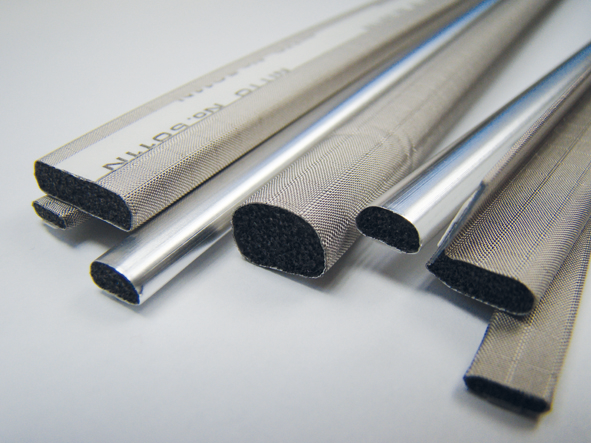
Fabric over foam gaskets combine EMI shielding, compressibility, and easy installation in one sealing solution. A conductive fabric outer layer provides the electrical path needed for shielding and grounding, while the foam core helps the gasket conform to uneven gaps and enclosure tolerances.
This makes them well suited to doors, lids, panel seams, and covers in equipment where both EMC performance and practical assembly are important.
Range features
A high level overview of what this range offers
- High EMI attenuation: Typically delivers 80–90 dB shielding up to 18 GHz for broad EMC protection.
- Conductive fabric over foam construction: Combines low surface resistance with soft compression for reliable electrical contact across uneven gaps.
- Wide choice of profiles: Available in rectangular, square, D-shape, C-shape, knife-edge, P-shape, triangular, L-shape, and M-shape versions.
- Four foam density options: Choose from 32, 45, 70, or 150 kg/m³ to balance compression force and resilience.
- Self-adhesive mounting: Standard non-conductive adhesive backing supports quick and secure installation.
- Additional adhesive options: Conductive adhesive, wide release liner, and multiple adhesive-strip configurations are available for specialised assemblies.
- Flexible supply formats: Supplied as 2 m strips, custom cut lengths, continuous rolls, or kiss-cut sheet formats for efficient production.
- Durable and protective: Resistant to abrasion and shear, with environmental sealing performance up to IP54 against dust and light splashes.
- Safety-focused variants: Flame-retardant and halogen-free options are available, including versions suitable for EN 45545-2 railway fire protection requirements.
- Broad operating temperature range: Designed for use from -25 °C to +80 °C.
Downloads
for Fabric over foam gaskets
What’s in this range?
All the variants in the range and a comparison of what they offer
Profile shape | Series code | Standard width (mm) | Standard thickness (mm) |
Rectangular strips (small) | DRE | 3.0 – 9.5 | 1.2 – 12.7 |
Rectangular strips (large) | DRE | 10.0 – 30.0 | 0.5 – 20.0 |
Square section | DQU | 2.0 – 17.0 | 2.0 – 17.0 |
D-shape profile | DHR | 2.0 – 12.7 | 1.5 – 18.0 |
C-shape profile | DCW | 6.0 – 14.7 | 3.5 – 17.9 |
Knife-edge profile | DKE | 8.0 – 11.3 | 2.3 – 2.7 |
P-shape profile | DPT | 8.0 – 29.0 | 3.0 – 10.0 |
Triangular profile | DTR | 9.1 – 12.7 | 2.3 – 4.5 |
L-shape profile | DLS | 5.6 | 3.0 |
M-shape profile | DMP | 12.7 | 9.5 |
- Core material: Low-density polyurethane foam
- Outer layer: Conductive copper-nickel plated fabric
- Alternative construction: Profiles can also be ordered with aluminium foil coating on the foam core
- Operating temperature: -25 °C to +80 °C
- Environmental sealing: Up to IP54
- Standard supply: Self-adhesive backing with optional conductive adhesive variants
FAQs
for Fabric over foam gaskets
These gaskets typically achieve 80 to 90 dB of electromagnetic attenuation over a frequency range from around 100 MHz to 18 GHz. This is generally suitable for many commercial and industrial EMC requirements, helping sensitive equipment meet emission and immunity targets.
The range includes rectangular strips, square profiles, D-shapes, C-shapes, knife-edge profiles, P-shapes, triangular wedges, L-sections, and M-shapes. This variety allows engineers to match the gasket to the enclosure geometry, mounting method, and available space while maintaining good electrical contact.
Yes. The foam core is available in four standard density options: 32, 45, 70, and 150 kg/m³. Lower-density foam gives a softer, easier-to-compress gasket, while higher-density foam offers firmer support, stronger spring force, and potentially improved long-term resilience.
Standard fabric-over-foam gaskets are supplied with a non-conductive self-adhesive backing for easy installation. Optional versions can include conductive adhesive backing where electrical continuity through the bond line is needed, as well as wide release liners or multiple adhesive-strip configurations for specialised assembly requirements.
Yes. Flame-retardant and halogen-free versions are available for applications with strict fire, smoke, or toxicity requirements. Certain variants use UL94 V-0 rated foam and are suitable for demanding sectors such as railway, aerospace, and other safety-critical environments.
They are commonly supplied as 2 m strips, but can also be provided as custom cut-to-length pieces, continuous rolls, or kiss-cut sheet formats (STP) for efficient installation of multiple small parts. Bespoke dimensions and special profile configurations can also be produced for specific applications.
Yes, they also provide a degree of environmental sealing in addition to EMI shielding. Standard versions can achieve up to IP54, helping protect against dust ingress and light splashes. They are not intended as fully waterproof seals, but they are effective for many indoor and sheltered equipment enclosures.