The complete guide to electronic component compliance: regulations, certifications, and sourcing best practices
Explore component regulatory compliance for electronic components and systems, including RoHS, REACH, CE, UKCA, EMC, cybersecurity, traceability, and certification readiness. Learn how we support electronic compliant sourcing, design, integration, and market access across regulated industries.

What is component regulatory compliance and why is it important?
Component regulatory compliance refers to the process of ensuring that electronic components, assemblies, and finished systems meet the legal, environmental, safety, quality, and operational requirements of the markets in which they are sold or deployed. In today’s electronics industry, compliance is no longer a consideration reserved for the final stages of product development. Instead, it influences decisions from the earliest design phases, shaping component selection, system architecture, sourcing strategies, cybersecurity planning, technical documentation, testing programmes, and long-term lifecycle management.
The importance of component compliance extends far beyond meeting regulatory obligations. Effective compliance management helps organisations gain access to international markets, reduce certification and audit risks, improve supply chain assurance, and minimise the likelihood of costly redesigns or project delays. As electronics systems become increasingly connected, software-driven, and globally distributed, manufacturers must navigate a growing number of overlapping regulations covering environmental performance, product safety, EMC, radio approvals, cybersecurity, and traceability. We help organisations simplify this complexity through compliance-aware sourcing, engineering collaboration, supply chain expertise, and practical integration support that strengthens certification readiness throughout the product lifecycle.
What are the key regulatory standards for electronic components?
Electronic components and systems are subject to a broad range of regulatory frameworks that vary according to product type, application, and destination market. Environmental regulations such as RoHS, REACH, and WEEE remain fundamental to modern electronics manufacturing, governing restricted substances, chemical transparency, material declarations, and end-of-life responsibilities throughout the supply chain. These regulations place increasing emphasis on accurate supplier information and traceable compliance evidence.
Alongside environmental requirements, market access regulations such as CE marking and UKCA marking play a critical role in demonstrating conformity with applicable legislation and enabling products to be legally placed on the market. Product safety frameworks, including the Low Voltage Directive and various safety certification schemes, focus on electrical protection, thermal management, insulation systems, and risk reduction measures. EMC and radio regulations, including the EMC Directive and Radio Equipment Directive, ensure that products operate reliably within their intended electromagnetic environments without causing unacceptable interference. Increasingly, cybersecurity requirements linked to connected devices and software-enabled products are becoming formal compliance obligations, driven by developments such as the Cyber Resilience Act and cybersecurity provisions within the Radio Equipment Directive. Supporting these technical requirements are broader quality and management frameworks such as ISO 9001, ISO 14001, and ISO 45001, which help organisations establish structured processes for quality, environmental management, and operational governance. Organisations looking to strengthen their environmental management practices can learn more through our Environmental Policy .
Need help understanding which regulations apply to your project? Contact our compliance specialists for guidance .
What is the certification process for electronic components?
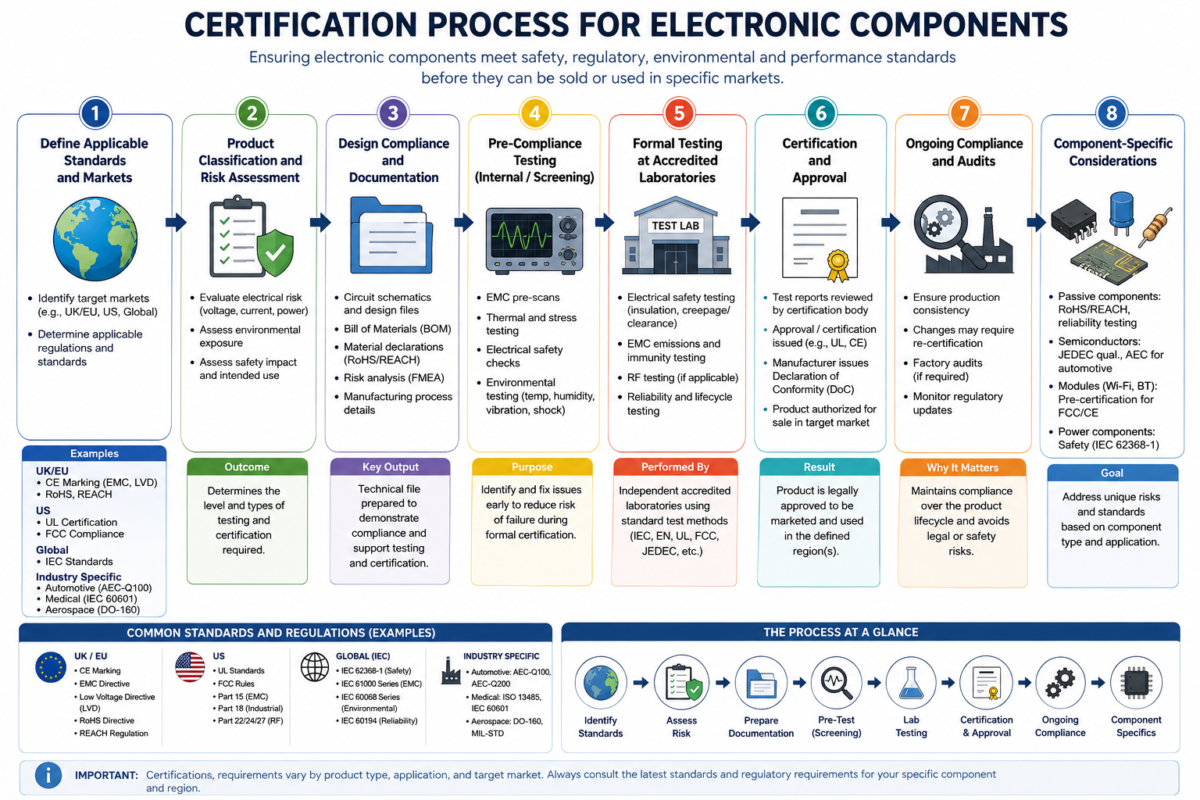
The certification process for electronic components and systems begins with identifying the regulations, directives, and standards that apply to the intended product and target markets. Once the applicable requirements have been established, manufacturers must gather evidence demonstrating conformity, which may include supplier declarations, material data, test reports, risk assessments, technical documentation, and verification activities. It is important to distinguish between compliance and certification.
Compliance refers to meeting the relevant legal or regulatory obligations, whereas certification often involves formal assessment against recognised standards or schemes. In some cases, manufacturers may self-declare conformity through a Declaration of Conformity supported by technical evidence. In higher-risk applications or regulated sectors, third-party testing, notified body involvement, or ongoing surveillance audits may be required.
Throughout the process, organisations must maintain comprehensive technical files, ensure configuration control, and demonstrate that the product submitted for assessment accurately reflects the version intended for market release. Early compliance planning can significantly improve certification readiness by reducing redesign cycles, strengthening documentation quality, and supporting smoother testing and approval processes.
What is the role of electronic component traceability in regulatory compliance?
Electronic component traceability is a critical foundation of effective regulatory compliance. It enables organisations to demonstrate that the components used within a product can be identified, verified, and linked back to approved suppliers, declarations, manufacturing records, and released product configurations. In regulated industries, traceability provides the evidence required to support audits, customer reviews, certification activities, and product investigations.
Strong traceability practices help organisations maintain confidence that products remain compliant throughout their lifecycle, even as suppliers change, components become obsolete, or new product revisions are introduced. Effective traceability extends beyond component identification and includes approved bills of materials, firmware version control, supplier declarations, revision histories, product change notifications, and configuration management processes. In sectors such as medical technology, aerospace, industrial systems, and communications infrastructure, the ability to quickly identify affected products or manufacturing lots can be essential when responding to audits, field actions, or regulatory enquiries. We support customers through structured supplier evidence management, configuration control processes, and traceability practices that improve audit readiness and long-term compliance confidence.
What risks arise from non-compliance in the electronic component sourcing process?
The risks associated with non-compliance in the electronic component sourcing process can be significant and often extend well beyond regulatory penalties. Many compliance failures do not originate from a single missing certificate or test report. Instead, they arise from incomplete documentation, uncontrolled design changes, supplier inconsistencies, poor change management practices, or assumptions made too late in the development cycle.
When compliance requirements are overlooked during sourcing, organisations may encounter certification delays, failed audits, blocked market access, unexpected redesigns, increased project costs, supply chain disruptions, or damage to customer confidence. Component substitutions made without fully evaluating material declarations, safety approvals, EMC performance, thermal characteristics, or software dependencies can introduce hidden risks that may only become apparent during formal testing or customer reviews. As regulatory requirements become increasingly interconnected, organisations must ensure that sourcing decisions support not only product performance and availability but also long-term compliance objectives.

Reduce compliance risk before it impacts your project.
Speak with one of our experts to discuss compliant sourcing strategies, supplier verification, and regulatory requirements for your application.
How do companies ensure compliance with global regulatory requirements for components?
Companies typically ensure compliance with global regulatory requirements by adopting a compliance-by-design approach that integrates regulatory considerations into engineering, procurement, sourcing, and lifecycle management activities from the outset. Rather than treating compliance as a final-stage exercise, successful organisations build regulatory requirements into product planning, architecture development, supplier qualification, verification programmes, and change-control processes.
Achieving compliance across multiple regions requires close collaboration between engineering teams, procurement professionals, quality managers, cybersecurity specialists, regulatory experts, and supply chain stakeholders. Organisations must identify target markets early, understand the regulations that apply within each jurisdiction, maintain robust technical documentation, verify supplier declarations, and continuously monitor changes that may affect product conformity. As cybersecurity, environmental obligations, and market access requirements continue to evolve, maintaining alignment between technical decisions and compliance responsibilities has become increasingly important throughout the product lifecycle.
Early-stage verification and testing activities can play a critical role in reducing certification risk and supporting compliance readiness. Learn more about our pre-production services
What are the key differences in compliance requirements for components used in industrial vs. medical applications?
Although many compliance principles apply across industries, the expectations placed on industrial and medical applications differ significantly because of their respective operating environments and risk profiles. Industrial systems often prioritise EMC robustness, electrical safety, environmental durability, reliability, and long-term serviceability. Products deployed within industrial environments frequently operate in electrically noisy conditions, demanding greater attention to electromagnetic compatibility, lifecycle planning, and maintenance considerations.
Medical applications typically involve much stricter requirements relating to risk management, software governance, documentation control, usability, lifecycle traceability, and change management. Because medical devices are often subject to lengthy certification processes and stringent patient safety requirements, component selection and supplier stability become particularly important. Any change to approved configurations may require extensive assessment and documentation, making traceability and configuration control central elements of compliance management. While both sectors require rigorous compliance processes, medical applications generally demand a greater level of documentation, validation, and regulatory oversight.
Compliance requirements: industrial vs medical electronic components
| Area | Industrial Applications | Medical Applications |
|---|---|---|
Primary Focus | Reliability, EMC performance, environmental robustness | Patient safety, clinical effectiveness, risk control |
Core Standards | IEC-based standards (e.g. EMC, safety, environmental) defined by International Electrotechnical Commission | Medical device standards such as IEC 60601 and ISO 13485 |
Regulatory Framework | CE marking (EU/UK), FCC (US), general product safety directives | Medical device regulations (EU MDR, FDA 21 CFR Part 820) |
Risk Classification | Typically low to medium risk depending on environment | Formal risk classes (Class I, IIa, IIb, III) based on patient impact |
Safety Requirements | Electrical safety (basic protection, insulation, thermal limits) | Enhanced safety (patient leakage current limits, isolation, fail-safe design) |
Quality Management System (QMS) | Recommended but not always mandatory | Mandatory ISO 13485-certified QMS required |
Documentation Level | Technical file, BOM, test reports | Extensive technical documentation + clinical evaluation evidence |
Testing Requirements | EMC, environmental, vibration, thermal cycling | All industrial tests PLUS biocompatibility, usability engineering, clinical validation (if applicable) |
Traceability Requirements | Batch-level traceability often sufficient | Full end-to-end traceability (components → manufacturing → patient use) |
Change Control | Engineering change control (ECO) process | Strict regulatory change notification; re-certification often required |
Audit Requirements | Occasional customer or certification audits | Regular regulatory audits by notified bodies / FDA inspections |
Failure Consequences Considered | Equipment downtime, financial loss, safety risk to operator | Potential patient injury or death (much stricter tolerance) |
Software Requirements (if applicable) | Basic functional safety if embedded systems involved | IEC 62304 software lifecycle requirements (critical for many devices) |
Time to Certification | Weeks to a few months depending on complexity | Often 12–36 months due to regulatory approval cycles |
How can regulatory compliance impact the cost and lead time of sourcing electronic components?
Regulatory compliance can have a significant influence on both the cost and lead time associated with sourcing electronic components. For example, compliance requirements often necessitate supplier qualification activities, documentation reviews, material verification, testing programmes, certification assessments, and ongoing evidence management. These activities require resources and can extend project timelines if not planned effectively. However, the greatest costs frequently arise when compliance considerations are addressed too late. Products that require redesign following failed testing, supplier changes, or certification issues often experience substantial delays and increased development expenditure. By incorporating compliance requirements into sourcing strategies from the beginning, organisations can reduce the likelihood of unexpected disruptions, improve supply chain resilience, and maintain more predictable development schedules. Compliance-aware sourcing helps balance availability, lifecycle considerations, technical performance, and regulatory obligations while reducing long-term commercial risk.
When should companies consider custom component solutions to meet compliance needs?
Companies should consider custom component solutions when standard commercial products cannot adequately satisfy specific compliance, performance, environmental, safety, EMC, cybersecurity, or lifecycle requirements. This is particularly relevant in highly regulated industries where unique operating conditions, extended product lifecycles, specialised certifications, or system-level integration requirements create challenges that cannot be addressed through off-the-shelf solutions alone.
Customisation may also be appropriate when organisations require enhanced reliability, specialised environmental protection, unique radio characteristics, or compliance with sector-specific regulations. Early engagement with technical specialists helps ensure that customised solutions are developed with regulatory requirements in mind, reducing the risk of introducing new compliance challenges later in the development process. When approached strategically, custom component development can support both product performance objectives and long-term certification readiness.
Need a custom solution to meet complex compliance requirements?
Explore our Technology Network to discover how our specialist engineering teams can support custom component development, integration challenges, and compliance-driven design requirements across a wide range of applications.

What are the best practices for sourcing compliant components?
The most effective approach to sourcing compliant components begins with integrating compliance requirements into product development and supply chain planning from the earliest stages. Organisations should establish clear understanding of their target markets, applicable regulations, certification pathways, and documentation requirements before component selection decisions are made. Working with trusted suppliers and certified electronic components distributors can improve visibility into compliance evidence, supplier quality systems, lifecycle considerations, and change-control processes.
Strong sourcing practices also depend on maintaining accurate technical documentation, verifying supplier declarations, implementing robust traceability systems, and carefully evaluating alternate components against compliance-related characteristics rather than purely commercial considerations. Material composition, environmental declarations, safety approvals, EMC performance, software dependencies, and cybersecurity implications should all be considered as part of the evaluation process. By aligning sourcing activities with engineering, quality, and compliance functions, organisations can reduce risk, strengthen certification readiness, improve lifecycle resilience, and accelerate market access. Through compliance-aware sourcing, engineering support, and supply chain expertise, we help customers make informed decisions that support both innovation and long-term regulatory confidence.
Looking for compliant, traceable components? Contact us to discuss your sourcing requirements.
What are the strategic benefits of component regulatory compliance?
Component regulatory compliance delivers benefits that extend well beyond satisfying legal obligations. When compliance requirements are embedded throughout the product lifecycle, organisations can reduce regulatory risk, improve audit readiness, accelerate market access, and strengthen supply chain resilience. Effective compliance management also helps minimise the likelihood of costly redesigns, certification delays, product recalls, and market restrictions.
For organisations operating in regulated sectors, compliance provides greater confidence that products can be launched, maintained, and supported throughout their lifecycle. Strong compliance processes improve documentation quality, enhance traceability, support supplier management, and create a more predictable route to certification and market approval. As regulatory frameworks continue to evolve, organisations that adopt a proactive compliance strategy are often better positioned to respond to legislative changes while maintaining commercial agility and customer confidence.
Why partner with Acal BFi for component regulatory compliance?
Successfully navigating regulatory compliance requires more than access to compliant components. It requires a partner with the technical expertise, supply chain insight, and engineering support needed to identify potential risks early and help maintain compliance throughout the product lifecycle.
We support customers through compliance-aware sourcing, engineering collaboration, supplier management, lifecycle planning, and technical consultation. Our specialists work closely with customers to align component selection, system integration, documentation requirements, and certification readiness with project objectives and regulatory obligations.
In addition to providing access to traceable and certified technologies from leading manufacturers, we help organisations address complex compliance challenges through custom solutions, technical support, and guidance across environmental, safety, EMC, wireless, and cybersecurity requirements. This consultative approach helps reduce project risk, improve certification readiness, and accelerate the path to market.
Speak with our engineering and compliance specialists to discuss your regulatory requirements and identify the most suitable solution for your application.
Key takeaways
- Component regulatory compliance should be considered from the earliest stages of product development, not as a final-stage activity.
- Regulations such as RoHS, REACH, CE, UKCA, EMC, and emerging cybersecurity frameworks can significantly influence design, sourcing, and market access decisions.
- Strong documentation, electronic component traceability, and supplier management are essential for maintaining compliance and supporting audits.
- Early compliance planning can reduce certification delays, redesign costs, and supply chain disruption.
- Different industries have different compliance expectations, with medical applications typically requiring higher levels of documentation, validation, and lifecycle control.
- Compliance-aware sourcing helps organisations balance technical performance, availability, lifecycle requirements, and regulatory obligations.
- Working with an experienced compliance partner can improve certification readiness, reduce risk, and accelerate time to market.
Need support with component regulatory compliance? Speak with an expert to discuss compliant sourcing, certification readiness, traceability, and custom compliance solutions for your next project.