HF series filter wheels
- Technology
- Photonics accessories
- Partner
- Prior Scientific
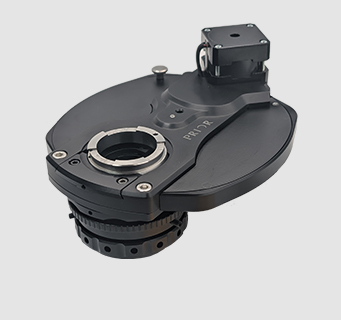
The HF series is a multi-variant range of high-speed motorised filter wheels for laboratory engineers, microscope integrators and OEM teams developing automated optical imaging systems. Available configurations accommodate 25 mm or 32 mm filters, with six, eight or ten positions depending on the required channel count and optical aperture. The wheels can be mounted directly to a microscope, installed on an optical-table stand or incorporated into a compatible microscope deck.
ProScan III control coordinates filter changes with other motorised microscope operations. The range supports multi-channel fluorescence imaging and other wavelength-selective microscopy routines requiring controlled filter sequencing. Compatible 10 ms shutters can be added when the optical path must be blocked during filter changes or between exposures. Filters are not included, and a suitable microscope- or optical-port-specific adapter must be selected separately.
Range features
A high level overview of what this range offers
- Adjacent filter changes in as little as 55 ms – Supports time-sensitive multi-channel acquisition routines.
- Six, eight and ten-position configurations – Matches filter capacity to the required imaging workflow.
- 25 mm and 32 mm filter formats – Provides options for compact optical paths and wider beam diameters.
- Excitation or emission path installation – Supports different microscope automation architectures.
- Stand-mounted and stand-free variants – Enables optical-table or direct microscope integration.
- ProScan III control – Coordinates automated filter positioning with the wider microscope system.
- 10 ms shutter compatibility – Combines wavelength selection with rapid light blocking.
- Microscope-specific adapters – Supports mechanical and optical alignment with compatible systems.
- Dedicated deck-insert option – Provides direct integration with compatible microscope decks.
What’s in this range?
All the variants in the range and a comparison of what they offer
Specifications
| Specification | Range details |
|---|---|
Filter capacities | 6 or 10 positions for 25 mm filters; 8 or 10 positions for 32 mm filters |
Adjacent-position change time | As little as 55 ms |
Controller | ProScan III microscope automation controller |
Optical-path installation | Excitation or emission channel, subject to the microscope and adapter configuration |
Mounting formats | Stand-mounted, microscope-mounted without a stand, or dedicated deck insert |
Shutter integration | Compatible with a 10 ms shutter; combined wheel-and-shutter configurations are available |
Range Comparison
| Variant | Positions | Filter diameter | Mounting format | Configuration |
|---|---|---|---|---|
HF106A | 6 | 25 mm | Without stand | Standard motorised filter wheel |
HF110A | 10 | 25 mm | Without stand | Standard motorised filter wheel |
HF110 | 10 | 25 mm | With stand | Optical-table filter wheel |
HF108A | 8 | 32 mm | Without stand | Standard motorised filter wheel |
HF108 | 8 | 32 mm | With stand | Optical-table filter wheel |
HF108IX3 | 8 | 32 mm | Dedicated deck insert | Microscope-deck filter wheel |
HF110A + HF200HT | 10 | 25 mm | Without stand | Filter wheel with mounted high-temperature shutter |
HF108A + HF201HT | 8 | 32 mm | Without stand | Filter wheel with mounted high-temperature shutter |
Optical filters are not included. Select the required filter set and a microscope- or optical-port-specific adapter separately for the intended installation.
FAQs
for HF series filter wheels
Choose 25 mm filters when channel capacity and a compact spectral set are the main priorities; the HF106A and HF110 variants provide six or ten positions. Choose 32 mm filters when the optical path has a wider beam, high field number or larger camera sensor, as the HF108 variants provide eight positions with the larger filter format. Filter diameter alone does not guarantee an unvignetted optical path because the adapter, tube optics and microscope port can also restrict the beam. In practice, calculate the beam footprint at the wheel location and confirm the clear aperture of each adapter before selecting the filter wheel.
The required capacity depends on the number of fluorescence channels, calibration filters and open positions needed by the acquisition routine. A six-position HF106A can suit focused assays with a limited fluorophore set, while the ten-position HF110 variants provide more capacity for complex protocols or future channel additions. Eight-position HF108 variants combine a relatively high channel count with support for 32 mm filters. Engineers should reserve positions for neutral-density filters, blockers or an empty optical path where the workflow requires them. The wheel should therefore be sized from the complete imaging protocol rather than only the initial fluorescence channel count.
HF filter wheels can be fitted within excitation or emission channels when the correct mechanical adapter and optical clearance are available. Excitation-side installation selects the wavelength reaching the specimen, while emission-side installation selects the wavelength band reaching the detector. The preferred location depends on the illumination architecture, fluorophore set and whether multiple cameras or detection branches are present. HF110 and HF108 stand-mounted variants can also support optical-table arrangements where direct microscope attachment is unsuitable. Before installation, verify the optical-axis height, port thread, adapter aperture and available infinity space for the complete assembly.
The stated figure represents an adjacent-position movement taking as little as 55 ms under the appropriate controller configuration. Moves across several wheel positions may take longer, so software should not assume that every filter change has the same duration. The complete acquisition interval also includes shutter operation, camera exposure, sensor readout and any settling delay required by the optical system. For tightly timed experiments, measure the full trigger-to-image sequence with the selected filters and controller settings. This provides a more useful system-level timing value than treating the wheel movement figure as the total channel-switching time.
HF filter wheels are intended for operation through the ProScan III automation platform, allowing wheel movement to be coordinated with other microscope actions. The control design should define position numbering, homing behaviour, move-completion handling and whether the shutter closes during filter transitions. Keeping motion control within one platform helps maintain consistent positioning and accessory sequencing. Engineers should confirm that the selected imaging software exposes the required filter-wheel and shutter commands before finalising the system. OEM integrations should also validate the start-up state and error-recovery process so an interrupted routine cannot leave an unintended filter in the optical path.
Add a shutter when the application requires the illumination or detection path to be fully blocked between exposures or during filter movement. A filter wheel changes the spectral channel but does not by itself guarantee a dark optical path while the wheel is moving. Compatible shutters can open or close in 10 ms, and combined configurations include the HF110A with HF200HT and the HF108A with HF201HT. This arrangement is particularly relevant to fluorescence workflows where unnecessary specimen illumination should be limited. The acquisition software should coordinate shutter closure, wheel movement and camera triggering to avoid recording transitional light or exposing the sample between frames.
Filters are not included, so the optical set must be specified separately for the intended fluorophores, illumination source and detector. The range supports nominal filter diameters of 25 mm or 32 mm, depending on the selected wheel. A single universal filter-thickness limit is not defined across all HF variants in the available range information. Before ordering filters, confirm their finished outside diameter, mounted thickness, edge geometry and retaining method against the selected wheel. Coating orientation and thermal loading should also be considered, particularly where intense illumination or a high-temperature shutter is used.