Benchtop Universal Gas Analysers (UGA)
- Technology
- Scientific instruments
- Partner
- Stanford Research Systems (SRS)
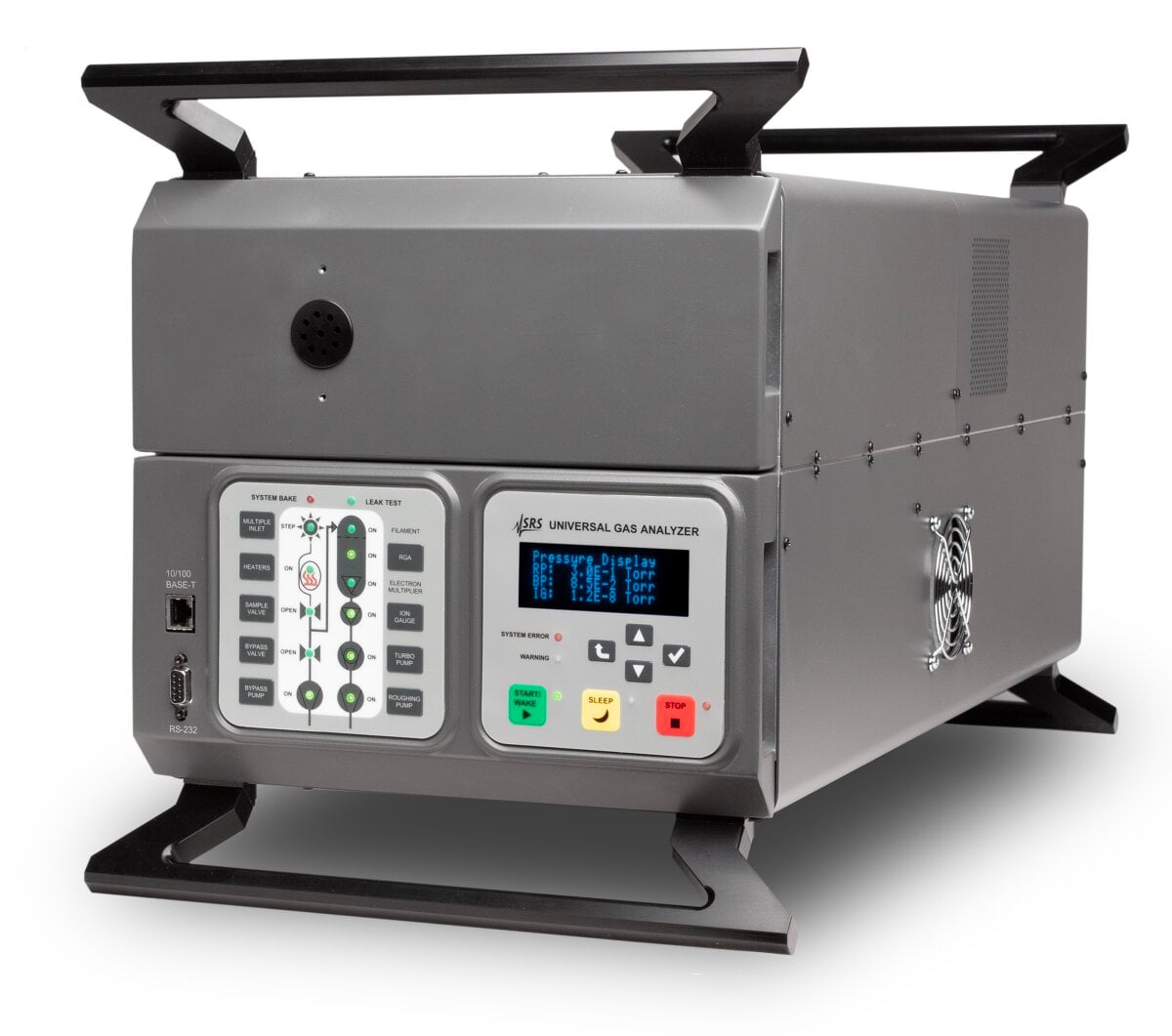
The UGA range combines a quadrupole residual gas analyser with the pressure-reduction, pumping and control components required for benchtop gas analysis. UGA120, UGA220 and UGA320 models cover mass ranges up to 120, 220 and 320 amu respectively. A two-stage capillary and pinhole inlet reduces sample pressure before the gas reaches the high-vacuum analysis chamber. This arrangement enables continuous, low-flow sampling with a specified response time below 200 ms. Faraday cup and electron multiplier detectors support measurements ranging from general gas-mixture analysis to trace-level detection.
Applications include semiconductor exhaust monitoring, glovebox analysis, fuel-cell studies, refrigerant detection, fermentation research, catalysis, pollution monitoring and vacuum-system diagnostics. Measurements and system functions can be controlled locally or through Windows software using RS-232C, Ethernet or ASCII commands. Optional multi-point sampling, dry-gas venting, heated sample handling and hydrogen pumping adapt the system to different laboratory and process requirements.
Range features
A high level overview of what this range offers
- 120, 220 or 320 amu model ranges: Match the analyser to the highest mass-to-charge ratio required by the application.
- Two-stage pressure-reducing inlet: Supports continuous sampling while maintaining the vacuum required by the quadrupole analyser.
- Response time below 200 ms: Tracks rapid changes in gas composition during online measurements.
- Dual detector system: Faraday cup and continuous-dynode electron multiplier detectors provide detection limits below 10 ppm and below 1 ppm respectively.
- Dual diaphragm pump architecture: Separates bypass flow from turbopump backing flow to help limit backstreaming into the analysis chamber.
- Built-in heaters: Chamber and turbopump-connector heaters enable system bakeout at temperatures up to 120 °C.
- Local and remote control: Operate the system from the front panel or integrate it into automated test and monitoring systems.
- Flexible communications: RS-232C, Ethernet and high-level ASCII commands provide multiple software and instrument-control options.
- Multiple measurement modes: Analogue scans, histogram scans, pressure-versus-time monitoring, scheduled acquisition and leak detection support varied analytical tasks.
- Optional 16-channel inlet: Sequentially monitors multiple sampling locations with one analyser.
- Optional hydrogen turbopump: Supports continuous measurements of high hydrogen concentrations, including samples containing up to 100% H₂.
- Optional heated sample path: Helps prevent condensation when analysing water vapour and other condensable species.
- Horizontal or vertical operation: Provides installation flexibility on laboratory benches and within equipment areas.
- Stand-alone leak detection: Supports sniffing and vacuum leak investigations without requiring continuous computer control.
Downloads
for Benchtop Universal Gas Analysers (UGA)
What’s in this range?
All the variants in the range and a comparison of what they offer
Main specifications
| Specification | Value |
|---|---|
Product models | UGA120, UGA220 and UGA320 |
Instrument technology | Quadrupole mass spectrometer with residual gas analyser |
Mass range | UGA120: 1–120 amu; UGA220: 1–220 amu; UGA320: 1–320 amu |
Inlet type | Capillaries available in stainless steel, PEEK and glass-lined plastic |
Sample pressure capability | Selectable from 1 × 10⁻⁶ bar to 1 bar; configured high-pressure capillaries can cover 10 Torr to 2 atm or higher |
Atmospheric-pressure flow rate | 1–10 mL/min |
Response time | Less than 200 ms |
Detector types | Faraday cup and continuous-dynode electron multiplier |
Resolution | Better than 0.5 amu at 10% of peak height |
Faraday cup detection limit | Less than 10 ppm |
Electron multiplier detection limit | Less than 1 ppm |
Detector operating pressure | 10⁻⁴ mbar for Faraday cup; 10⁻⁶ mbar for electron multiplier |
Atmospheric inlet connection | ⅛-inch Ultra-Torr fitting |
Additional vacuum connections | Two 2¾-inch CF ports |
Exhaust connection | ¼-inch tube adaptor |
Computer interfaces | RS-232C via DB-9 and Ethernet via RJ-45 |
Remote command interface | High-level ASCII command set |
Software | Windows application controlling the complete system and residual gas analyser |
Measurement modes | Analogue scan, histogram scan, pressure versus time, leak detection and scheduled acquisition |
High-vacuum pump | Hybrid turbomolecular/drag pump, 81 L/s, ultimate pressure 2 × 10⁻⁹ mbar |
Diaphragm pump | Ultimate pressure below 1 mbar |
Pump protection class | IP44 |
Construction materials | 304 and 316 stainless steel |
Insulating materials | Alumina and ceramic |
Principal seal materials | Viton, Buna-N, neoprene, nitrile butyl rubber and copper |
Other gas-path materials | Molybdenum, aluminium, glass, chromium, silver and Tygon tubing |
Start-up time | Approximately 5 minutes from a full stop |
Maximum ambient operating temperature | 35 °C |
System bakeout temperature | Up to 120 °C |
Optional sample-heater range | 40–100 °C for the standard UGA configuration |
Power requirement | 100–240 V AC input, less than 600 W total |
Dimensions without handles | 28 cm H × 30 cm W × 65 cm D |
Dimensions with handles | 33 cm H × 35 cm W × 67.5 cm D |
Weight | 41 kg |
Operating orientation | Horizontal or vertical |
Product warranty | One year against defects in materials and workmanship; pump seals and diaphragms have a 90-day warranty |
Model range comparison
| Specification | UGA120 | UGA220 | UGA320 |
|---|---|---|---|
Maximum mass range | 120 amu | 220 amu | 320 amu |
Minimum mass | 1 amu | 1 amu | 1 amu |
Detector configuration | Faraday cup and electron multiplier | Faraday cup and electron multiplier | Faraday cup and electron multiplier |
Resolution | Better than 0.5 amu | Better than 0.5 amu | Better than 0.5 amu |
Specified response time | Less than 200 ms | Less than 200 ms | Less than 200 ms |
UGA family configuration comparison
| Specification | UGA | UGA LT | UGA HT | UGA PM |
|---|---|---|---|---|
Sample pressure range | 10 Torr to 2 atm or higher; customer-specific configurations above 2 atm | 10 Torr to 2 atm | 10 Torr to 2 atm | 1 mTorr to 20 Torr |
Pressure reduction | Two stages: capillary and pinhole | Two stages: capillary and pinhole | Two stages: capillary and pinhole | Single-stage capillary |
Primary pumping system | Dual diaphragm pumps: separate bypass and turbopump-backing pumps | Shared single diaphragm pump | Dual diaphragm pumps: separate bypass and turbopump-backing pumps | Single turbopump-backing diaphragm pump without a bypass pump |
Hydrogen-specific turbopump | Optional | Not available | Optional | Standard |
Sampling valve system | Dual sample and bypass valves | Dual sample and bypass valves | Continuous sampling without valves | Single sample valve, with optional valve for multi-channel sampling |
Vent valve | Optional | Optional | Optional | Optional |
Multiple-inlet option | 16-channel multiplexer | Not available | Not available | Eight-channel multiplexer |
Heated capillary | Optional; accessory rated up to 105 °C, with standard control settings limited to 100 °C | Not available | Heating up to 220 °C as standard | Optional heating up to 105 °C |
Chamber bakeout | Up to 120 °C | Not available | Up to 120 °C | Up to 120 °C |
Sniffing leak-detection mode | Available | Not available | Available | Not available |
FAQs
for Benchtop Universal Gas Analysers (UGA)
Select the model according to the highest mass-to-charge ratio needed for identifying or monitoring the target gases. UGA120 measures from 1 to 120 amu, UGA220 extends the range to 220 amu, and UGA320 reaches 320 amu. The detector arrangement, response specification and basic gas-handling architecture are otherwise shared across the three systems. Engineers should consider both the molecular ion and the diagnostically useful fragment ions when establishing the required range. Choosing a wider range than necessary provides future flexibility, although scanning more mass points can increase acquisition time depending on the selected scan settings.
Yes, provided that the inlet hardware and capillary are selected for the pressure at the sampling point. Atmospheric samples enter through the ⅛-inch Ultra-Torr capillary connection at a typical flow of 1–10 mL/min, while two additional 2¾-inch CF ports provide access for vacuum applications. The two-stage inlet reduces the sample pressure before it reaches the quadrupole chamber, where detector operation requires approximately 10⁻⁴ mbar for the Faraday cup or 10⁻⁶ mbar for the electron multiplier. Capillary length and bore affect conductance, chamber pressure and response time. The complete inlet arrangement should therefore be sized around the expected pressure range rather than treated as a universal unrestricted connection.
Yes, but quantitative work requires calibration and species-specific correction rather than direct interpretation of uncorrected peak heights. The stated detection limits are below 10 ppm with the Faraday cup and below 1 ppm with the electron multiplier, but these values are sensitivity limits rather than accuracy specifications. Fragmentation patterns can cause several gases to contribute to the same mass peak, so representative masses and correction factors must be selected for the actual gas mixture. Electron-multiplier gain is mass-dependent and changes over time, making periodic recalibration important. Before tuning or calibration, the analyser should operate under typical conditions with the filament on for at least one hour, using a known calibration gas and a suitable pressure reference.
The dual-diaphragm-pump architecture is intended to reduce the amount of bypass gas that can backstream towards the turbopump and analysis chamber, which is useful when handling corrosive or low-mass gases. This design does not remove the need for a formal chemical-compatibility review of the complete gas path. Exposed materials include 304 and 316 stainless steel, molybdenum, alumina, glass, aluminium, copper, Viton, Buna-N, neoprene, nitrile rubber and Tygon tubing. For continuous high-concentration hydrogen measurements, Option 03 replaces the standard turbopump with a version designed for low-mass molecules and supports samples containing up to 100% H₂. Hazardous or corrosive exhaust must also be routed to an appropriate treatment or containment system.
Condensable samples require the inlet temperature to remain above the relevant dew point throughout the capillary and sample line. The O100HC accessory heats the standard UGA capillary and sample path up to 100 °C, while the main chamber and turbopump connector can be baked at up to 120 °C. These functions can help with water vapour and other compounds that would otherwise adsorb or condense on internal surfaces. If the sample remains gaseous only at temperatures above the standard heater limit, the UGA HT configuration provides sample-path heating up to 220 °C. Engineers should assess the complete route from the process take-off to the analyser, because an unheated fitting or transfer section can still become the point where condensation occurs.
The system can be operated from its front panel or remotely through a Windows application. Computer connections include RS-232C through a DB-9 connector and Ethernet through an RJ-45 port, while a high-level ASCII command set supports custom control software. Available measurement functions include analogue and histogram scans, selected-mass pressure-versus-time plots, leak detection, scheduled acquisition and a gas library. The software can also control pumps, valves and heaters while recording system pressure and temperature information. With the optional 16-channel inlet, sampling channels can be changed during a programmed scan sequence, allowing several process locations or experimental chambers to be monitored from one analyser.
The selection should be based on sample routing, vapour temperature, hydrogen concentration and the expected frequency of vacuum cycling. Option 01 adds a 16-channel manifold for multi-point sampling, while Option 02 adds controlled turbopump venting through a 150 µm orifice using a selected dry gas. Option 03 replaces the normal turbopump with a version intended for continuous high-concentration hydrogen sampling. The O100HC accessory heats the capillary and internal sample line to reduce condensation in single-inlet applications. The multi-inlet and vent-valve options can be added separately, whereas the hydrogen turbopump replacement is better treated as a dedicated service operation rather than a routine field modification.
The analyser weighs approximately 41 kg, so two people should be used for lifting and it should not be moved while operating. Forced-air cooling is required, the rear air inlet and exhaust must remain clear, and the ambient operating temperature must not exceed 35 °C. Electrical provision should support 100–240 V AC and a total demand below 600 W. The enclosure may be used horizontally or vertically, provided that connections, ventilation and mechanical support remain suitable. Hazardous sample exhaust must be captured through the ¼-inch exhaust connection rather than released into the working area. Silicone greases and oils should not be used on the vacuum seals because silicone can irreversibly affect the glass within the electron multiplier.