RF Signal generators
- Technology
- Signal Generators
- Partner
- Stanford Research Systems (SRS)
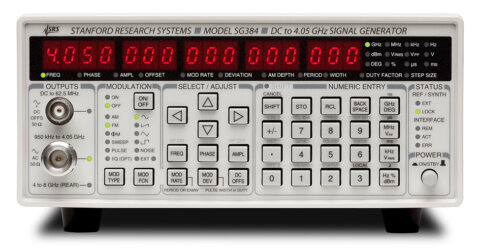
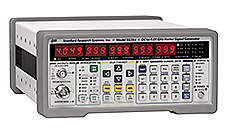
The range combines the SG380 analogue signal generator series and the SG390 vector signal generator series, with 2.025 GHz, 4.05 GHz and 6.075 GHz models available in each family. Both series use Rational Approximation Frequency Synthesis and provide 1 µHz frequency resolution throughout their operating ranges. A DC-coupled BNC output covers DC to 62.5 MHz, while an N-type output handles RF signals from 950 kHz to the upper frequency limit of the selected model. The SG380 series supports analogue modulation and can be configured with differential clock outputs, an external I/Q input, a rubidium timebase or, on selected models, an 8.10 GHz frequency doubler.
The SG390 series adds dual internal baseband generators, standard external I/Q modulation and digital modulation formats including PSK, QAM, FSK, CPM, MSK, ASK and VSB. Ethernet, GPIB and RS-232 interfaces support integration into automated and legacy test systems. These half-rack instruments are suited to RF development, communications testing and device characterisation where their specified frequency, modulation and interface capabilities meet the application requirements.
Range features
A high level overview of what this range offers
- Six carrier-frequency variants – Select a 2.025 GHz, 4.05 GHz or 6.075 GHz analogue or vector model.
- 1 µHz frequency resolution – Allows fine carrier, modulation-rate and sweep adjustment.
- RAFS synthesis architecture – Combines fine frequency control with specified low phase-noise performance.
- DC and RF front-panel outputs – Supports low-frequency waveform work and RF testing from one instrument.
- AM, FM, phase, pulse and sweep modulation – Covers common analogue stimulus requirements.
- Internal and external modulation paths – Accommodates built-in waveforms or externally generated test signals.
- Dual baseband generators on SG390 models – Generates digital I/Q waveforms without a separate baseband source.
- 300 MHz external I/Q bandwidth on SG390 models – Supports externally generated wideband modulation.
- Standard OCXO timebase – Provides specified stability and ageing performance for frequency-sensitive measurements.
- Optional rubidium timebase – Reduces temperature-related frequency variation and long-term ageing.
- Ethernet, GPIB and RS-232 interfaces – Enables integration into automated and legacy test systems.
- Single and dual rack-mount arrangements – Supports bench use or installation in a standard 19-inch rack.
Downloads
for RF Signal generators
What’s in this range?
All the variants in the range and a comparison of what they offer
Specifications
| Category | Specification |
|---|---|
Product families | SG380 analogue RF signal generators; SG390 analogue and vector RF signal generators |
Available models | SG382, SG384, SG386, SG392, SG394 and SG396 |
BNC output frequency range | DC to 62.5 MHz on all models |
N-type output frequency range | 950 kHz to 2.025 GHz, 4.05 GHz or 6.075 GHz, depending on model |
Frequency resolution | 1 µHz at any frequency |
Frequency switching speed | <8 ms to within 1 ppm |
Frequency stability | 1 × 10⁻¹¹ at 1 s Allan variance |
BNC output amplitude | 0.001 to 1.00 Vrms into 50 Ω |
BNC output offset | ±1.5 VDC with 5 mV resolution |
BNC output accuracy | Amplitude ±5%; offset and amplitude resolution as specified |
N-type output power | +16.5 to −110 dBm for SG382/SG392; same range below 3 GHz on SG384/SG394 and below 4 GHz on SG386/SG396 |
RF power resolution | 0.01 dBm |
RF power accuracy | ±1 dB; ±2 dB under the stated high-frequency and output-level conditions |
N-type output impedance | 50 Ω, AC coupled; VSWR <1.6 |
Typical phase noise at 1 GHz | −80 dBc/Hz at 10 Hz; −102 dBc/Hz at 1 kHz; −116 dBc/Hz at 20 kHz for 2 GHz and 4 GHz models; −114 dBc/Hz at 20 kHz for 6 GHz models |
Typical residual FM | 1 Hz rms over 300 Hz to 3 kHz bandwidth |
Typical residual AM | 0.006% rms over 300 Hz to 3 kHz bandwidth |
Standard timebase | Oven-controlled third-overtone SC-cut crystal oscillator |
Standard timebase stability | <±0.002 ppm from 0 to 45 °C |
Standard timebase ageing | <±0.05 ppm per year |
Optional rubidium stability | <±0.0001 ppm from 0 to 45 °C |
Optional rubidium ageing | <±0.001 ppm per year |
External timebase input | 10 MHz ±2 ppm; 0.5 to 4 Vpp; 50 Ω, AC coupled |
Timebase output | 10 MHz sine wave; 1.75 Vpp ±10%; 50 Ω |
Analogue modulation | AM, FM, phase modulation, pulse modulation, blanking and frequency sweeps |
Internal modulation waveforms | Sine, ramp, saw, square, pulse and noise |
Internal modulation rate | 1 µHz to 500 kHz at lower carrier frequencies; 1 µHz to 50 kHz at higher carrier frequencies |
AM range and bandwidth | 0 to 100%; >100 kHz modulation bandwidth |
FM deviation resolution | 0.1 Hz |
FM and phase-modulation bandwidth | Up to 500 kHz at lower carrier frequencies and 100 kHz at higher carrier frequencies |
Frequency sweeps | Phase-continuous triangle, ramp or sine sweeps up to 120 Hz |
Internal pulse generator | 1 µs to 10 s period; 100 ns to 9999.9999 ms width; 5 ns timing resolution |
Pulse-modulated RF response | 60 ns on/off delay; 20 ns rise and fall time |
SG380 optional external I/Q input | 400 MHz to the selected model limit; 200 MHz bandwidth at −3 dB; 50 Ω, ±0.5 V |
SG380 optional clock outputs | Differential SMA outputs from DC to 4.05 GHz; <35 ps transition time; ECL, PECL, RSECL, CML, NIM and LVDS levels |
SG380 optional frequency doubler | SG384: 4.05 to 8.10 GHz; SG386: 6.075 to 8.10 GHz; includes a ±10 VDC bias output |
SG390 external I/Q input | 400 MHz to the selected model limit; 300 MHz RF bandwidth; 50 Ω, ±0.5 V |
SG390 baseband generator | Two channels; dual 14-bit DACs at 125 MS/s; up to 16 Mbits of symbol memory |
SG390 symbol generation | 1 Hz to 6 MHz symbol rate with 1 µHz resolution; 1 to 9 bits per symbol |
SG390 digital filtering | Nyquist, root Nyquist, Gaussian, rectangular, linear, sinc and user-defined FIR filters |
SG390 vector modulation | PSK, QAM, FSK, CPM, MSK, ASK and VSB, including user-defined constellations |
SG390 preset modes | GSM, GSM-EDGE, W-CDMA, APCO-25, DECT, NADC, PDC, TETRA, ATSC DTV and audio clip |
Remote interfaces | 10/100 Base-T Ethernet, IEEE-488.2 GPIB and RS-232 from 4800 to 115,200 baud |
Stored configurations | Up to nine instrument configurations |
Line power | <90 W; 90 to 264 VAC; 47 to 63 Hz with power factor correction |
Dimensions | 8.5 × 3.5 × 13 in, width × height × length |
Weight | 10 lb |
Form factor | Half-rack benchtop instrument; single and dual 19-inch rack-mount kits available |
Warranty | One year against defects in materials and workmanship |
Model Range Comparison
| Specification | SG382 | SG384 | SG386 | SG392 | SG394 | SG396 |
|---|---|---|---|---|---|---|
Series type | Analogue | Analogue | Analogue | Analogue and vector | Analogue and vector | Analogue and vector |
BNC output | DC to 62.5 MHz | DC to 62.5 MHz | DC to 62.5 MHz | DC to 62.5 MHz | DC to 62.5 MHz | DC to 62.5 MHz |
N-type output | 950 kHz to 2.025 GHz | 950 kHz to 4.05 GHz | 950 kHz to 6.075 GHz | 950 kHz to 2.025 GHz | 950 kHz to 4.05 GHz | 950 kHz to 6.075 GHz |
Analogue modulation | Standard | Standard | Standard | Standard | Standard | Standard |
Internal vector baseband generator | Not included | Not included | Not included | Dual 14-bit, 125 MS/s | Dual 14-bit, 125 MS/s | Dual 14-bit, 125 MS/s |
External I/Q modulation | Optional, 200 MHz bandwidth | Optional, 200 MHz bandwidth | Optional, 200 MHz bandwidth | Standard, 300 MHz bandwidth | Standard, 300 MHz bandwidth | Standard, 300 MHz bandwidth |
8.10 GHz doubler | Not available | Optional | Optional | Not available | Not available | Not available |
Rubidium timebase | Optional | Optional | Optional | Optional | Optional | Optional |
FAQs
for RF Signal generators
The SG380 series is intended for analogue RF generation, while the SG390 series adds internal vector waveform generation as a standard function. Both families provide AM, FM, phase, pulse and sweep modulation, together with 1 µHz frequency resolution and matching 2.025 GHz, 4.05 GHz and 6.075 GHz model choices. SG380 instruments can accept external I/Q signals through an optional 200 MHz input, whereas SG390 models include dual 14-bit, 125 MS/s baseband generators and a 300 MHz external I/Q path. The SG380 is therefore appropriate when analogue modulation covers the test requirement. The SG390 is the relevant choice when internally generated PSK, QAM, FSK, MSK, ASK, VSB or custom I/Q signals are required.
The 2.025 GHz models are the SG382 and SG392, the 4.05 GHz models are the SG384 and SG394, and the 6.075 GHz models are the SG386 and SG396. Each instrument also provides a separate BNC output from DC to 62.5 MHz, so the maximum model frequency applies specifically to the N-type RF output. Selection should include the highest fundamental carrier, modulation sidebands and any margin needed for future test plans. If an SG380 application needs coverage above 6.075 GHz, the optional doubler extends the SG384 from 4.05 to 8.10 GHz and the SG386 from 6.075 to 8.10 GHz. That option has different amplitude and spectral specifications from the main N-type output, so it should be assessed as a separate RF path.
The BNC output is intended for signals from DC to 62.5 MHz and provides 0.001 to 1.00 Vrms into 50 Ω, together with an adjustable ±1.5 VDC offset. This makes it suitable for lower-frequency sine-wave work, baseband stimulus and tests that require a controlled DC component. The N-type connector covers 950 kHz to the selected model limit and provides RF power down to −110 dBm, with up to +16.5 dBm available within the specified frequency bands. Both outputs are designed around 50 Ω systems, but the BNC output is DC coupled while the N-type output is AC coupled. Engineers should choose cables, terminations and protection arrangements according to the active connector rather than treating the two outputs as interchangeable.
The standard OCXO is suitable where <±0.002 ppm stability from 0 to 45 °C and <±0.05 ppm annual ageing meet the uncertainty budget. Typical phase noise at a 1 GHz carrier is −80 dBc/Hz at 10 Hz offset and −116 dBc/Hz at 20 kHz offset for the 2 GHz and 4 GHz models. The optional rubidium timebase changes the specified temperature stability to <±0.0001 ppm and ageing to <±0.001 ppm per year. A rear-panel input also allows the generator to lock to an external 10 MHz reference between 0.5 and 4 Vpp. The correct choice therefore depends on whether the system is dominated by short-term phase noise, long-term frequency drift or traceability to an external laboratory reference.
All models support amplitude, frequency, phase and pulse modulation using either internal waveforms or an external modulation input. The internal generator provides sine, ramp, saw, square, pulse and noise functions, with rates up to 500 kHz at lower carrier frequencies and 50 kHz at higher carriers. AM depth is adjustable from 0 to 100%, while FM deviation begins at 0.1 Hz and varies with the selected carrier band. Phase-continuous sweeps can use sine, triangle or ramp functions at rates up to 120 Hz. This allows one instrument to cover conventional receiver tests, frequency-response sweeps, gated-carrier measurements and externally controlled modulation without requiring a separate low-frequency generator in many set-ups.
The SG390 series uses two 14-bit baseband channels operating at 125 MS/s to generate I and Q signals internally. Symbol rates extend from 1 Hz to 6 MHz, with up to 16 Mbits of symbol memory and one to nine bits mapped to each constellation point. Supported modulation families include PSK, QAM up to QAM256, FSK, CPM, MSK, ASK and 8- or 16-level VSB. Pulse-shaping choices include Nyquist, root Nyquist, Gaussian, rectangular, linear, sinc and user-defined FIR filters, while additive white Gaussian noise can be applied from −70 to −10 dBc. In practice, this permits protocol-oriented receiver and demodulator testing without assembling a separate arbitrary generator, I/Q modulator and noise source.
Every model provides 10/100 Base-T Ethernet, IEEE-488.2 GPIB and RS-232 interfaces, allowing it to work with both current networked systems and established test racks. RS-232 supports rates from 4800 to 115,200 baud with RTS/CTS flow control, while Ethernet uses TCP/IP with DHCP enabled by default. All instrument functions can be controlled and read remotely, and up to nine configurations can be retained in non-volatile memory. The half-rack enclosure measures 8.5 × 3.5 × 13 in and weighs 10 lb. Single and dual mounting kits allow one instrument or two side-by-side instruments to be fitted into a standard 19-inch rack.
The SG38x family contains 256 kB of microcontroller flash, an 8 Mbit serial EEPROM and 4 MB of parallel flash. Its factory reset overwrites the EEPROM containing instrument and interface settings, while firmware and FPGA configuration storage remain unchanged. The SG39x family contains an 8 Mbit serial EEPROM and 4 MB of flash used for user waveforms; the reset overwrites the EEPROM and sector-erases the waveform flash. Instrument settings are reset by powering up with BACK SPACE depressed, while remote-interface settings are reset by holding the decimal-point key during power-up. Organisations with controlled-data requirements should include these actions in their decommissioning procedure and account for the memory regions that retain firmware or configuration data.