Focus drives & controllers for motorised Z focus systems
- Technology
- Photonics accessories
- Partner
- Pearson Electronics
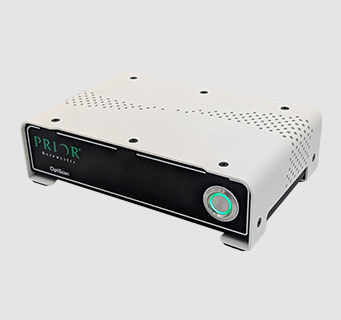
This product range provides motorisation and control for a microscope’s fine-focus axis. The PS3H122R focus drive couples to compatible focus mechanisms through an appropriate sleeve or direct-coupling kit. ProScan III provides modular control for stage, focus and selected microscope accessories, while OptiScan ES11 is intended for simpler three-axis XY/Z systems. CS200Z adds dedicated manual focus control and can be used alongside the CS200XY stage joystick for two-handed operation. USB and RS232 communications support software-led positioning, with SDK and ASCII command options available for integration work.
ProScan III also provides programmable TTL I/O for synchronising movement with cameras and other equipment. Encoder configurations support monitored, closed-loop positioning where motor rotation alone is insufficient. Typical applications include Z-stack acquisition, time-lapse imaging, slide scanning, inspection, metrology and motorised microscope upgrades.
Range features
A high level overview of what this range offers
- PS3H122R motorised fine-focus drive: Adds software-controlled Z movement to compatible microscope focus mechanisms.
- Z command steps from 0.002 µm with ProScan III: Supports fine incremental positioning; achieved accuracy remains dependent on the mechanical system and feedback configuration.
- Typically below 1 µm repeatability: Supports repeat visits to defined Z positions under suitable focus and stage system conditions.
- Encoder support on motor axes: Enables closed-loop position feedback for configurations that require monitored Z movement.
- USB virtual COM, RS232C, SDK and ASCII commands: Provides several routes for imaging-software and OEM integration.
- Four programmable TTL inputs and outputs: Allows motion and peripheral events to be coordinated with cameras and other external equipment.
- Three-axis base controller with modular expansion: Supports stage and focus initially, with ancillary modules available for additional functions and OEM axes.
- CS200Z dedicated focus control with speed selection: Gives the operator direct manual Z control without combining it with the XY joystick.
- Automatic accessory detection: Reduces manual configuration when supported components are connected before power-up.
- Rotating-cable focus-drive option: Helps prevent cable twisting while the drive operates.
What’s in this range?
All the variants in the range and a comparison of what they offer
The rated values below apply to ProScan III unless another product or variant is named.
ProScan III specifications
| Parameter | Value | Parameter | Value |
|---|---|---|---|
Power | Universal mains input, 110/240 VAC, 50–60 Hz | Stage speed | Up to 300 mm/s |
Computer interface | USB virtual COM and RS232C | Command step size | From 0.01 µm for XY and 0.002 µm for Z |
COM port protocol | 8-bit word, 1 stop bit, no parity and no handshake; 9,600, 19,200, 38,400 and 115,200 baud | Repeatability | Typically <1 µm for focus and stage systems |
Controller dimensions | 177 × 177 × 177 mm; ancillary box adds 59 mm | Linear scale options | 0.1 µm or 0.05 µm |
Controller weight | 3 kg; ancillary box 1 kg | Ball-screw options | 1, 2, 4 or 5 mm |
Controller capacity | Up to 9 axes, including 6 configurable OEM axes | Z limit switches | Optical and mechanical options available |
TTL I/O | Four programmable TTL inputs and outputs | Focus drive speed | Up to 60 rev/s for applicable stereo microscope systems |
Range comparison
| Specification | Option A | Option B | Option C | Option D |
|---|---|---|---|---|
Product or variant | PS3H122R | ProScan III | OptiScan ES11 | CS200Z |
Product type | Motorised focus drive | Modular automation controller | Three-axis automation controller | Manual Z-axis control |
Main function | Drives a microscope fine-focus mechanism through adapter hardware | Controls stage, focus and selected accessories | Controls motorised XY and Z axes | Provides direct operator control of focus |
Control connection | 15-way focus connection through a compatible controller | USB, RS232C, TTL and CS200 control | USB, RS232 and compatible manual control | Controller-connected rotary input |
Expansion approach | Microscope compatibility is configured through focus sleeves and coupling kits | Ancillary sections support additional functions and OEM axes | Fixed XY/Z control scope | Can be used individually or alongside CS200XY |
Typical use | Motorising a microscope fine-focus mechanism | Automated imaging requiring triggers or additional peripherals | Routine three-axis microscope automation | Manual focusing during setup and observation |
FAQs
for Focus drives & controllers for motorised Z focus systems
Select ProScan III when the system needs more than basic XY/Z motion, encoder options, programmable TTL I/O or future expansion. Its base unit accommodates a three-axis stage-and-focus arrangement, and the controller can support up to nine axes, including six configurable OEM axes, with ancillary sections added for further functions. OptiScan ES11 is the simpler choice when control is limited to the X, Y and Z axes and there is no requirement to add illumination or sample-handling functions through the same controller. In practice, define the full hardware list first, including focus feedback, filter wheels, shutters and triggers. This prevents the selection of a controller that cannot accommodate a later imaging sequence.
The ProScan III specification gives a minimum Z command step of 0.002 µm and typical repeatability below 1 µm for focus and stage systems. The 0.002 µm figure is the smallest commanded increment, not a guarantee that the specimen plane will move or settle with 2 nm absolute accuracy. Mechanical coupling, focus gear ratio, backlash, load, microscope construction and encoder arrangement determine the movement achieved in the completed system. For quantitative Z-stack or metrology work, verify performance on the assembled microscope using the intended objective, travel range and motion profile. Command resolution, repeatability and metric accuracy should be treated as separate acceptance criteria.
Specify encoded focus when the mechanical Z position cannot be inferred reliably from motor rotation alone, particularly with indirect couplings, backlash-prone mechanisms or long time-lapse runs. ProScan III supports encoder feedback on motor axes and can use closed-loop control to monitor whether the requested position has been reached. This improves confidence in mechanical return-to-position performance, but it does not directly measure optical sharpness at the sample. Thermal movement of the specimen, objective or microscope structure can still shift the best-focus plane even when the encoder reports the same Z coordinate. If optical focus must be maintained, combine suitable Z feedback with an autofocus strategy and validate the interaction between both control loops.
The PS3H122R is fitted to the microscope fine-focus mechanism with a model-specific sleeve or direct-coupling kit, so the microscope interface must be identified before ordering. Some configurations motorise only the fine-focus knob and leave coarse focus manual, while a direct coupling can reduce compliance where the microscope supports it. Focus hardware connects to the controller’s 15-way FOCUS port; on an H31ZFE configuration, the combined FOCUS/FILTER 1 connection is used. Power must be switched off before any focus, stage, encoder or joystick cable is attached or removed. After power-up, supported accessories are detected and configured, but travel direction, limits and the safe Z range should still be checked before installing a valuable objective or sample.
Both controller families support computer control through USB or RS232, while ProScan III adds an SDK, ASCII command access and programmable TTL I/O. Its serial protocol uses an 8-bit word, one stop bit, no parity and no handshake, with supported rates of 9,600, 19,200, 38,400 and 115,200 baud. The four programmable TTL inputs and outputs can coordinate stage or focus actions with cameras, shutters and other external equipment. For deterministic acquisition, decide whether the controlling event should originate in the imaging software, the controller or an external trigger device. Bench-test command completion, trigger polarity and timing margins because serial command latency and mechanical settling are separate from the electrical trigger transition.
Use CS200Z when the operator needs a dedicated physical control for the Z axis, particularly during specimen search, focus setup or manual scanning. The separate CS200XY and CS200Z units can be used individually or together, allowing one hand to position the stage while the other adjusts focus. A side-mounted speed-control button changes the response range, helping the same control cover coarse approach and finer adjustment. TS200 is more suitable when the operator also needs a touchscreen interface for system-wide control and parameter configuration. For workstation design, choose between tactile control and touchscreen operation according to glove use, available bench space and how frequently settings must be changed.
ProScan III is designed to start with a three-axis stage-and-focus system and accept ancillary sections for filter wheels, shutters or configurable OEM axes. The published architecture supports up to nine axes, six of which can be assigned to OEM functions, and more than one ancillary box may be added where the configuration requires it. The main controller is a 177 × 177 × 177 mm cube weighing 3 kg, while an ancillary section adds 59 mm and weighs 1 kg. OptiScan ES11 should instead be treated as a defined XY/Z controller rather than an expansion platform. Reserve enclosure space, connector access and cable bend radius during system design, especially where the controller will sit under shelving or inside an instrument frame.