Frequency standards & counters
- Technology
- Frequency counters
- Partner
- Stanford Research Systems (SRS)
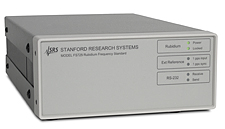
These frequency standards and oscillators provide a choice of stable timing and reference-frequency technologies for laboratories, test systems and integrated instrumentation. The FS725 and PRS10 are rubidium-based options, with the FS725 providing 10 MHz and 5 MHz outputs and the PRS10 accepting a 1 pps input. The FS740 and FS752 use GPS/GNSS disciplining but address different requirements. The FS740 combines a GPS-disciplined 10 MHz reference with time tagging and frequency counting, while the FS752 provides multiple 10 MHz and 1 pps outputs.
The SC10 is an ovenised SC-cut crystal oscillator with specified short-term stability, ageing and supply-voltage characteristics. Model selection can therefore be based on the required timebase technology, output frequency, number of outputs, phase-noise criterion and measurement functions. Connector details, environmental ratings, dimensions and control interfaces must be confirmed from model-specific documentation.
Range features
A high level overview of what this range offers
- Rubidium, GPS/GNSS and SC-cut crystal options: Select the timebase technology around the intended reference application.
- FS725 10 MHz and 5 MHz outputs: Support equipment requiring either of these standard reference frequencies.
- FS725 phase noise below −130 dBc/Hz at 10 Hz: Provides a quantified close-in phase-noise criterion for system selection.
- FS725 built-in distribution amplifiers: Can reduce the need for a separate distribution stage, subject to the required output configuration.
- PRS10 1 pps input: Supports integration with external pulse-per-second timing systems.
- PRS10 stated 20-year lamp life: Provides a defined figure for maintenance and lifecycle planning.
- FS740 GPS-disciplined 10 MHz output: Combines satellite-referenced timing with a standard laboratory reference frequency.
- FS740 time tagging and frequency counting: Brings time-reference and measurement functions into the same instrument.
- FS752 five 10 MHz and two 1 pps outputs: Supports reference distribution to several instruments or subsystems.
- SC10 +15 VDC or +24 VDC operation: Provides two stated supply-voltage options for equipment integration.
What’s in this range?
All the variants in the range and a comparison of what they offer
| Model | Technology and product type | Outputs and inputs | Stability, noise or service life | Other stated details |
|---|---|---|---|---|
FS725 | Rubidium frequency standard | 10 MHz and 5 MHz outputs | Phase noise below −130 dBc/Hz at 10 Hz | Built-in distribution amplifiers |
PRS10 | Rubidium oscillator | 1 pps input | Low phase noise; 20-year lamp life | Numerical phase-noise value is not included in the range information |
FS740 | GPS/GNSS system | GPS-disciplined 10 MHz | Long-term stability of 1 × 10⁻¹³ | Time tagging to UTC or GPS; frequency counter |
FS752 | GPS/GNSS reference with OCXO timebase | Five 10 MHz outputs; two 1 pps outputs | Low phase noise | GPS-disciplined 10 MHz reference |
SC10 | Ovenised SC-cut crystal oscillator | +15 VDC or +24 VDC operation | Allan variance of 2 × 10⁻¹² at 1 s; ageing below 2 × 10⁻¹⁰ per day | SC-cut crystal |
FAQs
for Frequency standards & counters
The available information covers a product range rather than one instrument with selectable variants. It identifies five distinct models: the FS725, PRS10, FS740, FS752 and SC10. These products use different reference technologies, including rubidium, GPS/GNSS disciplining and an ovenised SC-cut crystal. They should not be treated as interchangeable versions because their outputs, timing functions and stated performance criteria differ. Selection should begin with the required timebase technology and then consider output frequency, signal-distribution requirements, phase noise and any need for frequency counting or UTC/GPS time tagging.
Both models provide a GPS-disciplined 10 MHz reference, but they address different functional requirements. The FS740 states long-term stability of 1 × 10⁻¹³ and includes a frequency counter together with time tagging to UTC or GPS. The FS752 uses an OCXO timebase and provides five 10 MHz outputs and two 1 pps outputs, making its published configuration more oriented towards reference distribution. The FS752 is also described as having low phase noise, although no numerical figure is given. In practice, the FS740 suits applications prioritising measurement and time tagging, while the FS752 suits systems requiring several reference outputs.
The FS725 should be considered when a complete rubidium frequency standard with 10 MHz and 5 MHz outputs is required. It also includes built-in distribution amplifiers and specifies phase noise below −130 dBc/Hz at a 10 Hz offset. The PRS10 is presented as a rubidium oscillator with a 1 pps input, low phase noise and a stated lamp life of 20 years. This makes the PRS10 relevant where an oscillator must be integrated with an external pulse-per-second reference. The available information does not establish mechanical, electrical or interface compatibility, so the two models should not be substituted without checking their detailed integration requirements.
The FS725 is the only listed model with a numerical phase-noise value: below −130 dBc/Hz at a 10 Hz offset. This figure provides a defined close-in phase-noise point that can be compared with the requirements of signal sources, synthesisers or measurement systems. The PRS10 and FS752 are both described as having low phase noise, but no numerical values or offset-frequency curves are included. Their phase-noise performance therefore cannot be assumed to match the FS725. Engineers working on phase-sensitive applications should compare full phase-noise data across the required offset range before choosing among these models.
The FS752 has the clearest stated multi-instrument output arrangement, providing five 10 MHz outputs and two 1 pps outputs. This configuration can support systems that need to distribute both frequency and timing references without immediately adding an external distribution unit. The FS725 also incorporates distribution amplifiers, although the number, level and connector type of its outputs are not included in the range information. No equivalent output-count details are stated for the FS740, PRS10 or SC10. The final choice should therefore account for the number of connected loads, required signal levels, connector format, isolation and cable arrangement.
The SC10 states an Allan variance of 2 × 10⁻¹² at an averaging time of 1 second and ageing below 2 × 10⁻¹⁰ per day. The one-second figure provides a short-term stability criterion, while the ageing value describes the stated rate of longer-term frequency change. Its SC-cut crystal and ovenised construction identify it as a crystal-based reference rather than a rubidium or satellite-disciplined system. Operation from either +15 VDC or +24 VDC provides two stated supply options for integration. Warm-up time, output waveform, output level, load requirements and environmental performance must still be established before completing the surrounding electrical and thermal design.
The FS740 can potentially combine these functions where its stated capabilities match the measurement requirement. It provides a GPS-disciplined 10 MHz reference, frequency counting and time tagging to UTC or GPS, together with stated long-term stability of 1 × 10⁻¹³. Combining these functions can support test arrangements that need both a traceable timing reference and frequency measurement in the same instrument. However, counter bandwidth, resolution, input sensitivity, measurement modes and time-tag resolution are not defined in the range information. Those parameters must be checked against the expected signal frequency, level and required measurement uncertainty before replacing dedicated equipment.