Black silicon photoreceiver
- Technology
- Photodetectors
- Partner
- FEMTO Messtechnik
The LCA-S-400K-BSI and HCA-S-20M-BSI range combines a black silicon photodiode with an integrated, fixed-gain transimpedance amplifier. Both models cover a spectral range of 200 to 1100 nm and provide approximately 90% quantum efficiency from 240 to 1000 nm. The LCA-S-400K-BSI is configured for weak, relatively slow signals, with a transimpedance gain of 1 × 10⁷ V/A and a bandwidth of 400 kHz. The HCA-S-20M-BSI trades gain for speed, providing a 20 MHz bandwidth and an 18 ns rise and fall time.
Applications include UV-VIS-NIR spectroscopy, fluorescence measurement, chromatography, reflection and transmission testing, source characterisation and time-resolved optical measurements. A threaded free-space input supports integration with optical accessories, while optional screw-on adapters allow connection to fibre systems. Both models operate at room temperature without additional detector cooling.
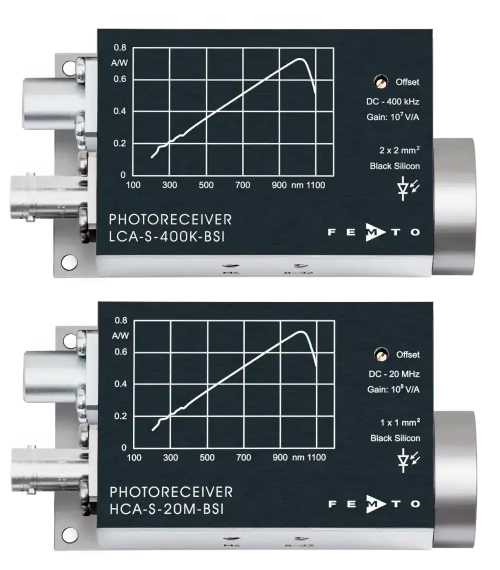
Range features
A high level overview of what this range offers
- 200–1100 nm spectral range – Covers ultraviolet, visible and near-infrared measurement tasks with one detector technology.
- Approximately 90% quantum efficiency from 240–1000 nm – Supports measurements requiring a relatively uniform response across a broad wavelength interval.
- 400 kHz and 20 MHz model options – Allows bandwidth to be selected for low-level signals or faster pulses and transients.
- Fixed-gain transimpedance amplifier – Converts photodiode current directly into a voltage signal for connection to measurement electronics.
- NEP from 110 fW/√Hz – Supports detection of low optical signal levels when measurement bandwidth and operating conditions are controlled.
- 2 × 2 mm or 1 × 1 mm active area – Provides a choice between greater optical alignment tolerance and a faster receiver configuration.
- Adjustable input offset compensation – Helps manage steady background current before the output reaches its operating limit.
- 1.035″-40 free-space input – Accepts compatible optical accessories and optional screw-on fibre adapters.
- M4 and UNC 8-32 mounting threads – Supports installation on metric or imperial optical posts.
- Room-temperature operation – Avoids the need for a separate detector cooling system.
What’s in this range?
All the variants in the range and a comparison of what they offer
Common range specifications
| Parameter | Specification |
|---|---|
Receiver architecture | Black silicon photodiode with fixed-gain transimpedance amplifier |
Spectral range | 200–1100 nm |
Quantum efficiency | Approximately 90% from 240–1000 nm |
Maximum sensitivity | 0.73 A/W typical at 1010 nm |
Optical input | 1.035″-40 threaded free-space flange with internally threaded coupler ring |
Coupler ring outside diameter | 30 mm |
Fibre adaptation | Optional screw-on adapters; FC and FSMA interfaces are supported |
Signal output connector | Female BNC socket |
Supply voltage | ±15 V nominal; ±14.5 to ±16.5 V operating range |
Absolute maximum supply voltage | ±20 V |
Recommended supply capability | At least ±150 mA |
Power connector | Three-pin series 1S fixed socket; mating plug type FFA.1S.303.CLAC52 |
Mounting threads | M4 and UNC 8-32 |
Input flange material | 1.4305 stainless steel, nickel-plated |
Coupler ring material | 1.4305 stainless steel, glass-bead blasted |
Case material | AlMg4.5Mn, nickel-plated |
Operating temperature | 0 to +60 °C |
Storage temperature | −30 to +85 °C |
Warm-up | 20 minutes for stated test conditions; at least 10 minutes recommended |
Variant comparison
| Specification | LCA-S-400K-BSI-FST | HCA-S-20M-BSI-FST |
|---|---|---|
Black silicon photodiode active area | 2 × 2 mm | 1 × 1 mm |
Spectral range | 200–1100 nm | 200–1100 nm |
Bandwidth at −3 dB | DC to 400 kHz | DC to 20 MHz, ±15% |
Rise and fall time, 10–90% | 900 ns | 18 ns, ±15% |
Transimpedance gain | 1 × 10⁷ V/A at a load of at least 100 kΩ | 1 × 10⁵ V/A at a 50 Ω load |
Electrical gain accuracy | ±1% | ±1% |
Conversion gain | 7.3 × 10⁶ V/W typical at 1010 nm | 7.3 × 10⁴ V/W typical at 1010 nm |
Gain flatness | ±0.5 dB | Not specified |
Noise equivalent power | 110 fW/√Hz at 1010 nm and 10 kHz | 3.3 pW/√Hz at 1010 nm and 1 MHz |
Optical saturation power for linear amplification | 1.37 µW at 1010 nm | 22 µW at 1010 nm |
Input offset compensation | ±300 nA, adjustable | ±8 µA, adjustable |
Output voltage | −3 to +10 V at a load of at least 100 kΩ | ±1.5 V for linear operation; ±2 V maximum at 50 Ω |
Output impedance and termination | 50 Ω output impedance; terminate with at least 100 kΩ | 50 Ω output impedance; terminate with 50 Ω |
Maximum output current | 30 mA, short-circuit protected | Not specified |
Output noise | 2.0 mV RMS typical; 18 mV peak-to-peak, measured over 20 MHz | 2.9 mV RMS typical; 19 mV peak-to-peak, measured over 200 MHz |
Supply current | ±40 mA, dependent on operating conditions | ±50 mA, dependent on operating conditions |
Weight including coupler ring | 212 g | 209 g |
Absolute maximum optical input | 10 mW CW | 80 mW/mm² CW |
Fibre adapter options | PRA-FC, PRA-FCA and PRA-FSMA | Optional screw-on FC and FSMA adapters |
Specification test load | 1 MΩ | 50 Ω |
Primary selection consideration | Higher gain, lower NEP and larger active area | Wider bandwidth, faster response and higher linear saturation power |
FAQs
for Black silicon photoreceiver
Choose the LCA-S-400K-BSI for weak signals within a 400 kHz bandwidth, and the HCA-S-20M-BSI when an 18 ns response or bandwidth up to 20 MHz is required. The LCA model provides a 1 × 10⁷ V/A gain and 110 fW/√Hz NEP, compared with 1 × 10⁵ V/A and 3.3 pW/√Hz for the HCA model. The HCA model accepts up to 22 µW at 1010 nm while remaining within its stated linear amplification range, whereas the LCA limit is 1.37 µW. Selection should therefore start with the expected modulation frequency, optical power and required signal-to-noise ratio. The LCA model also offers a larger 2 × 2 mm active area when optical alignment tolerance is important.
Yes, both models cover wavelengths from 200 to 1100 nm, allowing a single receiver to be used across UV, visible and near-infrared measurements. Quantum efficiency is approximately 90% from 240 to 1000 nm, while maximum sensitivity is stated as 0.73 A/W at 1010 nm. Responsivity in amperes per watt still varies with wavelength, so the same optical power will not necessarily produce the same photocurrent throughout the full range. Wavelength-specific calibration should therefore be applied when absolute optical power or spectral intensity is being measured. The extended spectral range can reduce the need to exchange detectors between adjacent wavelength bands.
The two receivers require different output loading, so the connected instrument must be configured for the selected model. Although the LCA-S-400K-BSI has a 50 Ω output impedance, it is designed for a high-impedance load of at least 100 kΩ and provides an output range of −3 to +10 V under that condition. The HCA-S-20M-BSI must be terminated with 50 Ω and provides ±1.5 V for linear operation, with a stated maximum of ±2 V. Incorrect termination can alter the delivered amplitude and invalidate the stated operating conditions. A short, well-shielded RF cable can help control electromagnetic interference between the receiver and an oscilloscope, converter or lock-in amplifier.
Both variants use a 1.035″-40 threaded free-space flange with an internally threaded coupler ring measuring 30 mm in outside diameter. This arrangement accepts compatible lenses, tubes, cage-system components and other threaded optical accessories. The LCA-S-400K-BSI can use PRA-FC, PRA-FCA and PRA-FSMA adapters, while optional FC and FSMA conversion is also available for the HCA-S-20M-BSI. Its 2 × 2 mm detector gives the LCA model more beam-placement tolerance than the HCA model’s 1 × 1 mm active area. M4 and UNC 8-32 tapped holes allow either receiver to be mounted on standard metric or imperial optical posts.
The optical saturation value defines the approximate upper input level for linear amplification, while the absolute maximum rating is a damage threshold and not a usable measurement range. At 1010 nm, the LCA-S-400K-BSI has a linear saturation power of 1.37 µW and an absolute maximum CW input of 10 mW. The HCA-S-20M-BSI remains linear up to 22 µW at 1010 nm, with an absolute maximum rating of 80 mW/mm². The HCA limit is expressed as optical power density, so beam area and local intensity must be considered rather than total power alone. Optical attenuation should be included whenever the expected signal could approach the linear saturation level or vary unpredictably.
NEP is an input-referred noise spectral density and must be evaluated together with the effective measurement bandwidth. The LCA-S-400K-BSI is specified at 110 fW/√Hz at 1010 nm and 10 kHz, while the HCA-S-20M-BSI is specified at 3.3 pW/√Hz at 1010 nm and 1 MHz. As a first-order estimate, RMS input noise scales with the NEP multiplied by the square root of the equivalent noise bandwidth, although the actual result depends on filtering and the full noise spectrum. The two figures are measured at different frequencies and should not be treated as total integrated noise across each receiver’s complete bandwidth. Receiver choice should therefore consider the intended filter bandwidth, modulation frequency, optical signal power and required acquisition time.
Both receivers require a regulated ±15 V supply and are specified for operation between ±14.5 and ±16.5 V. The stated supply currents are ±40 mA for the LCA model and ±50 mA for the HCA model, while a supply capability of at least ±150 mA is recommended. Performance values use a 20-minute warm-up period, with 10 minutes identified as the minimum recommended time before measurement. The operating temperature range is 0 to +60 °C, and the storage range is −30 to +85 °C. The installation area should remain free from smoke, dust, oil, grease, condensing moisture and similar contaminants; detector cooling is not required during normal room-temperature operation.