Automated slide handling robotic sample loaders
- Technology
- Photonics accessories
- Partner
- Prior Scientific
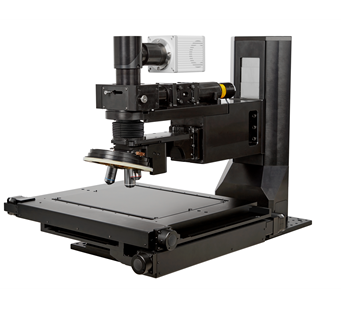
OpenStand® — Flexible, Modular Platforms for Automated Imaging
Prior’s OpenStand® platform is a flexible, fully customizable imaging system designed for optical microscopy, automated imaging, and the development of novel imaging techniques.
Available in four platform formats — OpenStand-V, OpenStand-L, OpenStand-U, and OpenStand-M — OpenStand provides a cost-effective route from prototype and proof-of-concept through testing and production. With a complete working system from day one, you can begin developing your application immediately while retaining the flexibility to modify the hardware as your requirements evolve.
Because all OpenStand configurations use the same software development kit (SDK), software developed during prototyping can be carried forward to your final instrument. This enables hardware and software development to progress in parallel, helping reduce development time and protect your investment.
Prior provides a complete, configurable imaging platform that allows you to concentrate on your application rather than building the underlying microscope infrastructure from scratch.
Start with the configuration you need today, test your imaging technique, automate your workflow, and modify the system as your requirements develop. When you’re ready to move toward an OEM instrument, your software and application development can transition with you.
Range features
A high level overview of what this range offers
-
Cost-efficient Purchase only the configuration and components your application requires. OpenStand eliminates the need to develop an entire imaging system from scratch, helping control development and equipment costs.
-
*Faster time to market**
The modular architecture makes it possible to prototype new imaging techniques quickly and evolve the system as your requirements become clearer. This can shorten development cycles and accelerate the transition from concept to production.
- *Easy automation**
Select the motion, focus, illumination, stage, imaging and other automated components required for your application from Prior’s extensive component portfolio.
Build the automation around your workflow rather than adapting your workflow to a fixed microscope.
- *Customised components**
When your application requires something beyond the standard configuration, Prior’s in-house development team can design specific components into your OpenStand system.
This provides a practical middle ground between an off-the-shelf microscope and the cost and complexity of developing a completely custom platform.
- *Expandable**
OpenStand is designed to evolve.
Add components as your application develops, change the configuration during prototyping, or remove unnecessary functionality as you transition toward an optimized OEM design.
Your initial system can therefore remain useful throughout multiple stages of development.
- *Future-proof**
OpenStand hardware is supported by Prior’s software development environment and command set, allowing software developed during the early stages of your project to remain portable as the hardware configuration changes.
This helps avoid the costly process of rebuilding application software when moving to a new system design.
What’s in this range?
All the variants in the range and a comparison of what they offer
Prior OpenStand platforms — specification/feature comparison
| Specification | OpenStand-V | OpenStand-L | OpenStand-U | OpenStand-M |
|---|---|---|---|---|
Platform type | Inverted microscopy | Large-format microscopy | Upright microscopy | Small-format microscopy |
Primary positioning | High-content screening, well-plate scanning, slide imaging | Large-format sample inspection / microscopy | General upright microscopy | Compact microscopy / integration |
Slide scanning | Yes | Yes | Yes | Yes |
Large samples / wafers | — | Yes — supports 12-inch wafer scanning | — | — |
Stage configuration | Motorized stage options | Large motorized stage options | Configurable stage | Compact stage configuration |
Focus | Dual 145 mm coarse focus + 20 mm fine focus; optional encoding | Dual 145 mm coarse focus + 20 mm fine focus; optional encoding | Stage or nosepiece focusing | Stage or nosepiece focusing |
Autofocus | Laser autofocus available | Laser autofocus available | Adaptable laser autofocus | Adaptable laser autofocus |
Illumination | Multiple light-source inputs | Reflected-light options; multiple illumination configurations | Transmitted/reflected light; interchangeable illumination ports | Adaptable episcopic illumination |
Camera integration | Multiple cameras supported | Multiple cameras supported | Configurable | Configurable |
Infinity-space access | Available | Available | — | — |
Non-visible imaging | Customizable optics | Customizable optics | — | — |
Reflected-light imaging | Available | Extensive options | Dedicated reflected-light configuration possible | Adaptable episcopic illumination |
Footprint / integration | Modular | Large-format | Modular | Compact / low profile |
Notable applications | High-content screening; live-cell imaging; slide imaging | Semiconductor inspection; industrial inspection; large-format scanning | Metrology; confocal microscopy; slide scanning; fluorescence microscopy | Industrial inspection; confocal microscopy |
Key differentiator | Inverted configuration | Largest sample/stage capability | Flexible upright configuration | Smallest/most compact format |
FAQs
for Automated slide handling robotic sample loaders
The 160-slide configuration is intended for standard 76 × 26 × 1 mm microscope slides. Each holder carries four slides, and two hotels each accept 20 holders, providing the full 160-slide batch capacity. The 80-slide configuration uses the same two-hotel arrangement but carries two 76 × 50 × 1 mm slides in each holder. Both configurations therefore retain the same holder and hotel workflow while changing the sample density. Selection should be based on the actual slide envelope, including labels, coverslips and fixtures, rather than capacity alone, with mechanical fit checked during system integration.
Each slide remains secured in a dedicated holder throughout loading, scanning and unloading. The robotic mechanism handles the complete holder rather than gripping the individual glass slides, so moving components do not contact the slide surfaces. A retaining mechanism inside each hotel keeps loaded holders in place when the hotel is moved between the bench and loader. Integrated sensors monitor the loading workflow and can provide the control software with information about system status. An optional assistance platform makes manual insertion and removal of slides from the holders more manageable during laboratory preparation.
The robotic loading operation takes 10 seconds per holder, increasing to 15 seconds when the LED preview is included. A representative imaging cycle is typically under 60 seconds for a 15 × 15 mm area at 20× magnification. Total throughput will also depend on exposure time, imaging channels, autofocus routines, tile overlap, camera readout and data processing. System designers should therefore calculate robotic transfer time and image-acquisition time separately before estimating slides per hour. Although preview adds five seconds to loading, it can reduce subsequent acquisition time when only selected regions require high-resolution scanning.
The loader can be configured with OpenStand, Leica DM6, Nikon Ni, Olympus BX63 and Zeiss AxioImager2 platforms. The critical mechanical requirement is a fixed stage or a microscope that can return reliably to a defined Z position for loading and unloading. Other microscope configurations may be possible, but they require an application-specific mechanical and control assessment. Integration work should verify the loading position, stage travel, objective clearance, focus position and available space around the microscope frame. A compatible microscope model alone does not remove the need to validate the complete optical, mechanical and software configuration.
The SL160 robotic sample loader uses ProScan controls and is supplied with an open software development kit. The host application must coordinate holder selection, robotic transfer, stage movement, optional preview and the subsequent imaging sequence. Integrated sensors and encoders provide information that can be used to monitor motion and loading status. The SDK supports system integration, but the final workflow, user interface, image acquisition and application-specific error recovery must still be implemented within the wider system. OEM teams should include software commissioning and exception testing in the integration plan rather than treating the loader as a standalone slide scanner.
The stage has a mean unidirectional repeatability of ±0.2 µm and a minimum step size of 40 nm, or 20 nm with the optional 1 mm-pitch ball screw. Recommended travel speed is 40 mm/s with the standard screw and 20 mm/s with the 1 mm-pitch version, while maximum speeds are 100 mm/s and 50 mm/s respectively. Metric accuracy is specified as 0.2 µm/mm, with optional encoders providing 100 nm resolution. These figures support closely spaced positioning for tiled acquisition, but final image registration will also depend on the optics, camera calibration, focus stability and control software. Image-based stitching performance should therefore be tested using the intended magnification and sample type.
The complete loader envelope is 850 × 650 × 710 mm, measured as width, length and height. Separately listed masses are approximately 41 kg for the base unit, 33 kg for the covers, 4 kg for the stage and 11 kg for OpenStand. Where all four listed components are present, their combined mass is approximately 89 kg before cameras, illumination equipment and other accessories are added. The supporting bench should therefore be selected for both the static load and the positioning stability required by the imaging process. Additional access should be allowed for loading hotels, connecting cables, servicing covers and integrating the selected microscope, as installation-clearance dimensions are not defined.