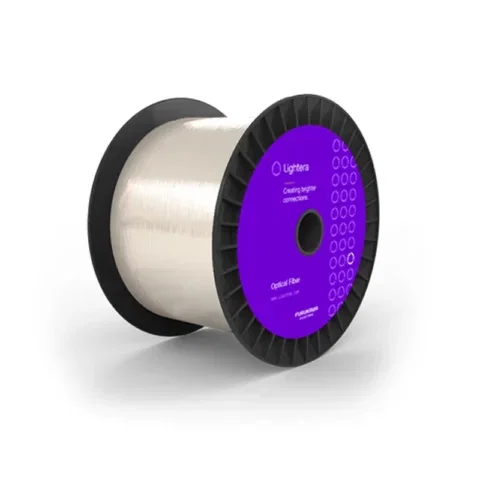
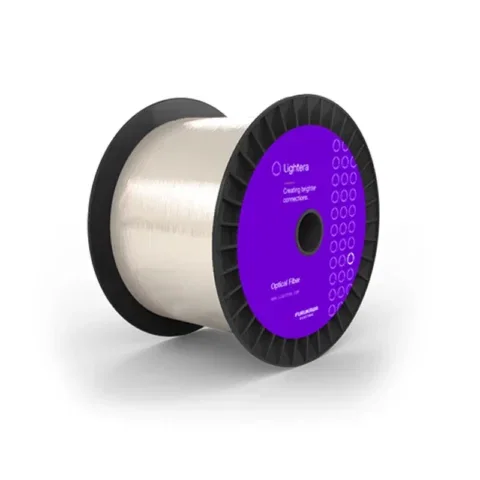
HCS® All Silica 365 µm 0.22 NA Step-Index High OH Optical Fibre
- Technology
- Speciality fibre
- Partner
- Lightera (formerly OFS)
The CF01493-42 is a large-core HCS® all-silica optical fibre engineered for reliable transmission of ultraviolet and visible light. Its high-OH silica core supports efficient power delivery across the high-UV to visible spectrum, making it well suited to illumination, fluorescence, spectroscopy, sensors, and laser-based systems. The 365 µm core provides high light throughput and simplifies coupling from broad-area or high-power light sources. Its 0.22 numerical aperture offers a balanced combination of light acceptance and controlled beam divergence for dependable multimode performance. The all-silica construction contributes to a high damage threshold, helping the fibre withstand intense optical power in demanding environments. HCS fluoroacrylate cladding and an ETFE buffer add durability and handling robustness. The fibre operates from -65 °C to +125 °C, with Pyrocoat® polyimide coating recommended for higher-temperature environments. Overall, it is a robust solution for engineers who need a large-core UV-visible optical fibre for industrial, medical, or scientific integration.
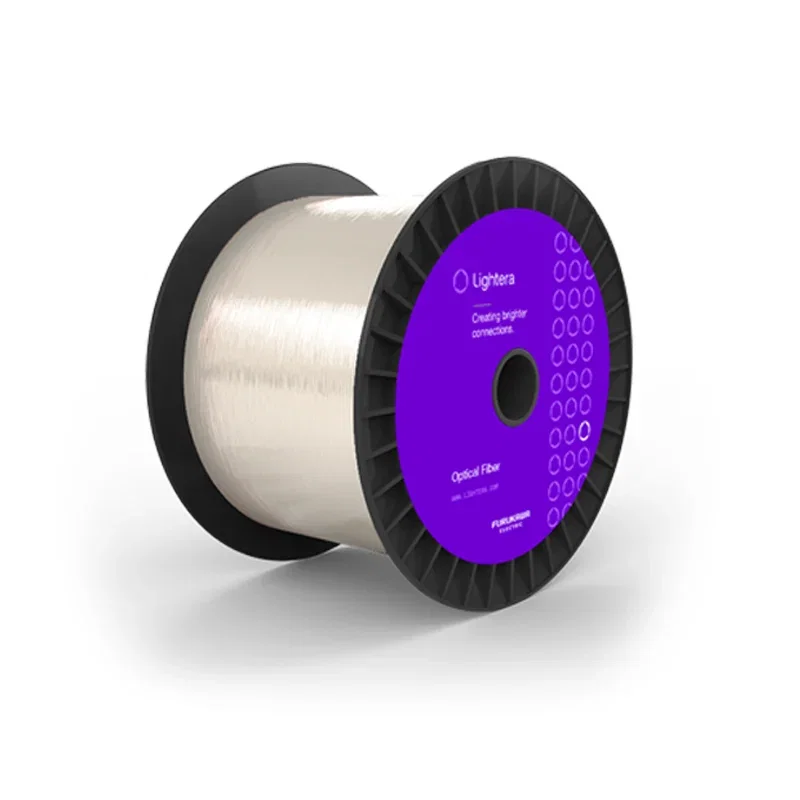
Designed for efficient UV and visible light delivery, the CF01493-42 combines a 365 µm core, 0.22 NA, and high-OH all-silica construction in a robust HCS® fibre format. It is well suited to demanding applications such as UV illumination, fluorescence spectroscopy, radiation analysis, sensors, and medical or industrial laser delivery.
The large core supports strong light throughput, while the step-index multimode design helps simplify coupling from lamps, LEDs, and lasers. With durable HCS fluoroacrylate cladding, ETFE buffering, and operating capability from -65 °C to +125 °C, this fibre is built for reliable use in harsh environments.
Range features
A high level overview of what this range offers
- High-OH silica core: Optimised for efficient transmission in the UV and visible wavelength range.
- Large 365 µm core diameter: Supports high light throughput and easier coupling from broad-area or high-power sources.
- All-silica optical construction: Provides a high damage threshold for demanding UV and visible light delivery.
- 0.22 numerical aperture: Offers broad light acceptance with controlled divergence for consistent multimode performance.
- Wide operating temperature range: Rated from -65 °C to +125 °C for harsh industrial and scientific environments.
- HCS fluoroacrylate cladding with ETFE buffer: Delivers strong mechanical protection, flexibility, and handling durability.
- High proof test strength: Proof-tested to ≥ 100 kpsi for dependable mechanical reliability.
Downloads
for HCS® All Silica 365 µm 0.22 NA Step-Index High OH Optical Fibre
What’s in this range?
All the variants in the range and a comparison of what they offer
Specification | Value |
Product Description | 365 All Silica Step-Index |
Core Diameter | 365 ± 10 µm |
Cladding Diameter | 400 ± 10 µm |
Coating Diameter | 430 +5/−10 µm |
Buffer Diameter | 730 ± 30 µm |
Core/Clad Offset | ≤ 9 µm |
Crimp & Cleave Compatible | No |
Cladding Material | HCS fluoroacrylate |
Buffer Material | ETFE |
Standard Buffer Colour | Natural |
Type | Multimode Step-Index |
Numerical Aperture | 0.22 |
Attenuation @ 820 nm | ≤ 10 dB/km |
Water Content | High OH |
Operating Temperature | -65 °C to +125 °C |
Short-Term Bend Radius | ≥ 29 mm |
Long-Term Bend Radius | ≥ 47 mm |
Proof Test Level | ≥ 100 kpsi (0.689 GPa) |
Order by Part Number | CF01493-42 |
Product Description Code | HCG-M0365T |
Options | Buffer Colour, Buffer Diameter, Buffer Material, Cabling, Clad Diameter, Core Diameter, Connectorisation, Numerical Aperture, Metallisation, Proof Test |
FAQs
for HCS® All Silica 365 µm 0.22 NA Step-Index High OH Optical Fibre
High OH means the fibre has a high hydroxyl ion content in its silica core. This helps improve transmission in the ultraviolet and visible wavelength range by reducing UV-related absorption losses. As a result, high-OH fibres are preferred for applications such as UV illumination, fluorescence, and spectroscopy, while low-OH fibres are typically chosen for infrared use.
A 0.22 NA gives the fibre a moderately wide light acceptance angle, making it easier to couple light from LEDs, lamps, and lasers into the core. It provides a practical balance between efficient light collection and controlled beam divergence, supporting stable multimode performance.
Yes. The all-silica construction provides a high damage threshold, and the large 365 µm core helps spread optical power over a larger area. This makes the fibre suitable for demanding UV and visible light delivery applications, provided installation and handling guidelines such as bend radius and end-face cleanliness are followed.
HCS® stands for Hard-Clad Silica. In this design, the fibre uses a silica core with a durable polymer cladding. This combination offers strong optical performance together with improved toughness, easier handling, and good suitability for industrial and medical environments.
The standard ETFE-buffered construction is suitable for operating temperatures up to +125 °C. For harsher high-temperature conditions, Pyrocoat® polyimide coating is recommended because it offers better thermal resistance and helps maintain fibre performance where standard polymer buffering may not be sufficient.
The specified short-term bend radius is ≥ 29 mm, and the long-term bend radius is ≥ 47 mm. In practice, this means the fibre should not be bent more tightly than these limits during installation or long-term routing, helping avoid excess optical loss or mechanical stress.
This fibre is not intended for quick crimp-and-cleave termination methods. Instead, it is generally terminated using a more traditional epoxy-and-polish process with a suitable connector. That approach helps achieve reliable mechanical retention and good optical performance.
Yes. A corresponding low-OH version is typically used when transmission in the near-infrared range is required. While this high-OH version is optimised for UV and visible wavelengths, the low-OH alternative is better suited to IR laser delivery and related applications.