CT-A000TPP-CB8L-E CWDM 24 dB Power Budget SFP Transceiver w. DDMI
- Technology
- Fibre optic transceivers
- Partner
- Coretek
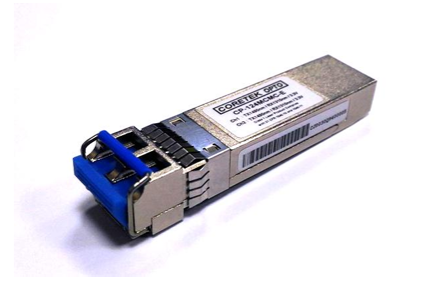
This pluggable transceiver module delivers long-range 10 Gigabit connectivity using coarse wavelength division multiplexing (CWDM) technology. It fits any standard SFP+ slot, enabling network engineers to upgrade links to 10 Gbps over single-mode fibre without changing existing hardware. By operating on a specific CWDM wavelength, it can be deployed alongside up to 17 other CWDM modules on the same fibre pair when used with CWDM multiplexers – dramatically increasing fibre capacity without the need for laying new fibre. With a 24 dB link budget, the module supports distances on the order of 80 km, making it ideal for connecting remote sites, metropolitan backbone segments, or campus networks that require extended reach.
Designed for industrial temperature environments (operation from -40 °C to +85 °C), this transceiver is well-suited to outdoor installations, roadside cabinets, or factory settings in addition to standard data centre use. It is fully compliant with the SFP+ MSA specification, ensuring broad compatibility with 10G Ethernet switches, routers, and optical transport equipment. The unit is hot-pluggable, allowing installation or replacement without network downtime. Integrated digital diagnostic monitoring (DDM) provides instant feedback on parameters like optical transmit power, receive power, temperature and supply voltage, which helps with proactive maintenance and troubleshooting. Overall, the CT-A000TPP-CB8L-E CWDM SFP+ module offers a reliable and efficient solution for long-haul fibre links, leveraging CWDM to expand network bandwidth while maintaining simplicity and robustness in operation.
Range features
A high level overview of what this range offers
This 10G CWDM SFP+ module offers a range of features that ensure long-distance connectivity and reliable performance even in challenging environments.
- CWDM wavelength technology – Enables multiplexing of up to 18 channels on a single fibre pair, allowing network capacity expansion without new fibre infrastructure.
- 24 dB optical power budget – Supports very long-distance links (on the order of 80 km) over single-mode fibre, ensuring connectivity to far-edge sites or between distant network nodes.
- Extended temperature range (-40 °C to 85 °C) – Industrial-grade design can operate reliably in extreme outdoor or industrial environments, maintaining performance in both high heat and sub-zero conditions.
- SFP+ MSA compliant & hot-pluggable – Standard SFP+ form factor fits into any compliant 10G SFP+ port; hot-swap support allows module changes without powering down equipment, simplifying maintenance and upgrades.
- Digital Diagnostic Monitoring (DDMI) – Built-in DDM functionality provides real-time monitoring of module status (Tx/Rx optical power, module temperature, voltage, etc.), helping administrators detect issues and perform preventive maintenance.
- Duplex LC optical interface – Uses a dual LC connector for transmitter and receiver, a widely adopted interface for single-mode fibre, ensuring easy integration with existing fibre patch cords and infrastructure.
- High-quality optics (EML & APD) – Utilises an EML laser transmitter and APD receiver for stable operation at 10 Gbps over long distances, delivering reliable signal quality across the full link span.
Downloads
for CT-A000TPP-CB8L-E CWDM 24 dB Power Budget SFP Transceiver w. DDMI
What’s in this range?
All the variants in the range and a comparison of what they offer
| Specification | Value |
|---|---|
Part Number | CT-A000TPP-CB8L-E |
Form factor | SFP+ (Small Form-Factor Pluggable Plus) module |
Data rate | 10.3 Gbps nominal (10 Gigabit Ethernet and OC-192/STM-64) |
Wavelength | CWDM, specific ITU channels from 1270 nm to 1610 nm (20 nm steps) |
Optical budget | 24 dB (supports ~80 km reach on single-mode fibre) |
Transmitter type | Cooled CWDM EML laser (various wavelengths available) |
Receiver type | APD photodiode (high-sensitivity) |
Connector | Dual LC/PC fibre optic connector |
Digital diagnostics | Yes (DDM/DOM per SFF-8472 standard) |
Operating temperature | -40 °C to +85 °C (industrial extended range) |
Power supply | +3.3 V DC |
Compliance | SFP+ MSA (SFF-8431); SFF-8472 DDM; Class 1 Laser Safety (IEC 60825); RoHS compliant |
FAQs
for CT-A000TPP-CB8L-E CWDM 24 dB Power Budget SFP Transceiver w. DDMI
A 24 dB optical power budget indicates the module can tolerate up to 24 decibels of fiber loss while maintaining a functional link. In practical terms, this means the transceiver is capable of an optical reach on the order of 80 km over standard single-mode fibre (assuming decent fibre quality and splices). This high budget accounts for attenuation in the fibre as well as connector losses, ensuring reliable communication over very long distances. It’s a key parameter that network designers use to judge if a link will work over a given fibre span.
This transceiver can be ordered to operate on any of the standard CWDM wavelengths in the ITU-T G.694.2 grid. CWDM defines 18 possible channels spaced 20 nm apart, typically ranging from 1270 nm up to 1610 nm. Each module is tuned to a fixed wavelength (for example, 1470 nm, 1550 nm, etc.), specified at time of purchase. Using different CWDM SFP+ modules on different channels, you can multiplex multiple 10G signals onto the same fibre with the help of CWDM MUX/DEMUX filters.
Yes. The CT-A000TPP-CB8L-E is built to the industry-standard SFP+ MSA specifications, so electrically and physically it will fit and function in any standard SFP+ slot for 10G optical modules. It supports the common 10GBASE protocols, making it broadly compatible with Ethernet switches, routers, optical transport equipment, and other hardware from various vendors. The only caveat is that some network equipment vendors implement proprietary firmware locks (vendor checking) on SFP+ ports — in those cases, you would need a module coded for that specific vendor. Otherwise, in open systems or vendor-agnostic devices, this CWDM SFP+ will operate transparently. It is also hot-swappable, which means it can be inserted or removed on the fly without powering down the host device.
The transceiver primarily targets 10 Gigabit Ethernet applications (10GBASE-ER/ZR on single-mode fibre), but it is generally capable of supporting any protocol in the 9.95 Gbps to 10.5 Gbps range. This includes standards like 10G Fibre Channel (used in storage area networks) and OC-192/STM-64 SONET/SDH in telecom networks, as long as the line rate falls within the module’s specifications. In practice, many 10G SFP+ modules are multi-rate, and this CWDM unit can usually handle the common 10G Ethernet and 10G Fibre Channel rates. Always verify the data rate compatibility in the datasheet for non-Ethernet use cases, but typically it’s quite flexible across standard 10G signalling rates.
The digital diagnostic monitoring interface (often called DOM or DDM) on this SFP+ provides a set of real-time measurements from inside the module. Using standard network management tools or the host device’s CLI, you can read metrics such as the module’s supply voltage, internal temperature, transmit optical power, receive optical power, and bias current of the laser. For example, you can monitor the received optical power to ensure the link has sufficient margin, or check the module temperature if it’s installed in a hot environment. These diagnostics help with troubleshooting (by spotting issues like fiber degradation or connector failure if receive power drops) and with preventive maintenance by alerting you to abnormal conditions before they lead to link failure.
This is a single-mode fibre (SMF) optical module, so it’s designed to work with single-mode optical cables (typically OS1/OS2 specifications). It uses a duplex LC connector interface. That means you’ll need an LC-terminated SMF patch cord or pigtail to connect each module to your fibre infrastructure — one fibre for the transmit direction and one for receive. In a CWDM setup, the module’s specific wavelength will correspond to a matching port on your CWDM multiplexer, and you’ll use standard LC patch leads from the SFP+ to the CWDM mux unit. The LC connector is very common and likely the same type already used in your 10G fibre equipment, ensuring easy installation.
Yes. This model is an extended-temperature transceiver, rated for -40 °C to +85 °C operation. The wide temp range means it can handle harsh outdoor climates and industrial environments where standard commercial-grade optics (typically 0 °C to 70 °C) would fail. You can use it in outdoor enclosures, cell tower base stations, roadside telecom cabinets, or factory floor switches with no issues, as long as it stays within that temperature range. The module’s components are designed and tested for reliability across these extreme conditions. Of course, you should ensure the host device (the switch or router) is also rated for those conditions if you plan to use it outdoors.
To take advantage of the CWDM capability, you will need additional passive optical components known as CWDM multiplexers/demultiplexers (MUX/DEMUX). While the SFP+ transceiver itself generates and receives signals on a specific CWDM wavelength, a MUX/DEMUX unit is used to combine different wavelengths onto a single fibre and later separate them at the other end. In practice, you would install a CWDM MUX/DEMUX chassis at each end of the fibre span. Each transceiver, set to different CWDM channels (e.g. 1510 nm, 1530 nm, 1550 nm, etc.), connects to the MUX via patch cables. The MUX then merges all those wavelengths into one fibre strand for transport. Therefore, the CWDM SFP+ will work as a normal 10G link by itself (if you just connect two identical modules back-to-back), but to fully utilise multiple channels on one fibre, CWDM filters are required in the network. The transceiver is essentially one piece of a CWDM system, and the MUX/DEMUX is the companion equipment that realises the multi-channel benefit.
Generally for a 10G CWDM SFP+ of this category, the optical transmitter output power is around 0 to +5 dBm (with the exact minimum/maximum depending on the chosen wavelength and laser tuning). The receiver sensitivity is roughly around -24 dBm (for a bit error rate of 1e-12). These values align with a link budget of ~24 dB. In other words, if you have near 0 dBm launch power and need at least -24 dBm at the receiver, you can afford about 24 dB of loss in the fibre path. It’s worth checking the official datasheet for the precise specs, as there are often small differences per wavelength (for example, lower wavelengths might have slightly different output due to laser characteristics). But on the whole, you can expect transmit levels on the order of a few milliwatts of optical power, and the receiver needing only a few microwatts to detect the signal reliably over 80 km.