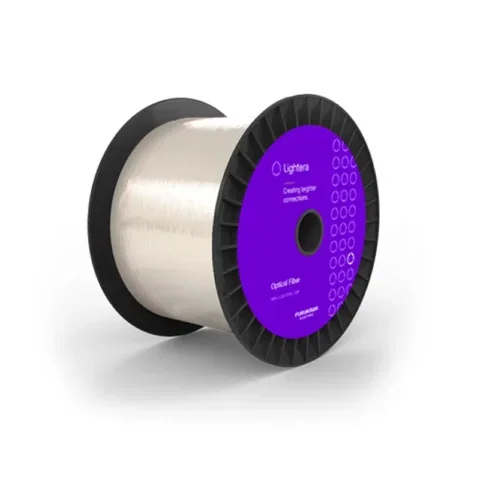
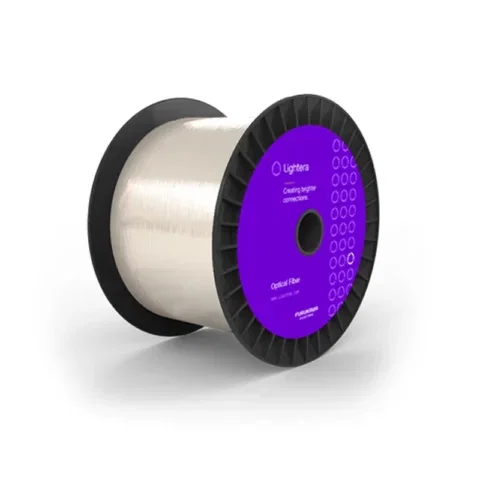
HCS® 600 µm 0.37 NA High OH Optical Fibre
- Technology
- Speciality fibre
- Partner
- Lightera (formerly OFS)
HCS Hard-Clad Silica 600 µm High OH optical fibre is a specialised polymer-coated silica fibre built for demanding environments. With its 600 µm core diameter and 0.37 numerical aperture, this step-index multimode fibre efficiently captures and transmits light from LED and laser sources. The pure silica core provides broad spectral transparency and is especially optimised around 650 nm and 850 nm for common industrial systems. A thin hard polymer cladding combined with a thick ETFE buffer delivers strong durability for use in harsh chemical and mechanical environments. The fibre operates across a wide temperature range from -65 °C to +125 °C. Its High OH composition makes it well suited to visible and UV applications such as laser delivery, medical systems, optical sensing, and UV-visible spectroscopy. The large core and rugged buffered construction also simplify handling, routing, and connectorisation in field and industrial installations.
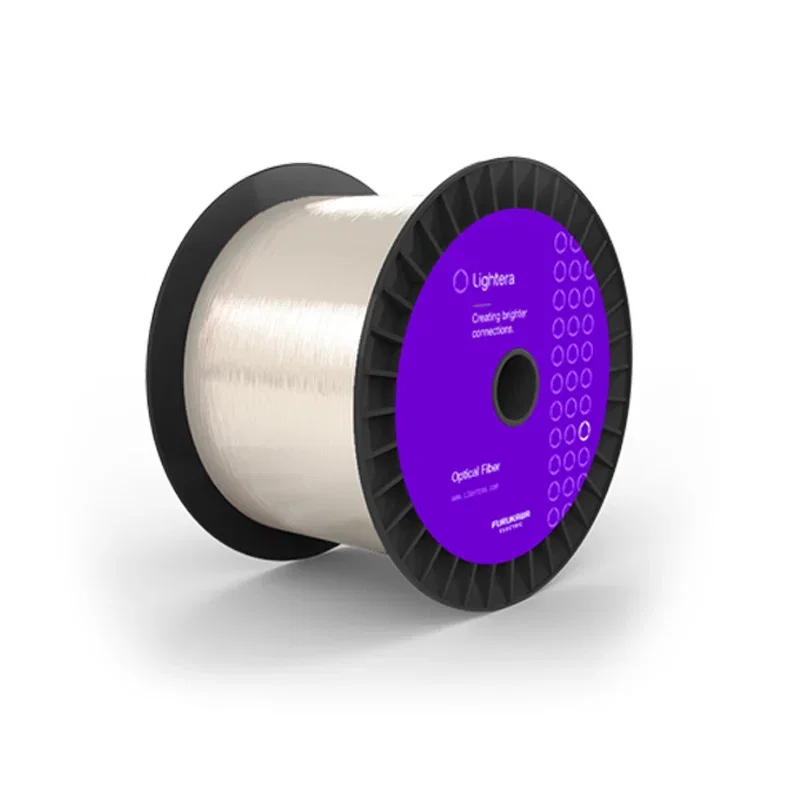
This HCS 600 µm High OH optical fibre is designed for applications that need a robust large-core multimode fibre with strong light-coupling performance and reliable handling in demanding environments. Its hard-clad silica construction combines a pure silica core with durable polymer layers, making it a practical choice for industrial systems, medical instrumentation, optical sensing, and UV-visible light transmission.
Optimised for visible and near-infrared use, especially around 650 nm and 850 nm, the fibre supports efficient coupling from LEDs, VCSELs, and laser sources while offering easier installation and termination than more fragile all-glass alternatives.
Range features
A high level overview of what this range offers
- High mechanical strength: Rugged hard-clad silica construction helps minimise fibre breakage during installation and use in demanding environments.
- Large 600 µm core: Captures more light from broad-beam sources for easier coupling and improved optical throughput.
- 0.37 numerical aperture: Supports efficient light acceptance from LEDs, VCSELs, and laser diodes with less critical alignment.
- High OH formulation: Optimised for UV and visible wavelength applications, including spectroscopy and medical or industrial laser systems.
- Wide operating temperature range: Performs from -65 °C to +125 °C for use in both cold and high-heat conditions.
- Chemical-resistant polymer cladding: Withstands oils, solvents, and industrial chemicals for reliable long-term service.
- Crimp and cleave compatible: Enables faster field termination with suitable connector systems and reduced installation complexity.
- Robust buffered design: Thick 1040 µm ETFE buffer improves handling, routing, and resistance to stress, twisting, and flexing.
- Long-term reliability: Designed for stable optical transmission and low maintenance in continuous-use applications.
Downloads
for HCS® 600 µm 0.37 NA High OH Optical Fibre
HCS® 600 µm 0.37 NA High OH Optical Fibre – Datasheet
DownloadWhat’s in this range?
All the variants in the range and a comparison of what they offer
| Product Description | 600 µm 0.37 NA High OH Optical Fibre |
|---|---|
Physical Characteristics | |
Core diameter | 600 ± 10 µm |
Cladding diameter (HCS polymer) | 630 +5/–10 µm |
Buffer diameter (ETFE coating) | 1040 ± 30 µm |
Core/clad concentricity offset | ≤ 8.0 µm |
Crimp & cleave compatible | Yes |
Cladding material | HCS fluoroacrylate polymer |
Buffer material | ETFE (ethylene tetrafluoroethylene) |
Optical Characteristics | |
Fibre type | Multimode step-index |
Numerical aperture (NA) | 0.37 |
Attenuation @ 820 nm | ≤ 12 dB/km |
Water content designation | High OH (high hydroxyl) |
Mechanical & Environmental | |
Operating temperature range | –65 °C to +125 °C |
Minimum short-term bend radius | ≥ 58 mm |
Minimum long-term bend radius | ≥ 94 mm |
Proof test level | ≥ 100 kpsi (0.689 GPa) |
Ordering Information | |
Part number | CF01493-22 |
Product code | HCN-M0600T |
Available options | Buffer colour, buffer diameter, buffer material, cabling, connectorisation, numerical aperture |
FAQs
for HCS® 600 µm 0.37 NA High OH Optical Fibre
HCS is a type of optical fibre that uses a silica glass core with a hard polymer cladding rather than an all-glass structure. Compared with standard glass fibre, it offers much higher mechanical durability and easier handling, although this usually comes with slightly higher attenuation. This makes HCS fibre especially suitable for industrial and field applications where robustness is more important than ultra-low loss.
A 600 µm core is very large compared with conventional fibre sizes, so it can capture and transmit a high amount of light. In practical terms, this means easier source alignment, better coupling efficiency, and strong performance in sensing, illumination, laser delivery, and short-distance transmission applications. The trade-off is that the fibre is inherently multimode, so it is not intended for long-distance high-bandwidth telecom use.
High OH means the silica core contains a higher level of hydroxyl content. This improves transmission performance in the UV and visible wavelength range, while making the fibre less suitable for some infrared wavelengths above about 1000 nm. A High OH fibre is the right choice for applications such as spectroscopy, biomedical systems, UV illumination, and visible-light laser delivery.
This fibre is especially optimised around 650 nm and 850 nm, which are common in industrial links and laser-based systems. Its broad transmission characteristics also make it suitable across much of the visible spectrum and into the near infrared. Typical uses include high-power laser delivery, medical laser systems, optical sensors, diagnostic instrumentation, and UV-visible spectroscopy.
Yes. The hard polymer cladding and ETFE buffer provide strong resistance to mechanical stress, bending, twisting, and rough handling compared with standard glass fibres. For best performance, the specified minimum bend radii should still be respected: 58 mm short-term and 94 mm long-term. Within those limits, the fibre is well suited to routing and installation in demanding environments.
Large-core HCS fibres are commonly terminated using a crimp-and-cleave method instead of traditional epoxy-and-polish processing. Compatible connector styles may include ST, SC, or SMA variants designed for large-core fibre. This approach allows quicker field termination using basic tools and helps simplify installation, maintenance, and repairs.
Yes. The large 600 µm core helps spread optical power over a wider area, reducing power density and lowering the risk of fibre damage during high-power transmission. This makes the fibre suitable for many medical, industrial, and materials-processing laser delivery applications. The input beam should still be matched to the fibre’s 0.37 NA for reliable guidance.
A 0.37 numerical aperture means the fibre has a relatively wide light acceptance angle. In practical use, this makes source coupling easier because light entering the fibre does not require extremely tight alignment or narrow beam shaping. Combined with the large core, this helps maximise captured optical power from LEDs, laser diodes, and other broad-emission sources.