TruePhase® 125/250 µm 980 nm PM Optical Fibre
- Technology
- Speciality fibre
- Partner
- Lightera (formerly OFS)
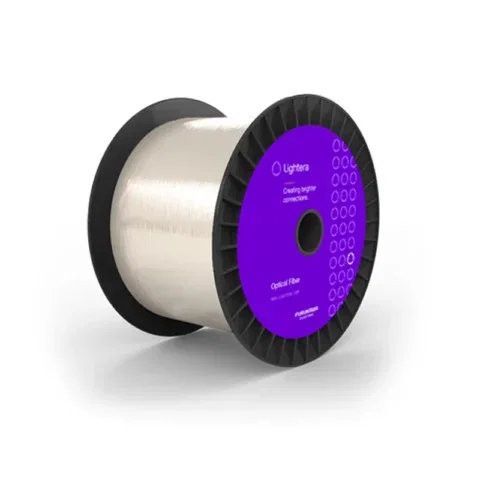
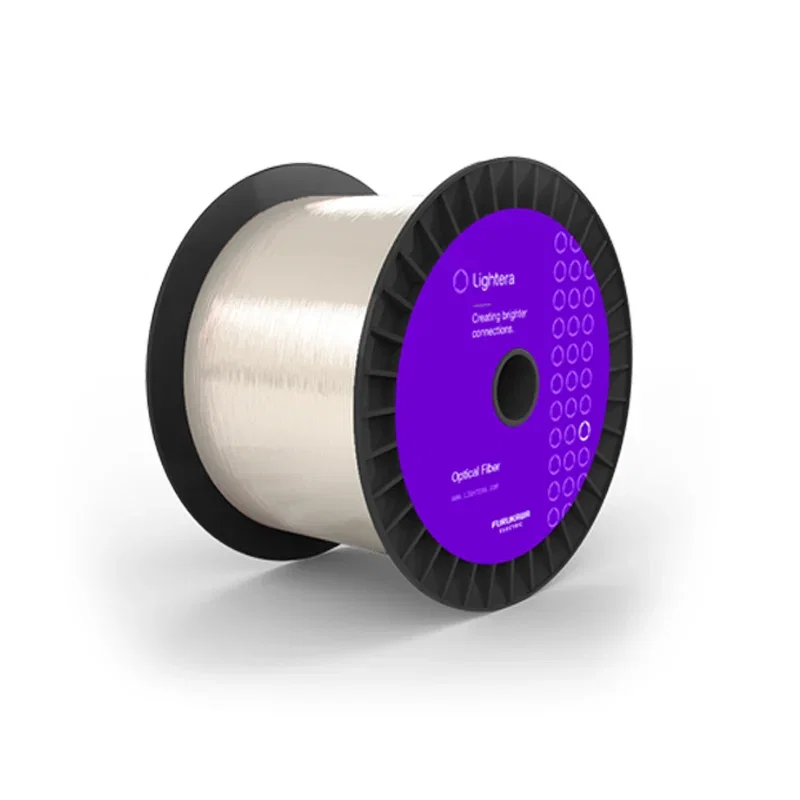
TruePhase 125/250 µm 980 nm PM Optical Fibre is a high-birefringence optical fibre designed to maintain a stable polarisation state of light for demanding applications. It features a standard 125 µm cladding with 250 µm coating, making it compatible with conventional fibre connectors and splicing tools. Optimised for operation at the 980 nm wavelength, this fibre ensures single-mode guidance and minimal polarisation cross-coupling, which is crucial for precision laser systems and interferometric sensors. Engineers working on fibre lasers, quantum optical set-ups, or fibre optic gyroscopes can rely on this fibre’s ability to deliver consistent polarised light output. The TruePhase fibre’s polarisation-maintaining design, often based on a PANDA-style stress rod construction, provides a high polarisation extinction ratio, so most optical power stays in the intended polarisation axis. With its robust acrylate coating and high tensile strength, the fibre is durable enough for both laboratory use and integrated OEM systems. Overall, this PM fibre addresses the needs of advanced photonics projects where maintaining the state of polarisation is critical to performance.
Range features
A high level overview of what this range offers
- Polarisation-maintaining design: Preserves the light’s polarisation state over long fibre lengths for consistent performance in interferometers, fibre lasers, and other polarisation-sensitive systems.
- Optimised for 980 nm: Supports low-loss, single-mode operation around 980 nm for efficient use in pump delivery and precision photonics applications.
- High extinction ratio: Delivers a typical PER of at least 20 dB, helping keep transmitted light strongly aligned to the intended polarisation axis.
- Standard 125/250 µm geometry: Uses a conventional fibre format that supports compatibility with common connectors, splicing tools, and handling methods.
- Durable dual acrylate coating: Provides mechanical flexibility and environmental protection for dependable use in laboratory and OEM environments.
- High-birefringence PANDA-style structure: Helps maintain polarisation stability under minor bending and thermal variation.
- Consistent optical performance: Tight control of numerical aperture and geometry supports predictable coupling and repeatable system integration.
- High proof strength: Typically proof tested to 100 kpsi for strong mechanical reliability during installation and operation.
Downloads
for TruePhase® 125/250 µm 980 nm PM Optical Fibre
TruePhase 125/250 µm 980 nm PM Optical Fibre – Datasheet
DownloadWhat’s in this range?
All the variants in the range and a comparison of what they offer
Specification | Value |
Fibre type | Polarisation-Maintaining single-mode fibre |
Operating wavelength | 980 nm (nominal centre wavelength) |
Mode field diameter @ 980 nm | ~6.5 µm (typical) |
Numerical aperture (NA) | ~0.12–0.14 (nominal) |
Cladding diameter | 125 µm |
Coating diameter (outer) | 245 µm (dual acrylate coating) |
Coating material | Dual UV-cured acrylate |
Polarisation extinction ratio (PER) | ≥ 20 dB (typical, over specified length) |
Beat length @ 980 nm | ~2–3 mm |
Attenuation @ 980 nm | Approx. 3 dB/km (typical) |
Proof test level | 100 kpsi |
Operating temperature range | –40 °C to +85 °C |
Application examples | Fibre lasers, EDFA pumps, fibre gyroscopes, polarisation-sensitive sensors |
FAQs
for TruePhase® 125/250 µm 980 nm PM Optical Fibre
A polarisation-maintaining fibre is a specialised single-mode fibre designed to preserve the input polarisation state of light as it propagates. Unlike standard fibre, which can allow polarisation to drift due to stress and imperfections, PM fibre uses a deliberately birefringent structure so light stays aligned to defined axes. This makes it valuable in interferometers, quantum optics, fibre lasers, and other systems where polarisation stability is critical.
This fibre typically relies on a PANDA-style high-birefringence design with stress-applying parts near the core. These create distinct fast and slow axes, reducing coupling between orthogonal polarisation states. When light is launched along one axis, it remains strongly confined to that axis over the fibre length, helping preserve a stable polarised output.
Typical applications include fibre lasers, pump delivery around 980 nm, interferometric sensing, fibre optic gyroscopes, polarisation-sensitive photonic components, and quantum optical experiments. It is especially useful wherever stable polarisation and repeatable optical behaviour are required.
It is optimised for operation around 980 nm, where its specified optical performance is intended to apply. It may also guide light at nearby wavelengths such as 1064 nm, but performance characteristics like attenuation, mode field diameter, and extinction ratio can shift away from the design wavelength. For significantly different wavelength ranges, a fibre designed for that band is the better choice.
The typical mode field diameter is about 6.5 µm at 980 nm. This is important because it affects coupling efficiency, splice compatibility, and bending sensitivity. A well-matched mode field diameter helps reduce insertion loss when coupling lasers or splicing to similar fibres.
The key requirement is alignment of the fibre’s principal axes during splicing or termination. For fusion splicing, PM-capable splicers are used to align the slow and fast axes correctly before joining the fibres. For connectorisation, the fibre must be rotationally aligned to the connector key so the same polarisation orientation is preserved through the interface.
A typical polarisation extinction ratio of 20 dB or higher can be expected under appropriate test conditions and correct alignment. In practice, PER depends on fibre length, launch alignment, splicing quality, and bending conditions. Careful handling is essential to achieving the best real-world result.
The fibre uses a dual acrylate coating, which provides mechanical protection, flexibility, and good handling characteristics for standard photonics workflows. It is suitable for typical operating environments in the range of –40 °C to +85 °C and can be stripped for splicing or termination. As with all coated optical fibres, avoiding sharp bends, pinching, and harsh chemical exposure helps maintain long-term reliability.