4-Fibre Waterblocked 2.5 mm Sub Unit LSZH Cable 200 µm HCS® Step-Index
- Technology
- Fibre optic cables, connectors and assemblies
- Partner
- Lightera (formerly OFS)
The C21053 is designed for industrial environments that require both durability and safety. It uses Hard Clad Silica (HCS®) step-index multimode fibres with a 200 µm core for robust optical performance in harsh conditions. Its LSZH jacket helps minimise toxic smoke emissions in the event of fire, making it suitable for enclosed spaces such as substations or wind turbine towers. The breakout construction with 2.5 mm sub-units supports easier handling, termination, and maintenance of each fibre.
Waterblocked materials help prevent moisture ingress and protect signal performance in damp or outdoor environments. Rugged construction also supports resistance to mechanical fatigue, vibration, and demanding installation conditions. The cable operates across a wide temperature range from –20 °C to +80 °C. It is suitable for indoor-to-outdoor links in applications such as offshore platforms, shipboard systems, nuclear facilities, renewable energy sites, and industrial plants.
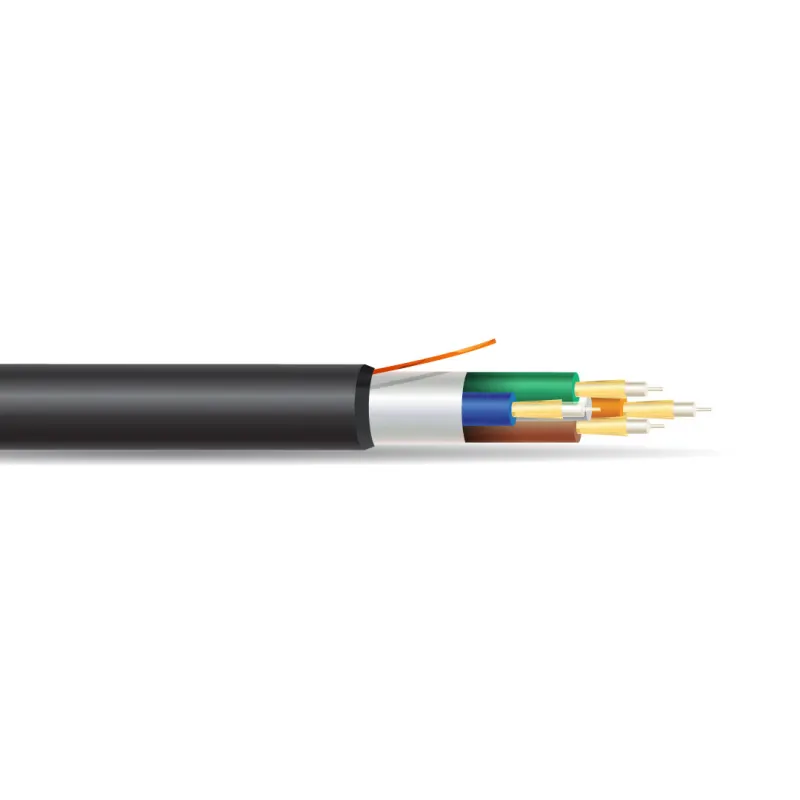
This 4-fibre waterblocked LSZH fibre optic cable is built for demanding industrial installations where fire safety, durability, and reliable transmission are all critical. The cable combines 200 µm HCS® step-index multimode fibres with a rugged breakout design, giving each fibre its own 2.5 mm sub-unit for easier routing and termination. Its waterblocked construction helps protect against moisture ingress, while the LSZH outer jacket supports safer use in enclosed or sensitive environments such as substations, wind turbines, offshore platforms, and industrial facilities. Designed for indoor/outdoor use, it also withstands vibration, mechanical stress, and wide temperature fluctuations.
Range features
A high level overview of what this range offers
- Waterblocked construction: Prevents moisture ingress and supports reliable performance in damp or outdoor environments.
- LSZH outer jacket: Reduces toxic and corrosive smoke emissions for safer use in enclosed or public areas.
- 4 x 2.5 mm breakout sub-units: Each fibre is individually protected for easier handling, termination, and maintenance.
- 200 µm HCS® step-index fibres: Durable multimode cores with strong mechanical resilience for industrial applications.
- ST and SMA connector compatibility: Supports simple crimp-and-cleave field termination without epoxy polishing.
- High tensile strength: Rated up to 2,358 N installation load for long pulls and vertical runs.
- Vibration resistance: Qualified for more than 500 flex cycles in dynamic environments.
- Wide operating temperature range: Performs from –20 °C to +80 °C across varied indoor and outdoor conditions.
- Custom configuration options: Available with higher fibre counts, alternative jacket options, custom print legends, and factory pre-terminated connectors.
Downloads
for 4-Fibre Waterblocked 2.5 mm Sub Unit LSZH Cable 200 µm HCS® Step-Index
What’s in this range?
All the variants in the range and a comparison of what they offer
| Physical Characteristics | |
|---|---|
Construction | 4-Fibre Waterblocked |
Fibre Core Diameter | 200 ± 4 µm |
Sub-Unit Diameter | 2.5 ± 0.2 mm |
Outer Cable Diameter | 8.0 ± 0.4 mm |
Cable Weight | < 65 kg/km |
Outer Jacket Material | LSZH (Low Smoke Zero Halogen) |
Outer Jacket Colour | Black |
Specialty Testing – IEC 754-2 (Acid Gas, Halogen Content) | Passes |
Specialty Testing – IEC 332-3 (Flammability) | Passes |
Specialty Testing – Cyclic Flexing (Durability) |
|
Optical Characteristics | |
Fibre Type | Step-Index Multimode |
Attenuation @ 850 nm | ≤ 8 dB/km |
Mechanical & Environmental | |
Installation Load (Maximum) | 530 lbf (≈ 2358 N) |
Operating Load (Maximum) | 265 lbf (≈ 1179 N) |
Minimum Bend Radius (Installation) | 120 mm |
Minimum Bend Radius (Operating) | 80 mm |
Operating Temperature | –20 to +80 °C |
Storage Temperature | –40 to +80 °C |
Intended Location | Indoor/Outdoor |
Part Number | C21053 |
Product Description Code | HCP-M0200T-A04ZB |
FAQs
for 4-Fibre Waterblocked 2.5 mm Sub Unit LSZH Cable 200 µm HCS® Step-Index
HCS stands for Hard Clad Silica, a multimode optical fibre design that uses durable polymer cladding around the silica core. In this cable, the 200 µm HCS® fibres provide improved mechanical robustness compared with more fragile standard glass fibres. This makes the cable better suited to industrial environments where bending fatigue, handling stress, and easy field termination are important.
Waterblocking helps prevent moisture from travelling along the cable if water enters the jacket. This protects the optical fibres from performance loss or damage caused by damp conditions. It makes the cable especially suitable for outdoor runs, industrial facilities, conduits, and other installations where rain, condensation, or humidity may be present.
Yes. The cable is designed for both indoor and outdoor use. Its rugged LSZH jacket, waterblocked construction, and broad operating temperature range help it perform reliably in exposed or demanding environments. For direct-burial or especially severe mechanical conditions, additional protection or a more specialised cable construction may still be appropriate.
The cable supports termination with standard ST and SMA fibre optic connectors commonly used with 200 µm HCS fibres. The design is intended for crimp-and-cleave field termination, allowing installation without epoxy polishing. This helps simplify connectorisation in industrial and field settings.
The maximum recommended installation tension is 530 lbf, approximately 2358 N. This high tensile rating supports long cable pulls and vertical installation runs while helping protect the fibres from damage during installation. The maximum operating load is 265 lbf, approximately 1179 N.
LSZH means Low Smoke Zero Halogen. It refers to the outer jacket material, which is designed to emit very low smoke and no halogenated fumes if exposed to fire. This is important in enclosed, populated, or equipment-sensitive environments because it helps reduce toxic and corrosive emissions during a fire event.
Yes. Custom options include versions with higher fibre counts, alternative jacket materials or colours, custom printed legends, and factory pre-terminated connectors. These options make it easier to align the cable with specific installation, identification, or project requirements.
During installation, the minimum bend radius is 120 mm. In normal operating conditions after installation, the minimum bend radius is 80 mm. Keeping within these limits helps protect the fibres from stress and supports long-term optical performance.