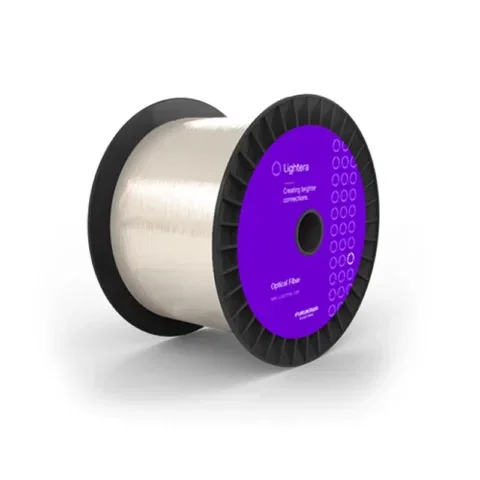
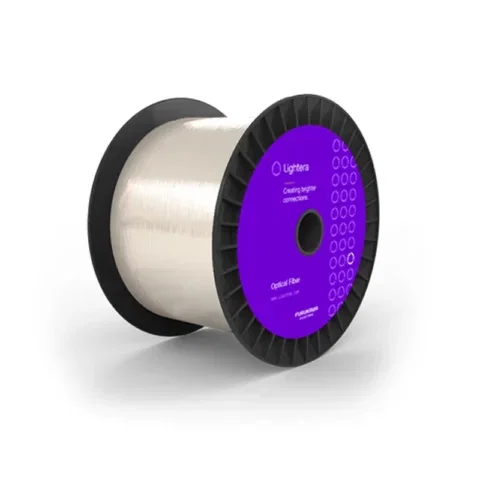
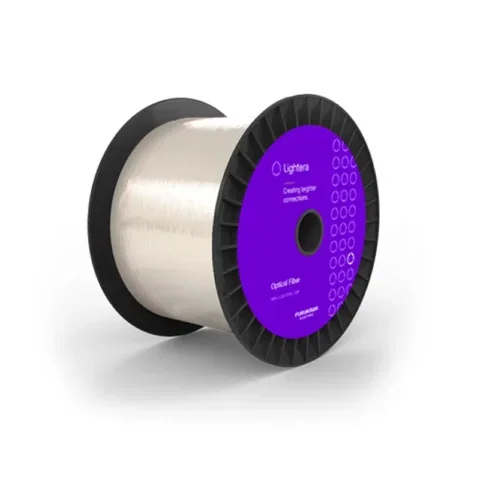
HCS® 940 µm 0.22 NA Step-Index Low OH Optical Fibre
- Technology
- Speciality fibre
- Partner
- Lightera (formerly OFS)
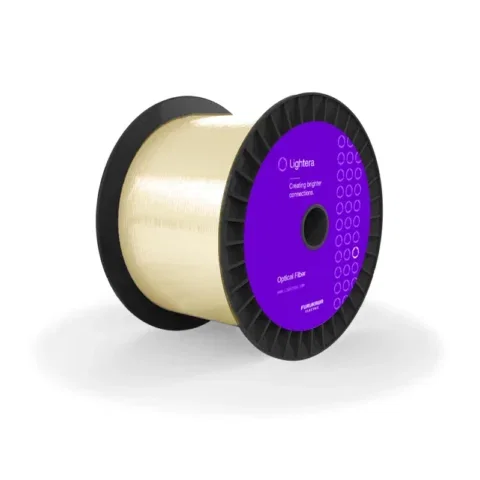
HCS® 940 µm Low-OH Step-Index Optical Fibre is a specialty large-core optical fibre built for efficient near-infrared light transmission in demanding environments. Its ultra-large 940 µm core makes coupling light from high-power lasers and other sources easier than with standard fibres. The low-OH silica design helps reduce absorption losses at wavelengths such as 850 nm and supports reliable NIR performance. An all-silica core and cladding structure, combined with hard polymer HCS cladding and an ETFE buffer jacket, provides strong mechanical durability and a high laser damage threshold. This makes the fibre well suited to industrial manufacturing, aerospace systems, and medical devices. Typical applications include high-power laser delivery, cutting and welding systems, and surgical or biocompatible fibre-optic tools. The materials are non-toxic and can be sterilised for sensitive medical use. For higher-temperature applications, an alternative Pyrocoat® polyimide-coated version is also available.
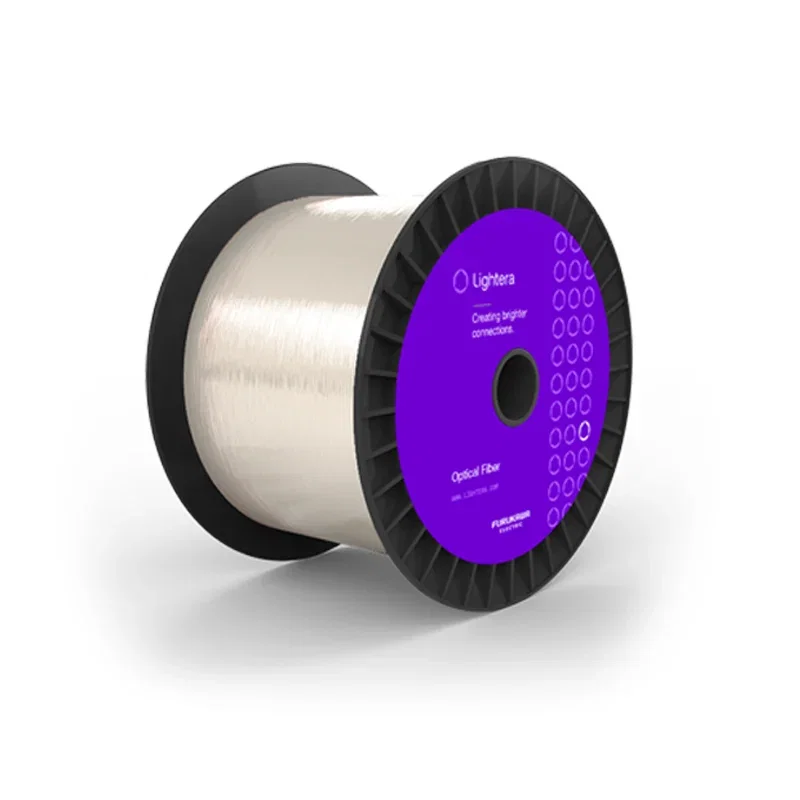
This ultra-large-core hard-clad silica fibre is engineered for efficient high-power light delivery in the near-infrared spectrum. Its nearly 1 mm core diameter supports easier coupling from lasers and LEDs, while the low-OH silica composition helps minimise attenuation at NIR wavelengths.
The combination of all-silica optical construction, durable HCS polymer cladding, and ETFE buffer jacket gives the fibre strong mechanical performance, chemical resistance, and suitability for demanding industrial, aerospace, and medical environments.
Range features
A high level overview of what this range offers
- Ultra-large 940 µm core – Simplifies coupling of high-power laser beams and maximises light throughput.
- Low-OH silica construction – Minimises absorption in near-infrared wavelengths for lower signal loss.
- 0.22 NA step-index multimode design – Provides broad light acceptance for efficient collection of LED and laser light.
- Hard Clad Silica (HCS) structure – Improves mechanical durability and supports high power handling.
- ETFE buffer jacket – Adds insulation and chemical resistance for harsh operating environments.
- Wide operating temperature range – Supports use from –65 °C to +125 °C in the standard buffered version.
- High damage threshold – Suitable for intense laser power delivery in industrial and medical systems.
- Biocompatible, sterilizable materials – Appropriate for medical devices, surgical probes, and life-science tools.
- High tensile strength – Proof-tested to ≥ 100 kpsi for reliable handling and long service life.
- Optional high-temperature variant – A Pyrocoat® polyimide-coated version is available for more extreme thermal conditions.
Downloads
for HCS® 940 µm 0.22 NA Step-Index Low OH Optical Fibre
What’s in this range?
All the variants in the range and a comparison of what they offer
Specification | Value |
Fibre Type | Multimode step-index |
Core Diameter | 940 ± 15 µm |
Cladding Diameter | 1000 ± 15 µm |
Coating Diameter | 1035 ± 15 µm |
Buffer Diameter | 1400 ± 50 µm |
Numerical Aperture (NA) | 0.22 (range 0.21–0.25) |
Attenuation @ 850 nm | ≤ 8 dB/km |
Water Content | Low OH (low hydroxyl) |
Operating Temperature Range | –65 °C to +125 °C |
Short-Term Bend Radius | ≥ 73 mm |
Long-Term Bend Radius | ≥ 118 mm |
Proof Test Level | ≥ 100 kpsi (0.689 GPa) |
Crimp & Cleave Compatible | No |
Coating Material | HCS fluoroacrylate polymer |
Buffer Material | ETFE fluoropolymer |
Standard Buffer Colour | Natural (clear) |
FAQs
for HCS® 940 µm 0.22 NA Step-Index Low OH Optical Fibre
This fibre is optimised for near-infrared wavelengths, particularly around 650 nm to 850 nm, where its low-OH silica core exhibits minimal attenuation. It can also effectively transmit at 1064 nm and other NIR wavelengths. However, it is less suitable for deep ultraviolet or blue visible light than a high-OH fibre designed for shorter wavelengths.
Yes. The extremely large 940 µm core reduces power density, allowing the fibre to carry very high-power laser beams without damage. Its all-silica construction and rugged HCS polymer cladding provide a high laser damage threshold, making it suitable for industrial cutting, welding, and medical laser delivery.
Terminating a 940 µm core fibre requires specialised connectors and procedures. SMA-type connectors are commonly used for large-core fibres, and an epoxy-polish termination method is typically recommended to achieve low loss. Simple crimp-and-cleave connector systems do not support this fibre diameter.
Yes. The fibre is made from biocompatible materials, including pure silica glass and inert fluoropolymers, that are non-toxic and suitable for medical devices. It can be sterilised without degrading performance, making it appropriate for surgical laser probes, biomedical sensors, and other life-science applications.
The recommended minimum bend radius is about 73 mm for short-term handling. For long-term installations, a bend radius of around 118 mm or larger should be maintained to avoid stress and signal loss.
In its standard form with the ETFE buffer, the fibre operates from approximately –65 °C up to +125 °C. If higher temperatures are required, a polyimide-coated Pyrocoat® version is available for substantially higher-temperature environments.
HCS stands for Hard Clad Silica. It refers to the durable hard polymer cladding applied around the silica fibre structure, improving protection, handling, and robustness while preserving optical performance.
Low-OH fibres have reduced hydroxyl ion content in the silica, which minimises absorption losses in the near-infrared. This makes them well suited to wavelengths such as 850 nm and 1064 nm. High-OH fibres generally have higher loss in the NIR but are often preferred for ultraviolet or visible-light applications because they transmit shorter wavelengths more efficiently and resist UV-related solarisation.