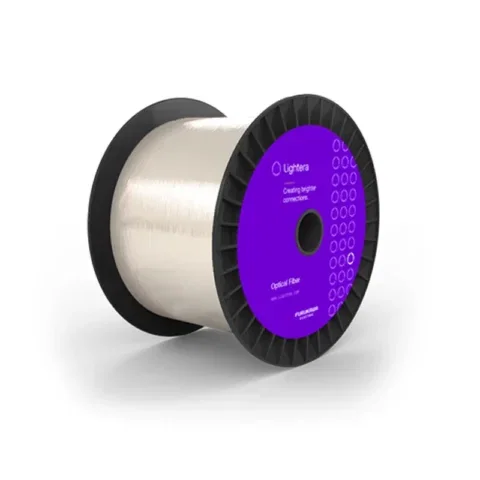
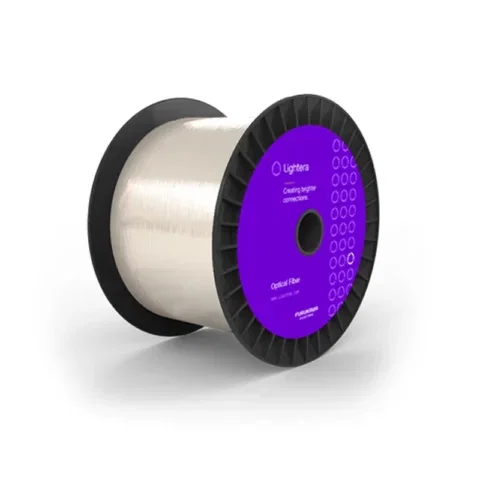
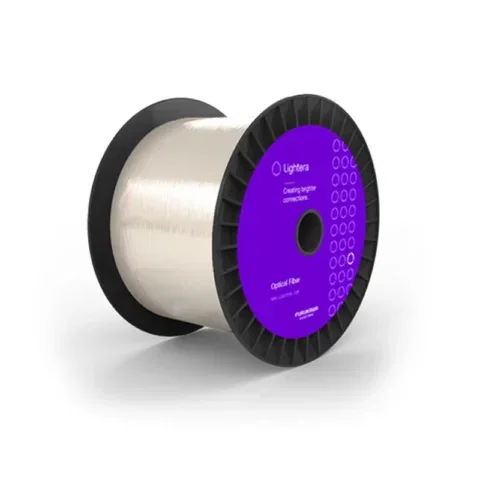
HCS® 400 µm 0.37 NA High OH Optical Fibre
- Technology
- Speciality fibre
- Partner
- Lightera (formerly OFS)
The CF01493-20 is a 400 µm Hard-Clad Silica (HCS®) optical fibre designed for reliable data transmission and light delivery in challenging environments. It combines a pure silica core with a proprietary polymer cladding and buffer for strong optical efficiency and mechanical durability. With a numerical aperture of 0.37, the fibre captures and transmits more light, helping simplify alignment and support lower-cost light sources. Its high OH content makes it especially suitable for visible wavelengths such as around 650 nm and 850 nm while remaining useful across a broad optical range. The large core and rugged construction make it well suited for high-power lasers, medical laser systems, optical sensing, and UV-visible spectroscopy. Overall, it provides an easy-to-terminate fibre solution that balances strong optical performance with industrial-grade toughness.
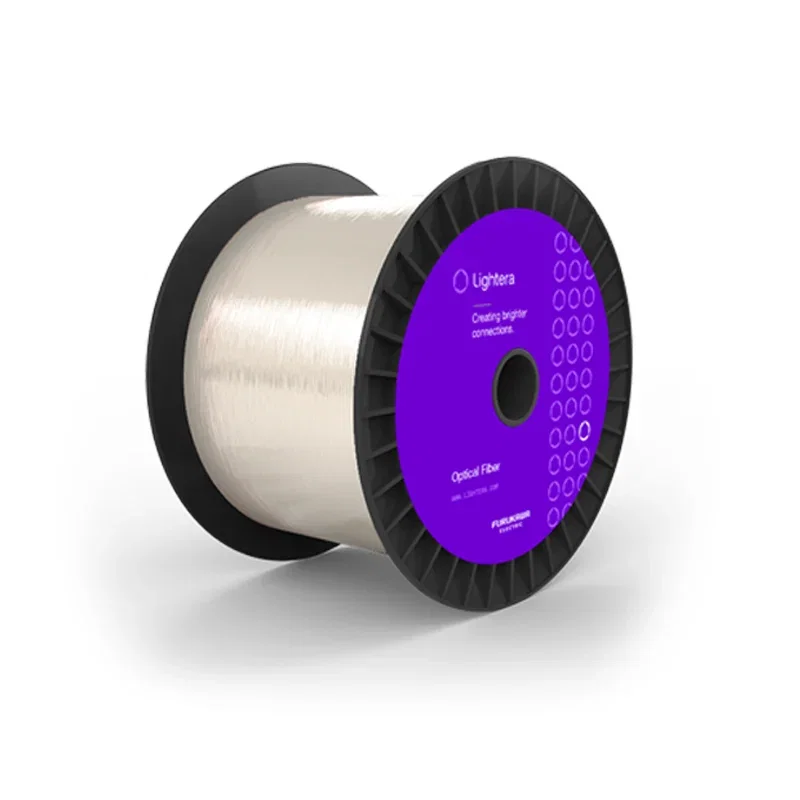
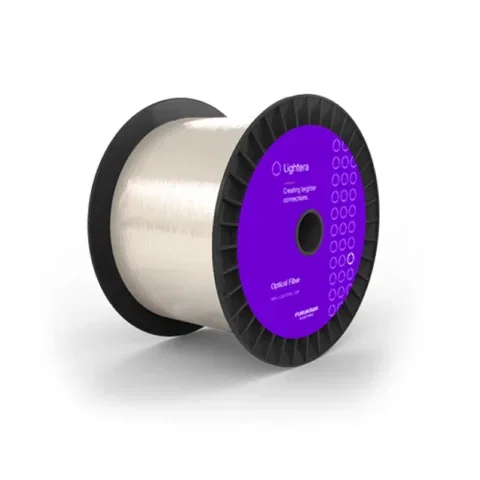
The CF01493-20 HCS® 400 µm 0.37 NA High OH optical fibre is engineered for reliable light delivery and signal transmission in demanding environments. Its Hard-Clad Silica (HCS®) construction combines a pure silica core with a hard polymer cladding and ETFE buffer, creating a fibre that is both optically capable and mechanically rugged.
With a large 400 µm core and 0.37 numerical aperture, it supports efficient coupling from LEDs and lasers while also reducing alignment sensitivity. This makes it a practical choice for industrial systems, medical devices, sensing platforms, and spectroscopy applications where durability, ease of termination, and dependable optical performance are critical.
Range features
A high level overview of what this range offers
- High mechanical strength – Designed to withstand demanding handling, pulling, and installation conditions.
- Bend insensitive performance – Helps maintain signal integrity when routed through tighter bends.
- Crimp & cleave termination – Enables quick field termination without epoxy or polishing.
- Chemical resistance – Suitable for use in chemically aggressive industrial environments.
- Wide operating temperature range – Supports reliable use from -65 °C to +125 °C.
- Large 400 µm core – Simplifies light coupling from LEDs and lasers for efficient power transfer.
- High NA of 0.37 – Accepts more light and improves tolerance to alignment variations.
- Rugged polymer cladding – Resists crushing, twisting, and flexing in dynamic installations.
- Easy handling – The 730 µm buffer diameter improves grip, stripping, and routing during installation.
- Long-term reliability – Built for stable optical and mechanical performance over time.
Downloads
for HCS® 400 µm 0.37 NA High OH Optical Fibre
What’s in this range?
All the variants in the range and a comparison of what they offer
Specification | Value |
Product Description | 400 µm 0.37 NA High OH |
Core Diameter | 400 ± 8 µm |
HCS® Cladding Diameter | 430 +5/-10 µm |
ETFE Buffer Diameter | 730 ± 30 µm |
Core/Clad Offset | ≤ 8.0 µm |
Crimp & Cleave Compatible | Yes |
Cladding Material | HCS fluoroacrylate (polymer) |
Buffer Material | ETFE (fluoropolymer) |
Fibre Type | Multimode step-index |
Numerical Aperture (NA) | 0.37 |
Attenuation @ 820 nm | ≤ 12 dB/km |
Water Content | High OH (high hydroxyl) |
Operating Temperature | -65 °C to +125 °C |
Short-Term Bend Radius | ≥ 29 mm |
Long-Term Bend Radius | ≥ 47 mm |
Proof Test Level | ≥ 100 kpsi (0.689 GPa) |
Part Number | CF01493-20 |
Product Code | HCN-M0400T |
Options Available | Buffer colour, buffer diameter, buffer material, cabling, connectorisation, numerical aperture |
FAQs
for HCS® 400 µm 0.37 NA High OH Optical Fibre
High OH means the fibre has a high hydroxyl content in the silica core. In practice, this makes it well suited for UV and visible wavelength applications, such as spectroscopy, visible-light data links, and UV laser delivery. Compared with low-OH fibre types, it is better optimised for shorter wavelengths.
A 0.37 numerical aperture allows the fibre to accept light over a wider range of incoming angles. This helps the fibre capture more light from LEDs or lasers and also improves tolerance to alignment variation during coupling and connectorisation.
HCS fibre uses a glass core with a hard polymer cladding, rather than a glass core with glass cladding. This construction improves mechanical toughness, enables crimp termination, and supports a relatively high numerical aperture, making the fibre easier to handle and deploy in industrial and medical systems.
This fibre is designed for crimp-and-cleave termination. Connectors can be attached by crimping onto the polymer cladding and then cleaving the fibre flush, eliminating the need for epoxy curing or polishing and making field installation faster and simpler.
Yes. The fibre is built for demanding use with chemical resistance, strong mechanical durability, and a wide operating temperature range of -65 °C to +125 °C. Its polymer cladding and ETFE buffer help protect it against abrasion, handling stress, and challenging installation conditions.
The specified short-term bend radius is 29 mm, which applies to temporary bending during installation or handling. For continuous use and long-term reliability, the recommended minimum bend radius is 47 mm.
This is a multimode step-index fibre with a 400 µm core. Its large core supports many propagation modes, making it suitable for light delivery, sensing, and short-distance transmission rather than single-mode communication applications.
Typical applications include high-power laser delivery, medical laser and diagnostic systems, optical sensing, and UV-visible spectroscopy. Its large core, rugged construction, and visible-wavelength optimisation make it a strong fit for demanding industrial, medical, and scientific uses.
The fibre is specified at ≤ 12 dB/km at 820 nm. This level is suitable for the short to moderate distances commonly used in equipment, sensing, and light-delivery applications, even though it is not intended for long-haul telecom transmission.
Yes. Available options include buffer colour, buffer diameter, buffer material, cabling, connectorisation, and even numerical aperture variants. These options help adapt the fibre to specific installation, identification, and optical performance requirements.