FLADE-R1 Flash Photodetector
- Technology
- Infrared photodetectors
- Partner
- IR Materials
The FLADE-R1 is a dual-sensor infrared flash photodetector system built to detect momentary IR flash events and indicate their angle of origin within a single plane. It is intended as an evaluation platform for engineers developing systems such as muzzle flash detectors or active protection solutions, where rapid infrared flash detection and localisation are essential. Two angled IR sensors enable directional measurement by comparing the detected flash response between channels. The unit is powered directly from USB at 5 V, allowing simple connection to a computer without a separate power supply.
Windows-based software lets users adjust gain and trigger thresholds to tune sensitivity for expected flash levels while reducing false alarms from ambient IR noise. When an event is detected, the system logs intensity, timing, and calculated direction for analysis. Its compact 3.6″ × 1.4″ form factor makes it easy to integrate into prototypes or use in lab and field testing. Swappable PbS or PbSe detector modules add flexibility for evaluating different infrared sensing ranges.
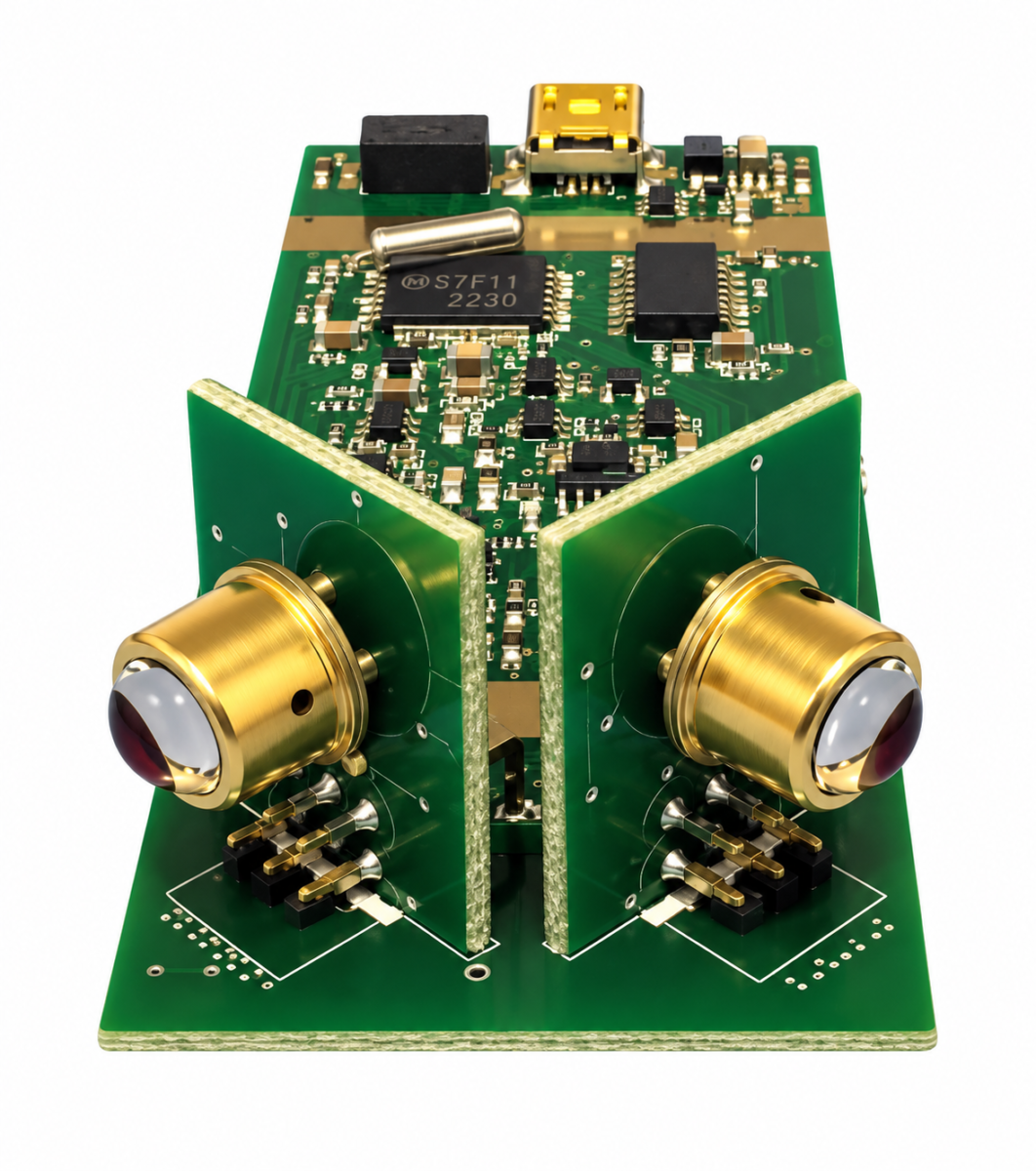
The FLADE-R1 flash photodetector is designed for engineers who need to detect very short infrared flash events and estimate where they came from. Using two angled IR sensors, the system compares flash responses to determine direction within one plane.
Because the board is USB-powered and includes Windows control software, it is straightforward to deploy for benchtop evaluation, prototype integration, and controlled field testing. Adjustable gain, trigger thresholds, and real-time event logging make it useful for both algorithm development and practical flash detection experiments.
Range features
A high level overview of what this range offers
- Dual angled IR sensors: Enable directional flash detection and estimation of the flash source angle within one plane.
- Matched-filter signal processing: AC-coupled design is tuned for brief millisecond-scale flash events while suppressing spurious IR fluctuations.
- USB-powered 5 V operation: Runs directly from a standard USB connection with no separate power supply required.
- Adjustable gain and trigger threshold: Software-configurable settings help optimise sensitivity and reduce false triggers.
- Real-time event logging: Records flash amplitude, timing, and direction for analysis and validation.
- Compact board format: Approx. 3.6″ × 1.4″ size supports easy use in prototypes and constrained test setups.
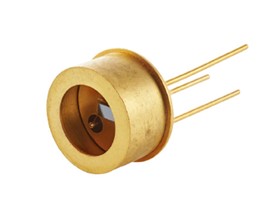
- Swappable detector modules: Socketed PbS/PbSe sensors allow quick replacement or experimentation with different IR ranges.
- Windows-compatible software: Supports setup, monitoring, and configuration from Windows XP and later systems.
Downloads
for FLADE-R1 Flash Photodetector
What’s in this range?
All the variants in the range and a comparison of what they offer
Specification | Value |
Sensors | 2 × IR photodetectors (PbS or PbSe, uncooled) |
Spectral sensitivity | ~1–3 µm (PbS) or ~1.5–5 µm (PbSe) |
Flash event duration | 1 ms to a few ms (typical detectable flash length) |
Signal processing | AC-coupled, matched-filter detection |
Interface & Power | USB (5 V DC via USB power) |
Dimensions (board) | Approx. 3.6″ × 1.4″ (≈ 91 mm × 36 mm) |
Software support | Windows OS (XP and newer) |
Outputs | Flash event amplitude, angle (direction), and time log (via PC software) |
Kit contents | FLADE-R1 board, USB cable, 2× IR detectors (PbS/PbSe), software & manual |
FAQs
for FLADE-R1 Flash Photodetector
It uses two infrared sensors mounted at an angle to each other. When a flash occurs, the system compares the signals from both sensors to estimate the flash direction within one plane, using differences in signal strength or timing to infer the incident angle.
The spectral response depends on the installed detector type. With PbS sensors, the system covers roughly ~1–3 µm, while PbSe sensors extend sensitivity to about ~1.5–5 µm, allowing use across near-IR and parts of the mid-IR range.
The electronics are tuned for the characteristic profile of a true flash event lasting around milliseconds. Slow ambient thermal changes or unrelated IR signals are filtered out, so the detector responds primarily to rapid flash signatures rather than background IR variation.
Yes. The preamp boards use socketed detector modules, so PbS or PbSe sensors can be swapped quickly for replacement, maintenance, or testing different spectral response ranges without replacing the whole board.
For each detected event, the software logs the flash amplitude, the calculated angle or direction of origin, and a time record. This supports event analysis, performance evaluation, and integration into larger detection workflows.
Typical uses include muzzle flash detection, active protection system development, and laboratory or field research involving short IR-emitting events. It is suited to applications where both fast flash detection and directional information are important.
The unit is powered entirely through USB at 5 V, so it can run from a host computer or USB power source without a dedicated external supply. The same USB connection is also used for communication with the control software.
The included control application is designed for Windows XP and later Windows versions, enabling users to configure gain and threshold settings and monitor event data in real time.