MCT (HgCdTe) LN2 Infrared Detectors for FTIR and Broadband IR Detection
- Technology
- Infrared photodetectors
- Partner
- Infrared Associates
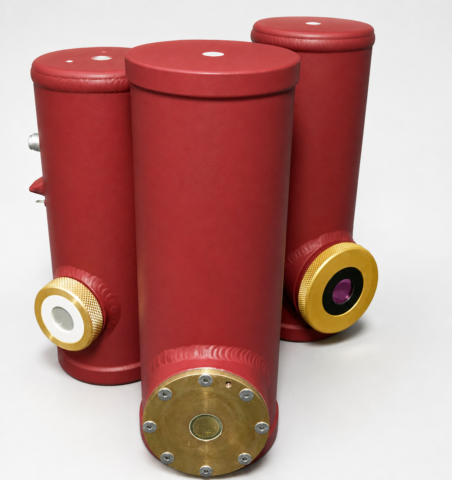
Mercury cadmium telluride (MCT) detectors cooled by liquid nitrogen deliver extremely high sensitivity across the mid- to long-wave infrared spectrum. These photoconductive IR detectors are optimised for specific wavebands – typically 2–5 µm, 2–13 µm, or an extended FTIR series reaching 2–24 µm – making them suitable for both narrow-band and broadband IR detection tasks. By maintaining the sensor at ~77 K with LN₂, thermal noise is greatly reduced, enabling detection of very weak infrared signals with D* on the order of 10^10–10^11 Jones. Each detector is packaged in a compact cryogenic dewar (side-looking or down-looking orientation) with an IR-transmissive wedged window to eliminate interference fringes. Standard dewar designs offer hold times of approximately 8, 12, or 24 hours before LN₂ refilling is needed, supporting day-long experiments or measurements. For specialised requirements, the MCT alloy composition can be adjusted to tailor the detector’s peak response wavelength and cutoff, and custom packaging interfaces are available to suit specific instruments or cooling systems. These LN₂-cooled MCT detectors are ideal for applications like Fourier-transform infrared (FTIR) spectrometers, broadband IR spectroscopy, gas analysis, and any precision measurement requiring ultra-low-noise IR detection in the 2–25 µm range.
Range features
A high level overview of what this range offers
- Liquid nitrogen cooling (77 K) – Greatly lowers thermal noise, achieving high detectivity and stable performance for low-signal IR measurements.
- Mercury cadmium telluride photoconductor – Broad infrared sensitivity from mid-wave to far-IR (2 µm up to 24 µm depending on model), allowing detection of a wide range of wavelengths.
- Multiple spectral range options – Standard detectors optimised for 2–5 µm, 2–13 µm, or 2–24 µm ("FTIR series") ensure you can choose a device best matched to your required IR band.
- *Excellent sensitivity (high D values)** – Detectivity up to ~1×10^11 Jones (cm·Hz^0.5/W) at peak wavelength, enabling detection of very low infrared signal levels in analytical and scientific applications.
- Fast response time – Photoconductive design with typical time constants down to ~2.0 µs (short-wave models) and ~0.2–0.5 µs for long-wave models, suitable for rapid scans and modulated IR signals (e.g. in FTIR spectrometers).
- Wedged IR window materials – Each dewar features a wedged infrared-transparent window (e.g. Sapphire for 2–5 µm, ZnSe for mid-IR, KRS-5 for long-IR) to cover the required spectrum and prevent etalon interference effects, improving measurement accuracy.
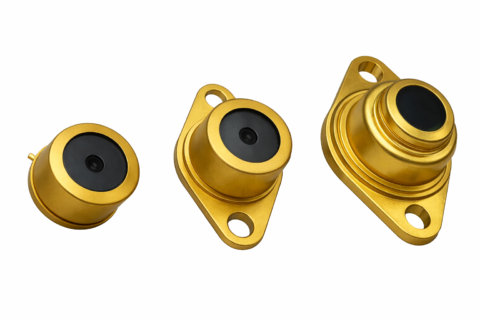
- Robust cryogenic packaging – Available in side-looking (MSL) or down-looking (MDL) metal dewars with 8, 12 or 24-hour hold time options, providing flexibility in mounting orientation and experiment duration without frequent refills.
- Customisable design – Detector parameters (alloy composition for custom cut-off wavelength) and packaging can be tailored on request, ensuring the detector can be adapted to specialized applications or integrated into custom cooling systems.
What’s in this range?
All the variants in the range and a comparison of what they offer
Standard Liquid Nitrogen–Cooled HgCdTe Detectors (Photoconductive MCT sensors, 60° field-of-view, measured at 77 K)
Spectral Range | Model Number | Active Area (mm × mm) | Peak λp (µm) | Cut-off λco | D* @ λp | Responsivity* | Standard Packaging | Window | Time Constant (µs) |
2 µm to 5 µm | MCT-5-N-0.05 | 0.05 × 0.05 | ~4.5 |
|
|
| MSL-8 or MSL-12 | Sapphire | ~2.0 µs |
MCT-5-N-0.10 | 0.10 × 0.10 | ~4.5 |
|
|
| MSL-8 or MSL-12 | Sapphire | ~2.0 µs | |
MCT-5-N-0.25 | 0.25 × 0.25 | ~4.5 |
|
|
| MSL-8 or MSL-12 | Sapphire | ~2.0 µs | |
MCT-5-N-0.50 | 0.50 × 0.50 | ~4.5 |
|
|
| MSL-8 or MSL-12 | Sapphire | ~2.0 µs | |
MCT-5-N-1.00 | 1.00 × 1.00 | ~4.5 |
|
|
| MSL-8 or MSL-12 | Sapphire | ~2.0 µs | |
MCT-5-N-2.00 | 2.00 × 2.00 | ~4.5 |
|
|
| MSL-8 or MSL-12 | Sapphire | ~2.0 µs | |
2 µm to 13 µm | MCT-13-0.025 | 0.025 × 0.025 | ~12.0 |
|
|
| MSL-8 or MSL-12 | ZnSe | ~1.0 µs |
MCT-13-0.05 | 0.05 × 0.05 | ~12.0 |
|
|
| MSL-8 or MSL-12 | ZnSe | ~1.0 µs | |
MCT-13-0.10 | 0.10 × 0.10 | ~12.0 |
|
|
| MSL-8 or MSL-12 | ZnSe | ~1.0 µs | |
MCT-13-0.25 | 0.25 × 0.25 | ~12.0 |
|
|
| MSL-8 or MSL-12 | ZnSe | ~1.0 µs | |
MCT-13-0.50 | 0.50 × 0.50 | ~12.0 |
|
|
| MSL-8 or MSL-12 | ZnSe | ~1.0 µs | |
MCT-13-1.00 | 1.00 × 1.00 | ~12.0 |
|
|
| MSL-8 or MSL-12 | ZnSe | ~1.0 µs | |
MCT-13-2.00 | 2.00 × 2.00 | ~12.0 |
|
|
| MSL-8 or MSL-12 | ZnSe | ~1.0 µs | |
2 µm to 24 µm | FTIR-16-0.10 | 0.10 × 0.10 | ~14.0 |
|
|
| MSL-8 or MSL-12 | ZnSe (wedged) | ~0.5 µs |
FTIR-16-0.25 | 0.25 × 0.25 | ~14.0 |
|
|
| MSL-8 or MSL-12 | ZnSe (wedged) | ~0.5 µs | |
FTIR-16-0.50 | 0.50 × 0.50 | ~14.0 |
|
|
| MSL-8 or MSL-12 | ZnSe (wedged) | ~0.5 µs | |
FTIR-16-1.00 | 1.00 × 1.00 | ~14.0 |
|
|
| MSL-8 or MSL-12 | ZnSe (wedged) | ~0.5 µs | |
FTIR-16-2.00 | 2.00 × 2.00 | ~14.0 |
|
|
| MSL-8 or MSL-12 | ZnSe (wedged) | ~0.5 µs | |
FTIR-22-0.25 | 0.25 × 0.25 | ~18.0 |
|
|
| MSL-8 or MSL-12 | ZnSe (wedged) | ~0.3 µs | |
FTIR-22-0.50 | 0.50 × 0.50 | ~18.0 |
|
|
| MSL-8 or MSL-12 | ZnSe (wedged) | ~0.3 µs | |
FTIR-22-1.00 | 1.00 × 1.00 | ~18.0 |
|
|
| MSL-8 or MSL-12 | ZnSe (wedged) | ~0.3 µs | |
FTIR-24-0.25 | 0.25 × 0.25 | ~18.0 |
|
|
| MSL-8 or MSL-12 | KRS-5 (wedged) | ~0.2 µs | |
FTIR-24-1.00 | 1.00 × 1.00 | ~18.0 |
|
|
| MSL-8 or MSL-12 | KRS-5 (wedged) | ~0.2 µs |
* Responsivity: Values shown are typical peak responsivity (V/W) at the specified peak wavelength, given as minimum achievable (">" indicates the detector usually exceeds this value). Actual responsivity depends on operating bias and readout circuit.
Packaging codes: MSL-8/12 – Side-looking metal dewar (8 h or 12 h hold time); MDL-8/12 – Down-looking metal dewar (8 h or 12 h hold). All standard packages include a wedged infrared window as listed (e.g. Sapphire, ZnSe, KRS-5) for the given spectral range.
FAQs
for MCT (HgCdTe) LN2 Infrared Detectors for FTIR and Broadband IR Detection
Cooling an MCT detector to liquid nitrogen temperature (~77 K) dramatically reduces its thermal noise and dark current. At room temperature, the HgCdTe sensor would generate significant noise currents that mask low-level IR signals. By using LN₂ cooling, the detector operates in a background-limited regime, achieving much higher detectivity (D*) and enabling the detection of very weak infrared signals. In essence, liquid nitrogen cooling unlocks the full sensitivity potential of the MCT material, far beyond what is possible at ambient or thermoelectric-cooled temperatures.
The FTIR series refers to MCT detectors that are optimized for Fourier Transform Infrared (FTIR) spectrometers, covering an extended spectral range (approximately 2 µm to 22–24 µm). These detectors have a longer wavelength cut-off (up to ~24 µm) compared to standard 2–5 µm or 2–13 µm MCT detectors. This allows them to capture the broad infrared spectrum used in many FTIR applications. The FTIR series detectors typically have slightly lower peak D* (since longer wavelength detection is more challenging and noise-limited) but are designed to provide optimum performance (high sensitivity and fast response) across the entire mid- to far-IR range needed for broadband spectroscopy. They also feature wedged windows (e.g. ZnSe or KRS-5) to minimize interference fringes over that wide spectral band.
The choice of element size is a trade-off between sensitivity, field of view, and speed. Smaller element sizes (e.g. 0.1 mm or 0.25 mm) have higher electrical resistance and lower detector capacitance, which generally yields higher D and responsivity (i.e. better sensitivity) along with faster response times. However, a very small detector captures a smaller optical spot or field of view, which means it collects less total infrared energy unless your incoming beam is tightly focused. Larger element sizes* (e.g. 1 mm or 2 mm) can intercept more light from diffuse or large-area sources and have a wider acceptance angle, which is beneficial if your optical setup isn’t tightly focused. The trade-off is that larger detectors have lower impedance and higher device capacitance, so their detectivity is somewhat lower and their response can be slower (though still in the microsecond range). In summary, use the smallest detector that still comfortably captures your optical beam: for a collimated or small-spot FTIR beam, a 0.25 mm detector might be ideal for maximum sensitivity, whereas for a divergent source or large-area measurement, a 1 mm detector could be more suitable.
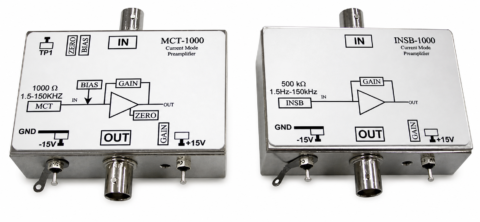
These LN₂-cooled MCT detectors are photoconductive devices. Unlike photovoltaic (PV) detectors which generate a voltage or current directly under illumination, photoconductive MCT detectors change their electrical conductivity in response to IR light and require an external bias voltage during operation. In practice, the detector is integrated into a bias circuit and usually connected to a low-noise transimpedance preamplifier. When infrared radiation hits the HgCdTe sensor, its conductivity increases, causing a change in the current flowing (under the applied bias). The preamplifier then converts this small current change into a measurable voltage signal. Photoconductive detectors often provide very high responsivity, but they do require this bias/preamplifier setup. The manufacturer offers dedicated preamplifier modules and recommends using them to achieve the best performance from the MCT detector.
The choice of window material depends on the detector’s spectral range, ensuring high transmission over that range. For example, standard 2–5 µm MCT detectors use a Sapphire window (good transparency in the near to mid-IR), while 2–13 µm detectors use Zinc Selenide (ZnSe) windows which transmit well up to ~14 µm. The longest-wavelength FTIR series detectors (up to 24 µm) often use KRS-5 (Thallium Bromoiodide) windows, since KRS-5 remains transparent into the far-infrared. All these windows are made slightly wedged (at a small angle, rather than perfectly parallel faces). The wedge is critical to prevent etalon effects – that is, interference fringes caused by multiple internal reflections between two flat parallel surfaces. By using a wedged window, any reflections are deflected and do not coherently interfere with the incoming signal, thus avoiding unwanted spectral ripples or baseline distortions in sensitive measurements.
The hold time on a single LN₂ fill depends on the dewar design. Standard packaging for these detectors includes 8-hour and 12-hour dewars as common options (often referred to as MSL-8, MDL-8 for 8 h and MSL-12, MDL-12 for 12 h). There are also larger dewars available (e.g. 24-hour hold time) for applications that require continuous overnight operation without refilling. In an 8 h dewar, the liquid nitrogen will gradually evaporate and warm up after about eight hours, so the detector needs topping up or will slowly lose cooling performance beyond that. The naming “side-looking” (MSL) vs “down-looking” (MDL) refers to how the infrared window is oriented: side-looking dewars have the window on the side of the cryostat, useful for horizontal optical paths, whereas down-looking dewars have the window at the top (the detector looks upward through the top window), which can be convenient for bench-top or upward-facing setups. By choosing the appropriate dewar (8h, 12h, or 24h and side- or down-looking), you can match the detector packaging to your experiment’s physical layout and the required duration of continuous operation. Keep in mind that if truly long-term 24/7 operation is needed without any user intervention, an alternative cooling method (such as an integrated Stirling cooler) might be recommended, but for most laboratory setups the LN₂ dewars are a practical and cost-effective solution.
Yes. One of the advantages of MCT (HgCdTe) technology is that its bandgap – and thus the detector’s cut-off wavelength – can be tuned by adjusting the alloy composition of mercury, cadmium, and telluride. The standard detectors cover popular ranges (5 µm, 13 µm, 16 µm, 22 µm cut-offs, etc.), but if your application requires a different cut-off (for example, perhaps you need peak sensitivity around 10 µm or a cut-off at 18 µm), the manufacturer can produce custom MCT detectors to meet those specifications. Custom orders can define the target wavelength range or the peak λ_p, and the material will be engineered accordingly. Additionally, packaging can be customized – for instance, if you need a different window material, a specific dewar form factor, or integration into a third-party cryocooler, those modifications can be discussed. Keep in mind that custom detectors may have longer lead times and certain minimum order requirements, but it is certainly possible to obtain an MCT detector precisely tailored to your spectral and mechanical needs.
LN₂-cooled MCT detectors are used whenever extremely sensitive IR detection is required over the mid to far-infrared range. A classic application is in FTIR (Fourier Transform Infrared) spectrometers, where an MCT detector can significantly increase the signal-to-noise ratio and allow fast scan speeds in the 2–16 µm region (for example, in analytical chemistry or materials identification). They are also employed in infrared microscopy and imaging setups (as single-point detectors for scanning microscopes), in gas analysis instruments (to detect absorption features of gases in the mid-IR), and in thermal emission measurements of materials (e.g. characterizing the infrared emissivity/reflectivity of surfaces). Scientists and engineers in fields like environmental monitoring, defense (IR signature analysis), and semiconductor research use these detectors for broadband IR spectroscopy and radiometry. In any scenario where you need to measure very faint IR signals or very small changes in infrared intensity – such as trace gas spectroscopy, low-concentration pollutant detection, or studying weak thermal radiation – an LN₂-cooled MCT detector is often the go-to solution for its superior sensitivity.