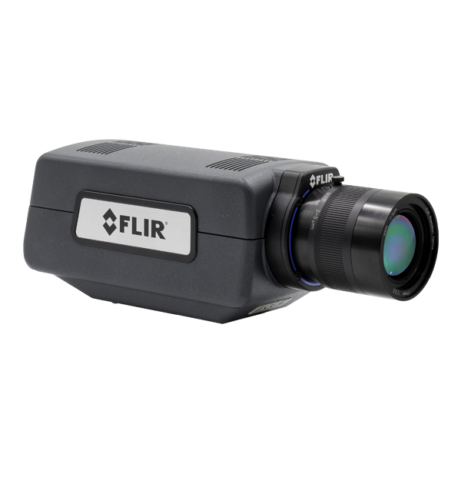
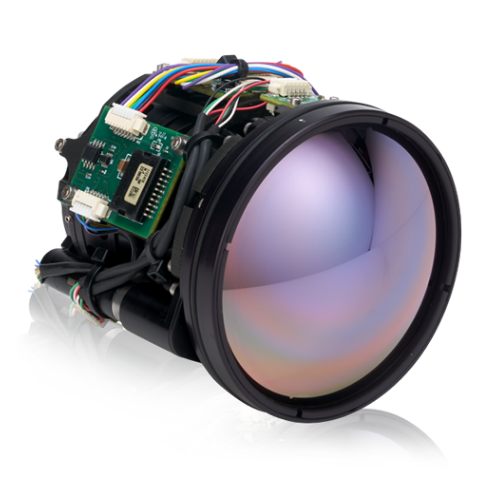
Boson+ CZ 14-75 LWIR OEM camera with continuous zoom lens
- Technology
- LWIR camera modules
- Partner
- Teledyne FLIR
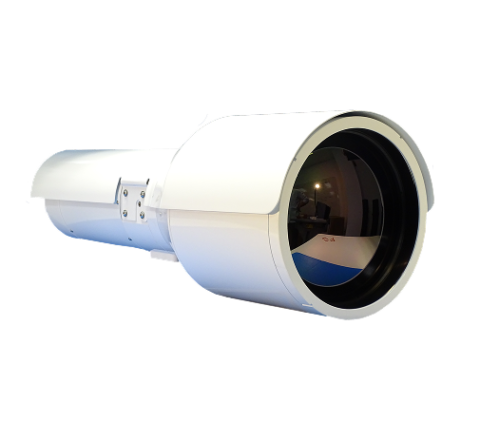
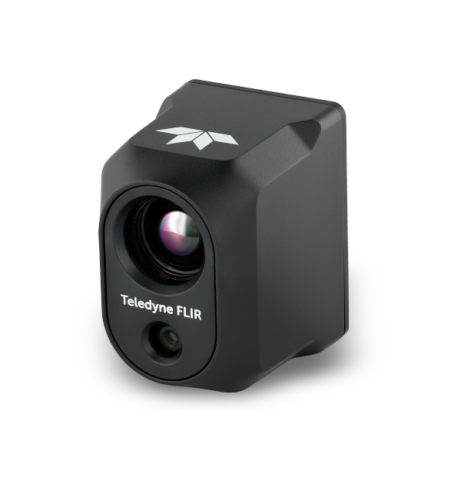
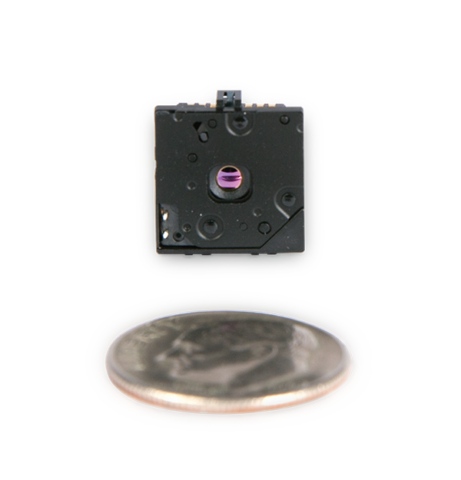
The Boson+ CZ 14-75 LWIR OEM camera module integrates a 640 × 512 thermal core and motorised continuous-zoom lens into one assembly. It is intended for embedded systems that need to change field of view without switching between separate optical channels. The 14–75 mm lens provides 5× optical zoom, covering an approximately 30° wide field of view and a 6° narrow field of view. A 12 µm detector and industrial-grade sensitivity of ≤20 mK support imaging where scene temperature differences are small.
Video can be routed through CMOS, MIPI or USB3, while separate interfaces are available for camera and lens control. Typical applications include uncrewed aerial vehicles, perimeter surveillance, vehicle situational awareness, targeting equipment and sighting systems. The 390 g assembly measures 101 × 77 × 77 mm and is specified for operation from −40 °C to 80 °C when correctly integrated.
Range features
A high level overview of what this range offers
- 640 × 512 uncooled LWIR detector with 12 µm pixels – Provides detailed thermal imagery for embedded observation and tracking systems.
- Industrial sensitivity of ≤20 mK – Supports differentiation of small temperature variations in low-contrast scenes.
- 14–75 mm f/1.2 continuous-zoom lens – Covers wide-area observation and narrower target examination through one optical channel.
- 5× optical and 8× digital zoom – Provides flexible control of the displayed scene and target scale.
- Boresight drift below 0.10 mm through zoom – Helps maintain alignment in tracking, sighting and multi-sensor applications.
- Parfocal design with thermal and range compensation – Supports focus retention while zooming and operating across changing temperatures.
- CMOS, MIPI and USB3 video outputs – Accommodate different embedded processors and system architectures.
- UART, USB and I²C camera control – Offers several options for host-system integration.
- RS232 motorised lens control – Enables commanded focal-length and focus adjustment from the host system.
- Automatic gain control and Silent Shutterless NUC – Manage scene contrast and detector non-uniformity in the video output.
- Built-in test feedback and configurable command aliases – Support system monitoring and adaptation to an existing command structure.
- IP67 protection at the front lens – Supports outdoor integration when the rest of the assembly is protected by the finished enclosure.
Downloads
for Boson+ CZ 14-75 LWIR OEM camera with continuous zoom lens
What’s in this range?
All the variants in the range and a comparison of what they offer
| Category | Specification | Value |
|---|---|---|
Identification | Model | 2526-350 |
Identification | Product status | In production |
Imaging | Detector technology | Uncooled LWIR microbolometer |
Imaging | Resolution | 640 × 512 |
Imaging | Pixel pitch | 12 µm |
Imaging | Spectral band | 8–14 µm |
Imaging | Thermal sensitivity | Industrial: ≤20 mK; Professional: ≤30 mK |
Imaging | Frame rate | 60 Hz baseline; 30 Hz runtime selectable |
Imaging | Temperature measurement | No |
Imaging | Non-uniformity correction | Factory calibrated; updated flat-field corrections with Silent Shutterless NUC |
Imaging | Symbol overlay | Rewritable each frame with alpha blending for translucent overlays |
Optics | Lens type | Motorised LWIR continuous-zoom lens |
Optics | Optical zoom | 5× |
Optics | Digital zoom | 8× |
Optics | Focal length | WFOV: 14 mm +0%/−4%; NFOV: 75 mm +4%/−0% |
Optics | f-number | f/1.2 |
Optics | Horizontal field of view | Approximately 6° to 30°; narrow HFOV listed as 5.9° |
Optics | IFOV | 0.16 mrad |
Optics | Spectrally weighted transmittance | HEAR L1: ≥84%; DLC L1: ≥78% across 8–12 µm |
Optics | NFOV/WFOV co-boresight location | <0.15 mm |
Optics | Boresight drift through zoom | <0.10 mm |
Optics | Boresight repeatability | ≤0.025 mm |
Optics | Parfocality | At 20 °C, focus remains within one-quarter wave at 10.6 µm through zoom |
Optics | Minimum focus distance | WFOV: >3 m; NFOV: >18 m |
Optics | Distortion | WFOV: <6%; NFOV: <1% |
Optics | Relative illumination | Fall-off <10%; flux change through zoom <4% |
Optics | Time to zoom | <1.5 seconds |
Optics | Time to focus | <0.5 seconds |
Electrical | Lens controller input | Nominal 12 V DC ±1 V |
Electrical | Camera core input | 3.3 V DC |
Interfaces | Sensor video channels | CMOS, MIPI or USB3 |
Interfaces | Camera control channels | UART, USB or I²C |
Interfaces | Peripheral channels | I²C, SPI and SDIO |
Interfaces | Lens serial communication | RS232, 38,400 baud, 8 data bits, one stop bit, no parity |
Mechanical | Dimensions | 101 × 77 × 77 mm |
Mechanical | Weight | 390 g |
Environmental | Operating temperature | −40 °C to 80 °C |
Environmental | Non-operating temperature | −40 °C to 80 °C |
Environmental | Focus over temperature | Maintains focus from −35 °C to 70 °C |
Environmental | Front-lens ingress protection | IP67 |
Environmental | Operational altitude | Up to 12 km |
Environmental | Shock | 9 g, 11 ms half-sine pulse; at least three pulses on each of three axes |
Environmental | ESS thermal test | −35 °C to 70 °C; maximum ramp of 5 °C/min and minimum dwell of 60 minutes at each extreme |
Environmental | ESS vibration | Random vibration from 10 Hz to 500 Hz along the optical axis for at least 10 minutes |
Environmental | Anti-reflection coating durability | Adhesion, moderate abrasion and humidity requirements of MIL-PRF-13830 |
Environmental | Optional DLC coating | Intended to withstand humidity, severe abrasion and salt-fog exposure |
Construction | Lens assembly requirements | MIL-STD-1472 and MIL-HDBK-1686 |
Protection | Solar protection | Yes, for the integrated lens |
Compliance | Procurement and export status | NDAA-compliant and ITAR-free |
Compliance | Export classification | 6A003.b.4.b for 60 Hz fast video; 6A993.A for 9 Hz slow video |
Compliance | Camera-core environmental declarations | RoHS EU 2015/863/EU and REACH Regulation (EC) No. 1907/2006 |
FAQs
for Boson+ CZ 14-75 LWIR OEM camera with continuous zoom lens
The 5× optical zoom changes the horizontal field of view from roughly 30° at 14 mm to about 6° at 75 mm. This allows one thermal channel to support wider-area search and narrower observation without changing a fixed lens or camera. Boresight drift through zoom is specified below 0.10 mm, co-boresight location below 0.15 mm and repeatability at or below 0.025 mm, which matters when the image feeds tracking or aiming functions. Zoom movement takes under 1.5 seconds, so control software should allow the mechanical transition to complete before making position-critical decisions.
Plan for separate electrical domains for the lens controller and thermal camera core. The lens controller requires a nominal 12 V DC supply within ±1 V, whereas the camera core requires 3.3 V DC, so the same unregulated rail must not be connected directly to both. Thermal video can use CMOS, MIPI or USB3, while camera command and control supports UART, USB or I²C. Lens motion uses RS232 at 38,400 baud with eight data bits, one stop bit and no parity. This separation should be reflected in the harness, grounding arrangement, start-up sequence and host software architecture.
The module is intended for installation within an enclosure rather than use as an exposed assembly. Its overall package measures 101 × 77 × 77 mm and weighs 390 g, but the IP67 rating applies only at the front of the lens. The remaining interfaces, seams and cables therefore require sealing at system level. The assembly is ESD-sensitive and vulnerable to foreign object debris, which can produce image artefacts, so controlled handling and clean assembly conditions are important. It should not be opened, and the enclosure should limit stray-light paths while avoiding mechanical loads that could disturb optical alignment.
Industrial-grade versions specify an NEdT of ≤20 mK, while professional-grade versions are rated at ≤30 mK. A lower NEdT means that the detector can distinguish smaller scene temperature differences, which is useful when a target and its background have similar thermal signatures. The 640 × 512 array provides spatial sampling, while automatic gain control and Silent Shutterless NUC manage contrast and detector non-uniformity. Sensitivity alone does not determine detection range because focal length, target size, atmospheric conditions, motion and display processing also affect performance. The complete imaging chain should therefore be validated under the expected operating conditions.
The optical assembly is designed to maintain focus through the 5× zoom range and includes temperature and object-range compensation. At 20 °C, parfocality is specified within one-quarter wave at 10.6 µm, while focus compensation covers −35 °C to 70 °C. Minimum focus distance is greater than 3 m at wide field and greater than 18 m at narrow field, so nearby targets require appropriate focus control rather than an assumed infinity setting. Focus movement takes less than 0.5 seconds and can be controlled independently from field of view. Position-critical applications should allow both focus and zoom movement to settle before evaluating image sharpness or alignment.
The specified environmental envelope supports these integrations, provided the finished enclosure meets the requirements of the complete system. Operating and non-operating temperature ranges are −40 °C to 80 °C, while optical focus compensation covers −35 °C to 70 °C. Integrated-assembly shock is specified at 9 g with an 11 ms half-sine pulse, and the random-vibration profile covers 10 Hz to 500 Hz along the optical axis. The front lens is rated IP67 and operational altitude is specified up to 12 km, but these figures do not establish whole-system ingress protection or airworthiness. Final qualification should also cover mounting, connectors, thermal paths, EMC and all relevant vibration axes.
No, this model is specified without temperature measurement and should be treated as a qualitative thermal imaging camera rather than a calibrated radiometric instrument. It can provide thermal scene imagery and processed or pre-gain-control data paths, but these outputs are not equivalent to a guaranteed object-temperature reading. Emissivity, reflected temperature, atmospheric transmission and optical transmission would also need to be addressed in a measurement system. Applications requiring alarm thresholds in degrees Celsius or traceable temperature accuracy should use a radiometric configuration with stated measurement ranges and tolerances. For surveillance, navigation and target observation, non-radiometric imagery may be sufficient.
The product is described as NDAA-compliant and ITAR-free, with ECCN 6A003.b.4.b applying to 60 Hz fast-video configurations and 6A993.A applying to 9 Hz slow-video configurations. ITAR-free status does not remove all United States export controls, so destination, end user and end use must still be checked against the applicable EAR classification. The Boson camera-core family has RoHS EU 2015/863/EU and REACH Regulation (EC) No. 1907/2006 declarations. Procurement teams should confirm that the selected grade, frame-rate configuration and complete integrated assembly meet the programme requirements. Any contractual, destination-specific or end-use approvals should be resolved before order release.