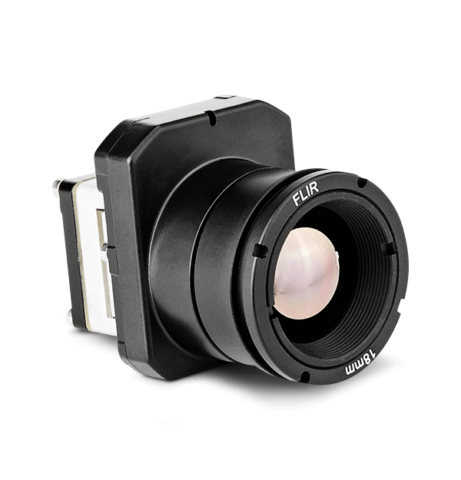
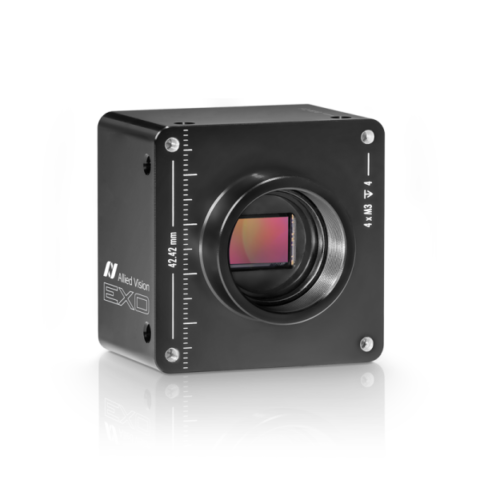
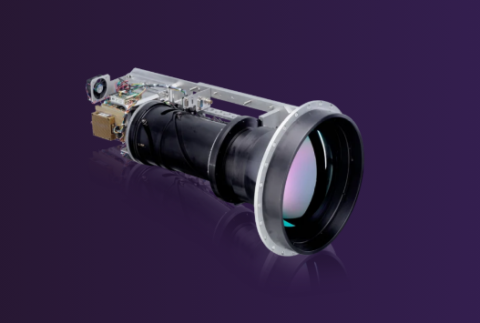
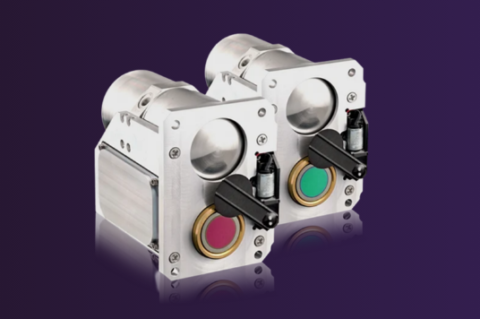
Goldeye SWIR InGaAs sensor technology cameras
- Technology
- SWIR camera modules
- Partner
- Allied Vision
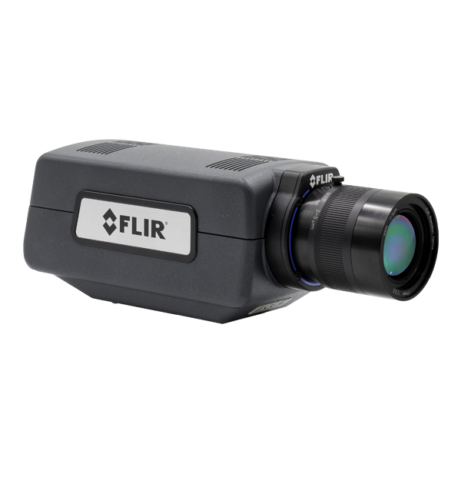
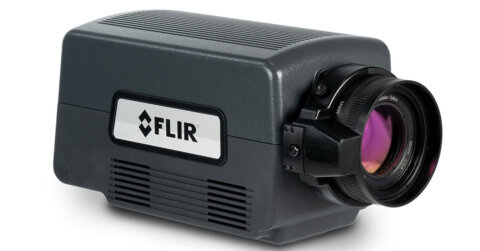
The Goldeye SWIR InGaAs camera range comprises multiple G and CL models rather than a single fixed configuration. It covers standard SWIR, visible-to-SWIR and extended-SWIR imaging, allowing engineers to match the spectral response to the target material and illumination system. Typical applications include semiconductor and solar-cell inspection, plastics sorting, laser-beam analysis, hyperspectral imaging, microscopy, thermal observation of hot metal or glass, remote sensing and security imaging.
Available sensor resolutions extend from 320 × 256 to 1280 × 1024, with full-resolution frame rates ranging from 94 to 344 fps. Compact fanless models are offered alongside actively cooled scientific configurations with single-stage or dual-stage thermoelectric temperature control. Integrated functions include non-uniformity correction, defect-pixel correction, background correction, look-up tables and multiple regions of interest. Model selection should consider wavelength range, spatial resolution, acquisition speed, interface, cooling method and mechanical format together.
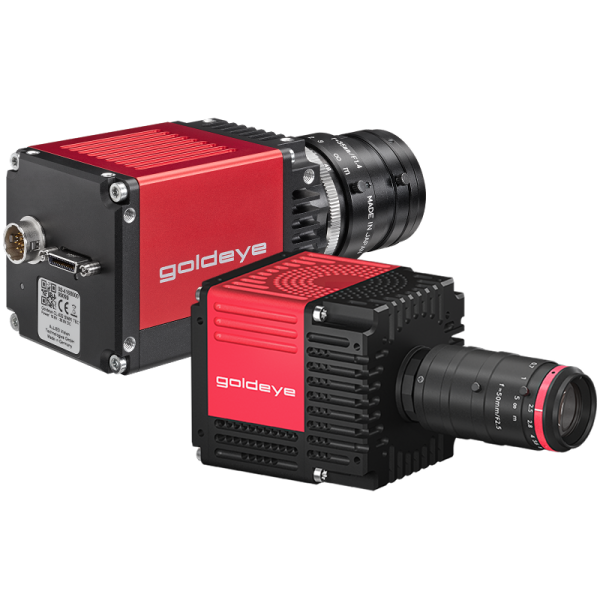
Goldeye G and CL cameras provide a configurable platform for standard SWIR, visible-to-SWIR and extended-SWIR imaging. Their combination of InGaAs sensors, global shutters, high acquisition rates and onboard image correction supports demanding inspection, measurement and scientific applications.
Range features
A high level overview of what this range offers
- Spectral options from 400 to 2,200 nm: Supports VSWIR, standard SWIR and extended-SWIR applications.
- Resolutions from 0.1 to 1.3 megapixels: Provides a choice between acquisition speed and spatial detail.
- Full-resolution rates up to 344 fps: Supports inspection and measurement of moving or rapidly changing targets.
- GigE Vision or Camera Link interfaces: Enables integration with network-based systems or frame-grabber architectures.
- Power over Ethernet on Goldeye G models: Can reduce system cabling when separate external I/O is not required.
- TEC1, TEC2 and TECless configurations: Allows the thermal design to be matched to exposure time and noise requirements.
- Housing operating temperature from −20 to +55 °C: Supports use in changing industrial and outdoor environments.
- NUC, DPC and background correction: Helps compensate for sensor non-uniformity, defective pixels and offset variation.
- Multiple regions of interest and binning: Supports selective acquisition and application-specific processing.
- 256 MB image buffer: Provides temporary image storage during host or interface interruptions.
- C-Mount, F-Mount and M42-Mount options: Accommodates different sensor formats and SWIR optical systems, subject to model availability.
- LVTTL, opto-isolated I/O and RS232: Supports triggering, status signalling and connection to external equipment.
Downloads
for Goldeye SWIR InGaAs sensor technology cameras
What’s in this range?
All the variants in the range and a comparison of what they offer
Specifications
| Specification | Goldeye SWIR camera range |
|---|---|
Product type | Monochrome SWIR, VSWIR and XSWIR area scan cameras |
Sensor technology | InGaAs focal plane arrays, including IMX990 and IMX991 InGaAs sensors |
Interface families | Goldeye G: GigE Vision over IEEE 802.3 1000BASE-T with IEEE 802.3af PoE; Goldeye CL: Camera Link Base, Camera Link V2.0 |
Spectral variants | VSWIR: 400 to 1,700 nm; SWIR: 900 to 1,700 nm; XSWIR 1.9: 1,100 to 1,900 nm; XSWIR 2.2: 1,200 to 2,200 nm |
Resolution range | 320 × 256 to 1280 × 1024 |
Resolution classes | 0.1, 0.3 and 1.3 megapixels |
Available resolutions | 320 × 256, 636 × 508, 640 × 512, 656 × 520 and 1280 × 1024 |
Sensor formats | Type 1/4, Type 1/2, Type 1 and Type 4/3, depending on model |
Pixel sizes | 5 × 5 µm, 15 × 15 µm, 25 × 25 µm or 30 × 30 µm |
Shutter | Global shutter |
Maximum full-resolution frame rate | 94 to 344 fps, depending on model |
A/D converter | 12-bit or 14-bit, depending on model |
Image output | Monochrome formats from 8-bit to 16-bit, depending on model and interface |
Image buffer | 256 MB |
Temperature-control options | Single-stage TEC1, dual-stage TEC2 or passive TECless operation |
Calibrated sensor temperatures | Model-dependent; calibrated default setpoints range from −30 to +25 °C |
Housing operating temperature | −20 to +55 °C |
Industrial housing dimensions | 78 × 55 × 55 mm body |
Scientific and XSWIR housing dimensions | 90 × 80 × 80 mm body |
Housing construction | Precision-machined 6061 aluminium |
Lens mounts | C-Mount; F-Mount and M42-Mount options for selected models |
Image-control functions | Auto exposure, auto contrast, background correction, binning, defect-pixel correction, look-up table, multiple regions of interest and non-uniformity correction |
Camera-control functions | Acquisition-frame-rate control, event channel, field firmware update, trigger and I/O control, image chunk data, stream hold and user sets |
Digital I/O | One LVTTL input and one LVTTL output |
Opto-isolated I/O | One input and two outputs |
Serial communication | RS232, approximately 115 kbaud, adjustable |
DC input | 10.8 to 30.0 V DC; Goldeye G models can also be powered through PoE |
Ingress protection | IP40 with a suitable lens fitted; IP20 for Cool models |
Environmental testing | IEC 60068-2-6 vibration, IEC 60068-2-27 shock and IEC 60068-2-64 random vibration |
Regulatory notices | FCC Part 15 Class B and CAN ICES-3(B)/NMB-3(B) |
Software support | Vimba X for Goldeye G and Vimba for Goldeye CL |
Each listed sensor and thermal variant is available with either a Goldeye G GigE Vision interface or a Goldeye CL Camera Link interface.
Variant comparison
| Model variant | Sensor and thermal design | Megapixels | Resolution | Sensor format | Shutter | Maximum full-frame rate | Pixel size | Spectral range |
|---|---|---|---|---|---|---|---|---|
G/CL-008 SWIR TEC1 | InGaAs FPA, TEC1 | 0.1 MP | 320 × 256 | Type 1 | Global | 344 fps | 30 × 30 µm | 900 to 1,700 nm |
G/CL-008 SWIR Cool TEC1 | InGaAs FPA, fan-cooled TEC1 | 0.1 MP | 320 × 256 | Type 1 | Global | 344 fps | 30 × 30 µm | 900 to 1,700 nm |
G/CL-008 XSWIR 1.9 TEC2 | Extended-range InGaAs FPA, TEC2 | 0.1 MP | 320 × 256 | Type 1 | Global | 344 fps | 30 × 30 µm | 1,100 to 1,900 nm |
G/CL-008 XSWIR 2.2 TEC2 | Extended-range InGaAs FPA, TEC2 | 0.1 MP | 320 × 256 | Type 1 | Global | 344 fps | 30 × 30 µm | 1,200 to 2,200 nm |
G/CL-030 VSWIR TEC1 | IMX991 InGaAs, TEC1 | 0.3 MP | 656 × 520 | Type 1/4 | Global | 234 fps | 5 × 5 µm | 400 to 1,700 nm |
G/CL-032 SWIR TEC1 | InGaAs FPA, TEC1 | 0.3 MP | 636 × 508 | Type 4/3 | Global | 100 fps | 25 × 25 µm | 900 to 1,700 nm |
G/CL-032 SWIR Cool TEC2 | InGaAs FPA, fan-cooled TEC2 | 0.3 MP | 636 × 508 | Type 4/3 | Global | 100 fps | 25 × 25 µm | 900 to 1,700 nm |
G/CL-033 SWIR TEC1 | InGaAs FPA, TEC1 | 0.3 MP | 640 × 512 | Type 1 | Global | 301 fps | 15 × 15 µm | 900 to 1,700 nm |
G/CL-033 SWIR TECless | InGaAs FPA, passive thermal design | 0.3 MP | 640 × 512 | Type 1 | Global | 301 fps | 15 × 15 µm | 900 to 1,700 nm |
G/CL-034 SWIR TEC1 | InGaAs FPA, TEC1 | 0.3 MP | 636 × 508 | Type 1 | Global | 303 fps | 15 × 15 µm | 900 to 1,700 nm |
G/CL-034 SWIR TEC2 | InGaAs FPA, TEC2 | 0.3 MP | 636 × 508 | Type 1 | Global | 303 fps | 15 × 15 µm | 900 to 1,700 nm |
G/CL-034 XSWIR 1.9 TEC2 | Extended-range InGaAs FPA, TEC2 | 0.3 MP | 636 × 508 | Type 1 | Global | 303 fps | 15 × 15 µm | 1,100 to 1,900 nm |
G/CL-034 XSWIR 2.2 TEC2 | Extended-range InGaAs FPA, TEC2 | 0.3 MP | 636 × 508 | Type 1 | Global | 303 fps | 15 × 15 µm | 1,200 to 2,200 nm |
G/CL-130 VSWIR TEC1 | IMX990 InGaAs, TEC1 | 1.3 MP | 1280 × 1024 | Type 1/2 | Global | 94 fps | 5 × 5 µm | 400 to 1,700 nm |
FAQs
for Goldeye SWIR InGaAs sensor technology cameras
Select the spectral band by matching the target material’s absorption characteristics with the illumination and optical transmission. The G/CL-030 and G/CL-130 VSWIR models cover 400 to 1,700 nm, making them suitable when visible and SWIR information must be captured with one camera. Standard SWIR models cover 900 to 1,700 nm, while XSWIR 1.9 models extend from 1,100 to 1,900 nm and XSWIR 2.2 models cover 1,200 to 2,200 nm. The lens, window, filter and illumination must all transmit the selected wavelengths. A longer spectral range is not automatically preferable because XSWIR models require TEC2 cooling and a larger thermal design.
Choose Goldeye G when Gigabit Ethernet integration, network cabling or Power over Ethernet is useful, and choose Goldeye CL when the host system already uses a Camera Link frame grabber. Goldeye G uses IEEE 802.3 1000BASE-T and can operate from PoE or a 10.8 to 30.0 V DC input. Goldeye CL uses the Camera Link Base configuration and requires a separate DC supply and compatible frame grabber. Camera Link does not support hot plugging, so its data cable must be connected before power is applied and power should be removed before disconnection. The image-sensor options are paired across both interface families, allowing the host architecture to guide the interface decision.
The appropriate model depends on whether spatial detail or acquisition rate is more important to the inspection. The 320 × 256 G/CL-008 models reach 344 fps, while the 656 × 520 G/CL-030 reaches 234 fps and the 1280 × 1024 G/CL-130 reaches 94 fps. At approximately 0.3 megapixels, the G/CL-032 reaches 100 fps, the G/CL-033 reaches 301 fps and the G/CL-034 reaches 303 fps. Pixel sizes also vary from 5 to 30 µm, affecting optical sampling, sensor area and photon collection. Regions of interest can raise acquisition speed, although final performance also depends on pixel format, interface bandwidth and host processing.
TEC2 is generally appropriate for extended-SWIR sensing, long exposure times or installations where sensor temperature must remain well below ambient. The XSWIR and G/CL-034 TEC2 models use calibrated sensor setpoints down to −30 °C, with a minimum temperature difference of up to 60 K for the relevant configurations. TEC1 models use single-stage stabilisation, commonly with calibrated operating points around +20 or +25 °C, while the G/CL-008 Cool version is calibrated at +5 °C. The G/CL-033 TECless variant removes thermoelectric cooling and retains a 301 fps full-resolution rate, but its dark current is more dependent on sensor temperature. Fan vibration, heat removal, power consumption and exposure duration should all be assessed before selecting the cooling method.
Start by confirming that the lens covers the selected sensor format and transmits the complete wavelength band used by the application. C-Mount is the standard configuration, while F-Mount and M42-Mount options are available for selected models; some VSWIR and XSWIR combinations require confirmation before ordering. The range includes Type 1/4, Type 1/2, Type 1 and Type 4/3 sensors, so the required image circle varies considerably. Optional IRBP 1450, BP 1450 and LP 920 filters can isolate water-absorption bands or remove visible wavelengths, subject to model compatibility. Removed-cover-glass variants are available for selected models but require stricter contamination control, optical cleaning procedures and careful handling.
The camera must be installed so that its housing remains within −20 to +55 °C under the intended load and ambient conditions. Compact industrial models use a 78 × 55 × 55 mm body, while scientific, Cool and XSWIR configurations use a 90 × 80 × 80 mm body. A thermally conductive mounting base or heat sink should be used, particularly for high-duty-cycle acquisition, PoE operation or enclosed installations. With a suitable lens fitted, standard models are rated IP40, while Cool models are IP20 and may need additional enclosure protection. Heavy or long lenses should have independent support, even though the cameras have been tested against IEC 60068 shock and vibration procedures.
The onboard processing functions can reduce the amount of corrective work required in the host application. Non-uniformity correction compensates for pixel-to-pixel response differences, while background correction and defect-pixel correction address offset behaviour and unusable pixels. Binning and multiple regions of interest can reduce the amount of transmitted data or concentrate processing on relevant image areas. Look-up tables, auto contrast and auto exposure can support visualisation and automatic adjustment, while the 256 MB buffer provides temporary storage during short interruptions. Correction settings should still be validated at the intended exposure time, sensor temperature, gain and illumination level before the system is released for production.
The cameras provide hardware and software controls for integration with lighting, motion equipment, sensors and process controllers. Available connections include one LVTTL input, one LVTTL output, one opto-isolated input, two opto-isolated outputs and an adjustable RS232 channel operating at approximately 115 kbaud. Trigger control, acquisition-frame-rate control, event reporting and image chunk data can be used to associate each image with the process state. Goldeye G models can use PoE or external DC power, while Goldeye CL models require external DC power and the prescribed Camera Link connection sequence. Shielded cables, strain relief and measured trigger latency should be included in the final installation plan.