TruePhase® 125/250 µm 1310 nm PM Optical Fibre
- Technology
- Speciality fibre
- Partner
- Lightera (formerly OFS)
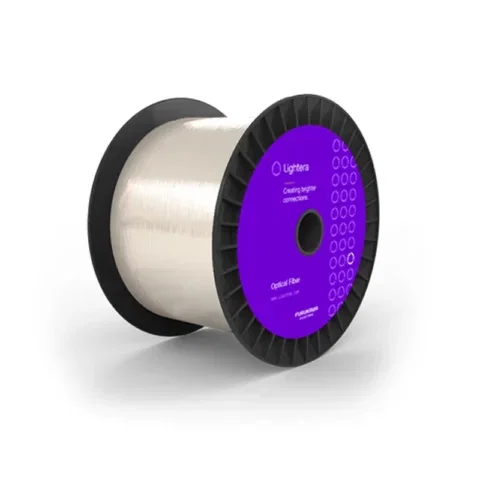
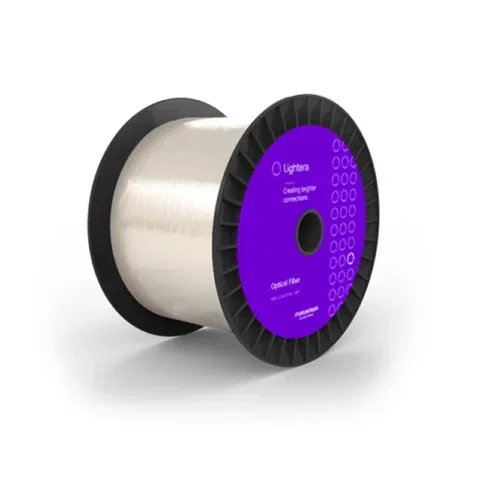
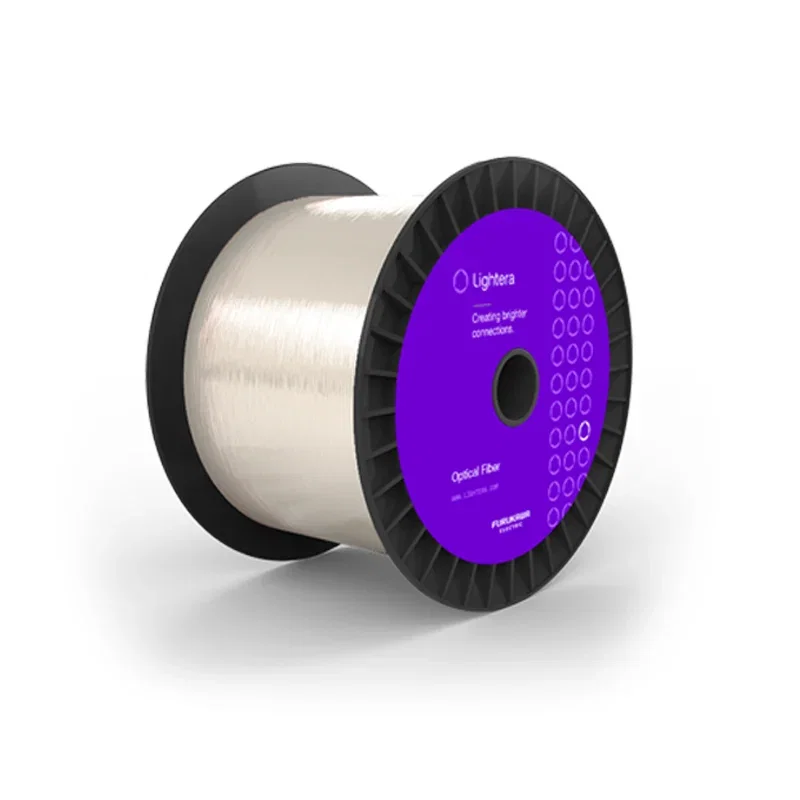
The TruePhase® 125/250 µm 1310 nm polarisation-maintaining optical fibre is an advanced single-mode fibre designed to maintain light in a fixed polarisation state. It is optimised for operation around the 1310 nm wavelength, delivering low loss and minimal dispersion in that band. Its high-birefringence construction strongly separates orthogonal polarisation modes to reduce cross-coupling. With a standard 125 µm cladding and 250 µm coated diameter, it supports integration with conventional splicing and connectorisation processes. This fibre is well suited to fibre optic gyroscopes, interferometric sensors, and other polarisation-sensitive instruments. The proof-tested design supports reliable handling and dependable long-term use in demanding precision photonic environments.
Range features
A high level overview of what this range offers
- Polarisation-maintaining design – Preserves the polarisation state of light for precise and stable signal transmission in sensitive applications.
- Optimised for 1310 nm – Low attenuation at the 1310 nm wavelength supports minimal signal loss and strong O-band performance.
- Standard 125/250 µm dimensions – Uses a 125 µm cladding and 250 µm coating for compatibility with standard splicing equipment and connectors.
- High birefringence construction – Minimises cross-coupling between orthogonal polarisation axes for consistent output and high extinction performance.
- Proof-tested fibre strength – Supports reliable handling and long-term deployment in demanding environments.
Downloads
for TruePhase® 125/250 µm 1310 nm PM Optical Fibre
TruePhase® 125/250 µm 1310 nm PM Optical Fibre – Datasheet
DownloadWhat’s in this range?
All the variants in the range and a comparison of what they offer
Specification | Value |
Fibre type | Polarisation-maintaining single-mode fibre |
Operating wavelength | 1310 nm (optimised nominal wavelength) |
Cladding diameter | 125 µm |
Coating diameter | 250 µm (acrylate coating) |
Mode field diameter @1310 nm | ~9 µm (typical) |
Numerical aperture | ~0.11 (typical) |
Attenuation @1310 nm | ≤ 0.7 dB/km (typical) |
Beat length @1310 nm | ~2–3 mm (typical) |
Proof test level | 100 kpsi (approximately 0.7 GPa) |
Operating temperature | –40 °C to +85 °C |
FAQs
for TruePhase® 125/250 µm 1310 nm PM Optical Fibre
A polarisation-maintaining optical fibre is designed to keep light aligned to a specific polarisation axis as it travels through the fibre. Unlike standard fibres, where polarisation can drift, PM fibre preserves the input state. This is important for interferometers, sensors, and communication or test systems where consistent polarisation is required for accurate and repeatable results.
It uses a high-birefringence structure that creates different refractive indices for two perpendicular polarisation axes. This strongly resists coupling from one axis into the other, helping the light remain aligned with the intended axis. When handled and connected correctly, the fibre maintains stable output polarisation relative to the input.
Yes. The fibre uses a standard 125 µm cladding and 250 µm coating, making it compatible with conventional fusion splicing equipment and common connector formats. However, the polarisation axis must be properly aligned during splicing or termination to preserve the PM performance.
Typical applications include fibre optic gyroscopes, interferometric sensing systems, polarisation-sensitive optical instrumentation, and certain quantum optics or communication setups. It is especially useful wherever a stable and predictable polarisation state is critical to system performance.
The fibre typically offers attenuation up to 0.7 dB/km at 1310 nm, which is low for many sensing and instrumentation applications. This helps preserve signal strength over short to moderate distances and reduces optical power loss in precision systems. For most lab and field deployments using practical fibre lengths, the loss is minimal.
Under normal operating conditions, moderate bending and the specified temperature range of –40 °C to +85 °C should have little effect on performance. Very tight bends, excessive mechanical stress, or operation beyond recommended limits can increase loss or introduce polarisation coupling. Following proper handling guidelines helps maintain optimal stability.