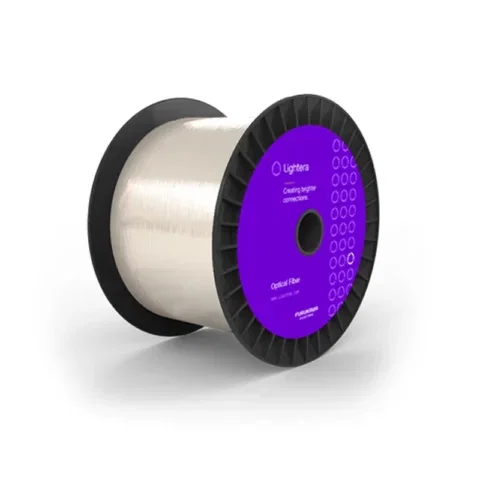
50/125 µm Multi-mode Step-Index Launch Optical Fibre
- Technology
- Speciality fibre
- Partner
- Lightera (formerly OFS)
The BF06864 is a specialised 50/125 µm multimode step-index launch optical fibre engineered for high-power laser systems and other demanding photonic applications. It features a 50 µm core diameter, 125 µm cladding and a 0.22 numerical aperture to control beam divergence. The fibre is designed to tolerate extremely high optical intensities of around 1 GW/cm² peak, making it suitable for intense pulsed or continuous high-power beams.
Its dual-layer UV acrylate coating provides durable protection while remaining easy to strip for termination or splicing. Optional carbon and polyimide coatings are available for hermetic sealing and improved high-temperature resistance in harsh environments. The fibre can also be metallised for soldering or hermetic integration into optoelectronic devices. Typical uses include diode-pumped laser systems, free-space optical links, medical imaging equipment, printing engines, Raman laser pumping, communications systems and power combiner input assemblies.
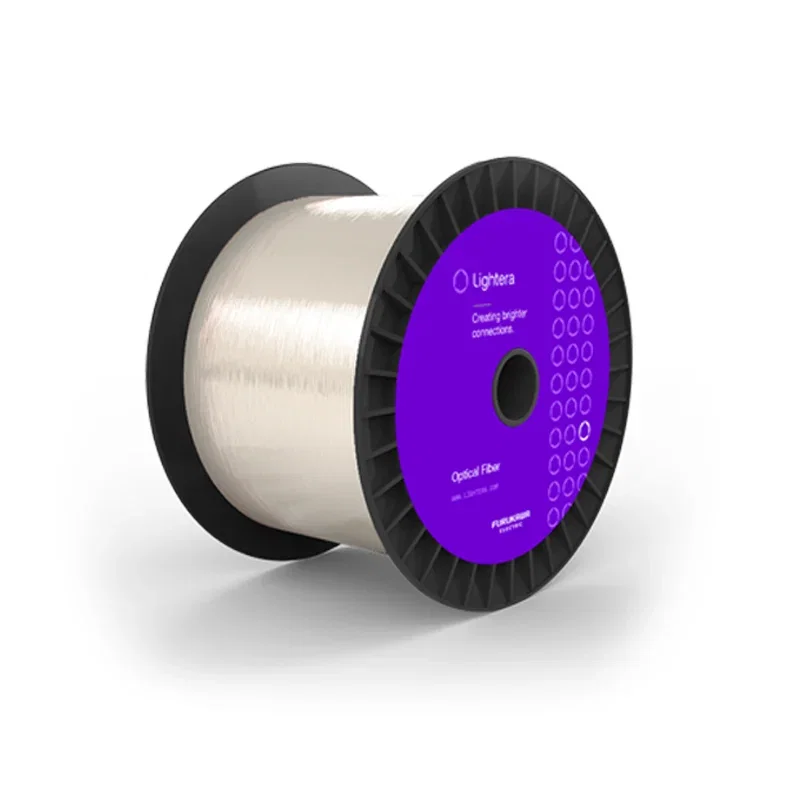
The BF06864 is a high-performance launch fibre designed for controlled light injection in demanding photonic systems. Its 50/125 µm multimode step-index structure combines reliable optical guidance with strong compatibility across standard fibre-based components.
With a low 0.22 NA, high peak power tolerance and optional advanced coating or metallisation configurations, this fibre is well suited to laser delivery, free-space coupling and rugged optoelectronic integration.
Range features
A high level overview of what this range offers
- Low numerical aperture (0.22 NA): Helps minimise beam divergence for stable coupling and efficient light transfer
- High peak power tolerance (~1 GW/cm²): Supports intense pulsed or continuous laser inputs for reliable high-power delivery
- 50/125 µm geometry: Standard multimode core and cladding dimensions support compatibility with common optical components
- Step-index multimode design: Delivers robust optical performance for short-distance power delivery and launch applications
- Dual UV acrylate coating: Provides durable protection while remaining easy to strip for termination and handling
- Optional carbon/polyimide coatings: Available for hermetic performance and higher-temperature operation in harsh environments
- Metallisation capability: Enables soldering or hermetic sealing into packages and optoelectronic assemblies
- Low-OH silica construction: Reduces near-infrared absorption and supports low attenuation at 850 nm
- Proof-tested to ≥ 100 kpsi: Offers strong mechanical reliability during installation and operation
Downloads
for 50/125 µm Multi-mode Step-Index Launch Optical Fibre
What’s in this range?
All the variants in the range and a comparison of what they offer
| Physical Characteristics | |
|---|---|
Core Diameter | 50 ± 3.0 µm |
Cladding Diameter | 125 ± 2.0 µm |
Coating Diameter | 250 ± 15 µm |
Core/Clad Offset | ≤ 3 µm |
Coating Concentricity | ≥ 80% |
Clad Non-Circularity | ≤ 2.0% |
Crimp & Cleave Compatible | No |
Coating Material | Dual UV Acrylate |
Optical Characteristics | |
Fibre Type | Multimode Step-Index |
Numerical Aperture | 0.22 |
NA Tolerance | ± 0.02 |
Attenuation at 850 nm | ≤ 5 dB/km |
Water Content | Low OH |
Mechanical & Environmental | |
Operating Temperature | –40 to +85 °C |
Short-Term Bend Radius | ≥ 10 mm |
Long-Term Bend Radius | ≥ 17 mm |
Proof Test Level | ≥ 100 kpsi (0.689 GPa) |
Orderable Part Number | BF06864 |
Options Available | Buffering; Cabling; Coating Colour; Connectorisation; Core Diameter; Metallisation |
FAQs
for 50/125 µm Multi-mode Step-Index Launch Optical Fibre
A launch optical fibre is a short length of fibre used to introduce light from a source into an optical system or test setup in a controlled way. It acts as the initial link between a laser or instrument and the rest of the optical path, helping to improve coupling consistency and system stability. Launch fibres are commonly used in high-power laser setups and optical test equipment.
In a step-index fibre, the core has a uniform refractive index, so light reflects sharply at the core-cladding boundary. In a graded-index fibre, the refractive index gradually changes from the centre outward, reducing dispersion and pulse spreading. Step-index fibres are simpler in construction and are typically preferred for short-distance or high-power applications where bandwidth is less critical.
A low NA means the fibre accepts light that is more closely aligned to its axis, resulting in a less divergent output beam. This improves coupling efficiency into other optics or free space and makes the beam easier to focus or collimate after exiting the fibre. For launch applications, the 0.22 NA helps support controlled and efficient light delivery.
This fibre is specified to withstand extremely high optical intensities of around 1 GW/cm² at the input face. That makes it suitable for demanding pulsed laser applications and very high continuous-wave power delivery when correctly coupled and handled. Proper alignment and handling remain important to maximise safe performance.
The standard configuration uses a dual-layer UV acrylate coating for mechanical protection and easy stripping. For harsher environments, optional carbon and polyimide coatings can improve hermeticity and temperature resistance. A metallised version is also available for soldering or hermetic sealing into packages and feedthroughs.
Yes. The BF06864 fibre can be supplied with a range of custom options including buffering, cabling, connectorisation, coating colour changes, core diameter variations and metallisation. These options allow the fibre to be tailored as a ready-to-use solution for specific optical system requirements.