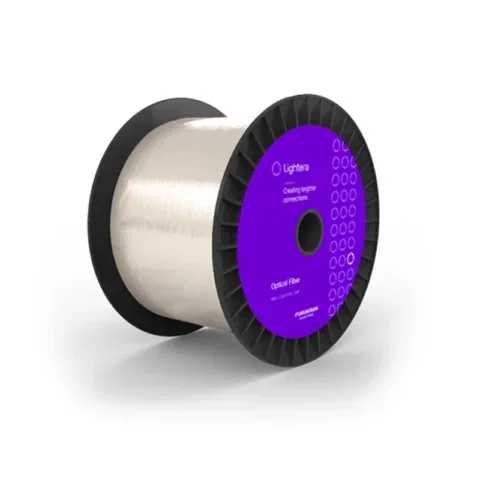
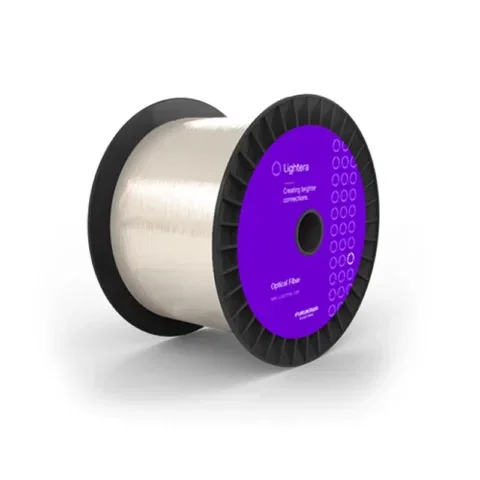
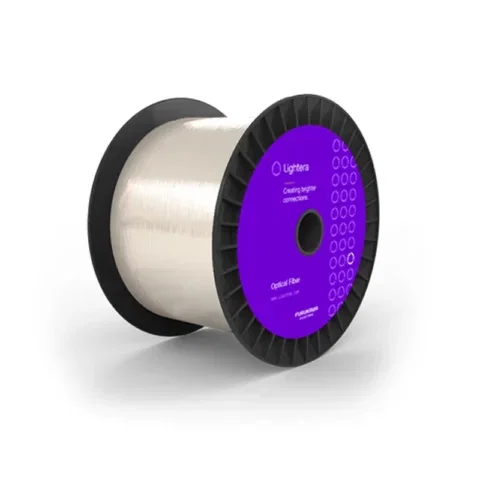
100 µm Multi-mode Step-Index PYROCOAT® Low OH Optical Fibre
- Technology
- Speciality fibre
- Partner
- Lightera (formerly OFS)
The CF04406-11 is a specialised 100 µm core multimode optical fibre designed for demanding near-infrared applications. It features a PYROCOAT® polyimide coating that supports reliable operation at temperatures up to 300 °C, far beyond standard fibre coatings. Its low-OH silica core helps minimise absorption in the near-IR range for efficient laser transmission with minimal loss. The all-silica glass construction provides a high damage threshold for high optical power handling. Biocompatible materials make it suitable for medical devices and laser-based clinical procedures. The fibre is also used in industrial laser processing, high-intensity illumination, sensing, and spectroscopy systems. With a 100 µm core and 0.22 numerical aperture, it enables easier light coupling and robust light delivery across a wide range of setups.
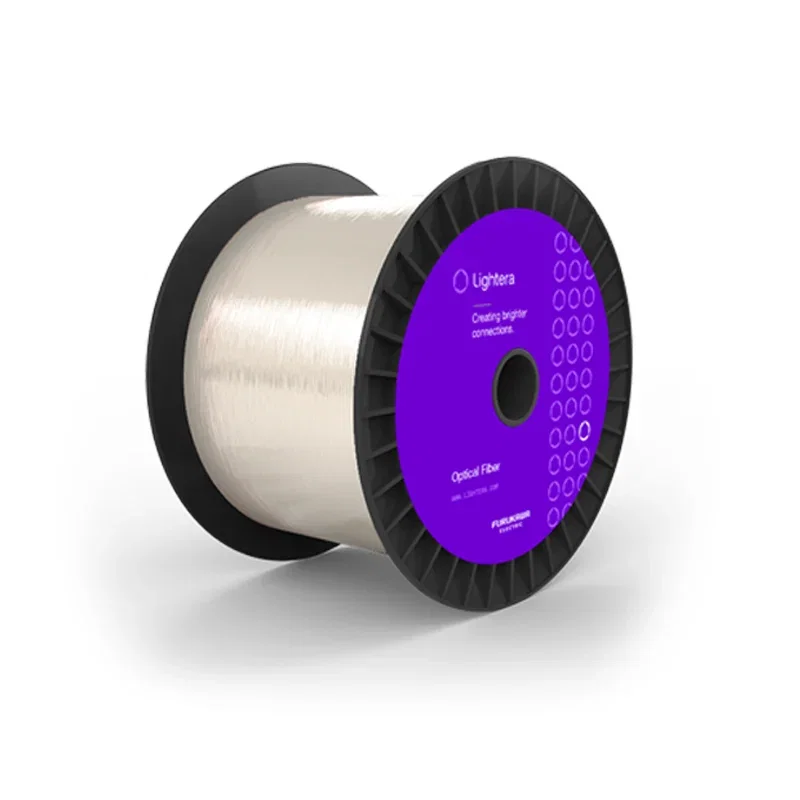
The CF04406-11 is engineered for near-infrared laser delivery in environments where conventional fibre coatings are not sufficient. Its combination of a low-OH silica core, step-index multimode design, and PYROCOAT® polyimide coating makes it a strong fit for medical, industrial, and analytical systems.
This fibre is especially useful where designers need high-temperature capability, high power handling, and reliable transmission in the near-IR range. The 100 µm core and 0.22 NA also help simplify coupling and support dependable light throughput in demanding integration scenarios.
Range features
A high level overview of what this range offers
- Low-OH silica core: Minimises absorption at near-infrared wavelengths for efficient IR transmission with low attenuation.
- PYROCOAT® polyimide coating: Supports continuous operation up to 300 °C and short-term excursions to around 400 °C.
- All-silica construction: Delivers a high damage threshold and stable performance under intense optical power.
- Biocompatible materials: Suitable for medical and biotech applications, including laser surgery systems.
- 100 µm core diameter: Enables easier alignment, improved light throughput, and more forgiving source coupling.
- 0.22 numerical aperture: Supports efficient light capture and delivery in illumination, sensing, and laser setups.
- Customisable configuration options: Available with variations in geometry, connectorisation, metallisation, numerical aperture, and proof test level.
Downloads
for 100 µm Multi-mode Step-Index PYROCOAT® Low OH Optical Fibre
What’s in this range?
All the variants in the range and a comparison of what they offer
Specification | Value |
Core Diameter | 100 ± 3 µm |
Cladding Diameter | 110 ± 3 µm |
Coating Diameter | 140 ± 5 µm |
Coating Concentricity | ≥ 80% |
Crimp & Cleave Compatible | No |
Fibre Type | Multimode Step-Index |
Numerical Aperture (NA) | 0.22 |
Attenuation @ 850 nm | ≤ 12 dB/km |
Water Content | Low OH (low hydroxyl) |
Operating Temperature | –65 °C to +300 °C |
Short-Term Temp. Excursions | Up to 400 °C (temporary) |
Short-Term Bend Radius | ≥ 9 mm |
Long-Term Bend Radius | ≥ 14 mm |
Proof Test Level | ≥ 100 kpsi (0.689 GPa) |
Order Part Number | CF04406-11 |
Product Code | TCL-MA100H |
Available Options | Cladding diameter, connectorisation, core diameter, metallisation, numerical aperture, proof test level |
Note: Polyimide-coated optical fibres can operate continuously up to around 300 °C, with short peaks to around 400 °C depending on the application and environment.
FAQs
for 100 µm Multi-mode Step-Index PYROCOAT® Low OH Optical Fibre
This fibre is used in medical, industrial, and scientific systems that require reliable high-power or high-temperature light delivery. Typical applications include laser surgery, medical laser devices, laser welding and cutting, high-intensity illumination, radiation analysis, and visible-to-near-IR spectroscopy.
Low OH means the silica contains very low hydroxyl content. This matters because hydroxyl impurities increase absorption at infrared wavelengths. By reducing OH content, the fibre achieves lower attenuation in the near-infrared range and transmits IR light more efficiently.
Yes, the fibre can transmit visible light and is suitable for applications such as visible-to-NIR spectroscopy. However, it is not ideal for deep UV below roughly 400 nm. For UV-focused applications, a high-OH or UV-optimised fibre is generally the better choice.
The fibre has a numerical aperture of 0.22. This gives it a relatively broad acceptance angle, which makes it easier to couple light from lasers, LEDs, or other sources into the fibre. In practical terms, it helps simplify alignment and improves light capture in sensing and illumination setups.
A 100 µm core offers easier alignment, higher light throughput, and lower power density than smaller-core fibres. This can improve robustness in high-power delivery applications and make the fibre more forgiving during integration where ultra-precise alignment is difficult.
The PYROCOAT® polyimide coating is designed for environments that exceed the limits of standard acrylate-coated fibres. It supports continuous operation up to 300 °C and can tolerate short-term peaks up to around 400 °C, helping maintain fibre reliability in hot industrial or medical environments.
For long-term use, the recommended minimum bend radius is 14 mm. For short-term handling or installation, the fibre can tolerate bends down to about 9 mm radius. Tighter bends than this may increase loss or risk mechanical damage.
This fibre is not compatible with crimp-and-cleave termination. It is typically terminated using an epoxy-and-polish process, where the fibre is bonded into a ferrule and the end-face is polished. Pre-terminated connector options may also be available for easier integration.
Yes. The fibre uses silica glass and a polyimide coating, both of which are suitable for many medical and biomedical uses. This makes it appropriate for medical laser delivery systems and other clinical or laboratory instruments where biocompatibility is important.
Yes. Custom options may include changes to core diameter, cladding diameter, numerical aperture, connectorisation, metallisation, and proof test level. These options help adapt the fibre to specific mechanical, optical, or packaging requirements.