LMS3826-PC+ OSFP Transceiver 8x100G 2xFR4 2km
- Technology
- Fibre optic transceivers
- Partner
- Ligent
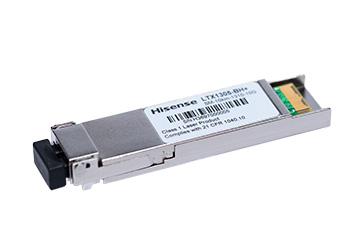
The LMS3826-PC+ 800G OSFP Optical Transceiver is a high-speed pluggable module designed for network equipment requiring very high capacity. It combines eight 100G PAM4 channels internally and multiplexes them into two 400G FR4 optical links, all within the compact OSFP form factor. This module supports up to 2 km reach over duplex single-mode fibre, making it well-suited for connections within large data centres or between nearby campus facilities. Each of the two 400G channels uses four CWDM wavelengths (1271–1331 nm) and standard duplex LC connectors, allowing easy integration with existing SMF cabling.
Network operators can deploy the LMS3826-PC+ to reduce the number of parallel links – one 800G transceiver can effectively replace multiple lower-speed modules. It is fully hot-pluggable and complies with relevant IEEE 802.3 Ethernet standards and the OSFP MSA, ensuring compatibility and smooth interoperability in modern 800G Ethernet switches and routers. Typical applications include high-bandwidth data center spine-leaf interconnects, cloud computing and HPC clusters, where this transceiver enables massive throughput and can even operate in a breakout mode to interface with dual 400G ports if required.
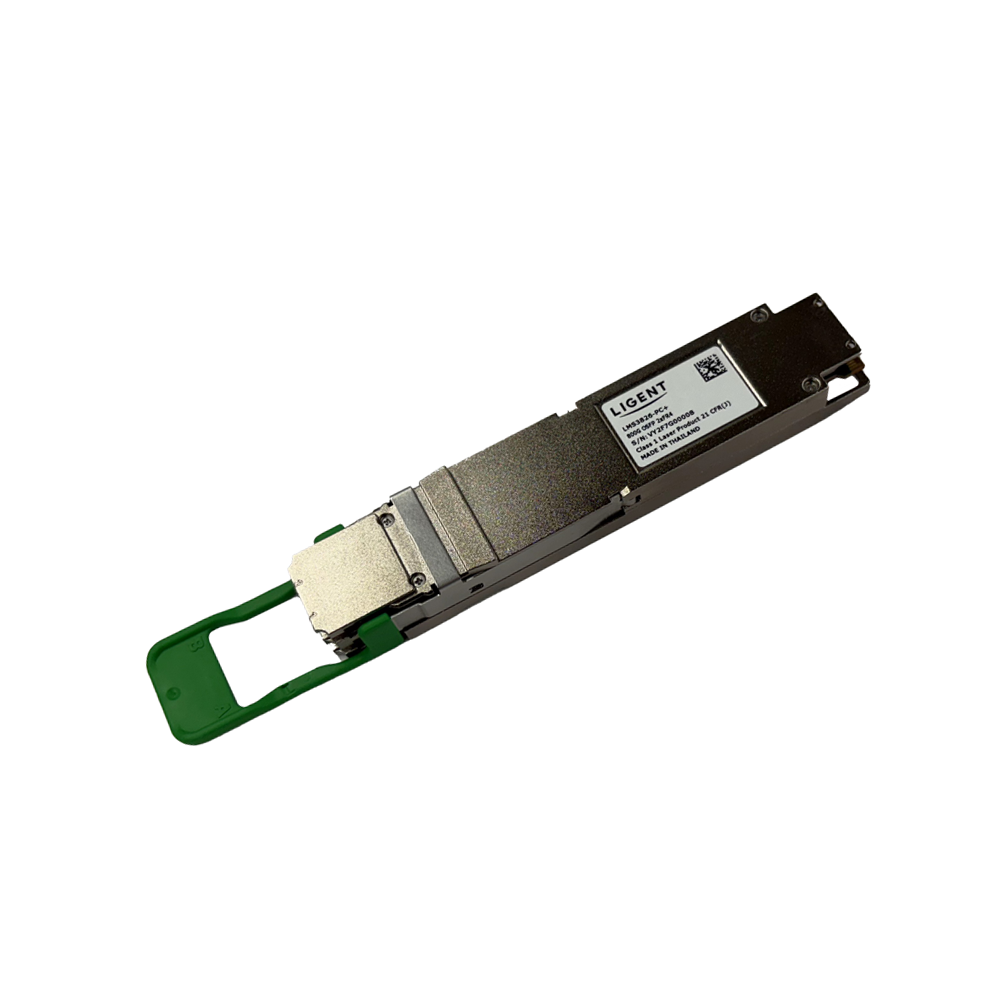
Range features
A high level overview of what this range offers
- 800 Gbps aggregated throughput – Provides the capacity of two 400G links in one module, reducing the number of ports needed for equivalent bandwidth.
- Dual 400G FR4 links (2 km) – Supports two independent 400 GbE (FR4) optical channels over single-mode fibre up to 2 km, suitable for data centre and campus connectivity at 400G per link.
- OSFP hot-pluggable form factor – Uses the high-density OSFP interface for 800G, allowing easy installation or replacement without downtime in compatible switch/router ports.
- Eight-lane PAM4 architecture – Utilises eight 106.25 Gbps electrical lanes with PAM4 modulation to achieve the 800G aggregate rate (100G per wavelength), leveraging advanced modulation for efficient high-data-rate transmission.
- Standard duplex LC connectivity – Equipped with two duplex LC ports for each 400G link, ensuring compatibility with standard SMF cabling and enabling straightforward breakout into separate 400G connections if required.
- Standards-compliant design – Fully compliant with the OSFP MSA and relevant IEEE 802.3 Ethernet specifications (for 400G/800G), which ensures interoperability with other 800G-capable devices and proper support for forward error correction.
- Power and thermal optimisations – Draws approximately 16 W (maximum) in operation, a manageable power consumption for an 800G module. The integrated heat-sink design and efficient electronics help maintain thermal performance in high-density deployments.
- Digital diagnostics monitoring – Supports real-time monitoring (DOM/DDM) via the I²C-based management interface (CMIS), allowing network engineers to read module parameters (temperature, optical power, voltage, etc.) and proactively manage link health.
What’s in this range?
All the variants in the range and a comparison of what they offer
| Specification | Value |
|---|---|
Form factor | OSFP (Octal Small Form Factor Pluggable, hot-pluggable) |
Aggregate data rate | 800 Gbps (8 × 100G PAM4 lanes) |
Optical channels | 2 × 400G (FR4 CWDM, 4 wavelengths per 400G link) |
Wavelengths | 1271 nm, 1291 nm, 1311 nm, 1331 nm (CWDM spectrum) |
Reach | Up to 2 km over SMF (single-mode fibre) with FEC |
Connector | Dual duplex LC (2 × LC UPC ports) |
Media | Duplex single-mode fibre (SMF) |
Transmitter type | EML lasers (CWDM, uncooled) |
Receiver type | PIN photodiodes |
TX power per lane | -3.2 to +4.4 dBm |
Receiver sensitivity | < -4.6 dBm (with FEC) |
Modulation format | PAM4 (Pulse Amplitude Modulation, 4-level) |
Power consumption | < 16 W (maximum) |
Power supply | +3.3 V DC |
Digital diagnostics | Yes (DOM/DDM via I²C, CMIS management) |
Operating temperature | 0 °C to +70 °C (standard commercial range) |
Compliance standards | OSFP MSA, IEEE 802.3 (400G-FR4/800G Ethernet), 100G Lambda MSA, CMIS 5.2, RoHS |
FAQs
for LMS3826-PC+ OSFP Transceiver 8x100G 2xFR4 2km
It accomplishes 800G by using eight 100 Gbps data lanes internally, each running PAM4 modulation. These lanes are optically grouped into two sets of four wavelengths (FR4), resulting in two 400G optical signals. Essentially, the module is like two 400G transceivers in one, aggregated through the OSFP interface to deliver a total of 800 Gbps. The host system interfaces with the module’s eight high-speed electrical lanes, and the transceiver handles multiplexing/demultiplexing to the two 400G optical links.
“2×400G FR4” indicates that the transceiver provides two separate 400 Gbps optical channels, each following the FR4 standard (4×100G CWDM wavelengths). In practice, this means the module can send and receive data over two duplex fiber links (one fiber pair per 400G channel). Each 400G link uses four wavelengths in the 1310 nm range (1271, 1291, 1311, 1331 nm), multiplexed onto a single fiber pair. This configuration allows an 800G OSFP port to potentially be split into two 400G connections if the network design or equipment requires, enabling flexible compatibility with existing 400G infrastructure.
Yes. The module is designed to comply with IEEE 802.3 Ethernet specifications for 400G and 800G, meaning it can interoperate with other standards-based equipment for 400 Gigabit and 800 Gigabit Ethernet. It also adheres to the OSFP MSA, ensuring it will function in any networking gear with OSFP slots. While primary use is for Ethernet, the high data rate and PAM4 modulation are similar to those used in high-performance computing interconnects (for example, InfiniBand HDR/NDR). As long as the host device supports the OSFP form factor and the appropriate forward error correction scheme, this transceiver can be used for those protocols as well (for instance, linking InfiniBand nodes at equivalent 8×100G speeds).
The LMS3826-PC+ uses duplex single-mode fibre (SMF) for each 400G channel, and it provides two duplex LC connector interfaces on the front. In other words, you will use two standard LC-terminated SMF patch cables with this transceiver (one for each 400G link). This is convenient because LC connectors and single-mode fibre are widely used for 100G/400G links. The use of dual LC ports means you do not need any special breakout cable; standard duplex fibre cables can directly connect this module to corresponding ports (for example, to two 400G FR4 QSFP-DD modules, or to another 800G OSFP module configured as 2×400G).
Yes, forward error correction (FEC) is required when using this transceiver. At 100 Gbps per lane with PAM4 modulation, the raw error rate of the optical link is higher than traditional NRZ-based links, so FEC is needed to ensure reliable communication. The LMS3826-PC+ is designed to work with the standard RS-FEC (Reed-Solomon FEC) that is typically built into 400G/800G Ethernet ports (as defined by IEEE 802.3ck). The host switch or router will handle the FEC encoding/decoding. From a user perspective, this is usually seamless – but it’s important to know that the host equipment must enable the appropriate FEC setting for the link to operate error-free. The module itself provides digital diagnostic info, but relies on the host for FEC processing as per the standard.
An 800G module like the LMS3826-PC+ consumes up to about 16 W of power, which is significantly higher than older lower-speed modules (for example, a 100G QSFP28 might be ~3.5 W, and a 400G QSFP-DD around 12 W). This means you should ensure your host device (switch, router, etc.) can supply sufficient power and has adequate cooling for OSFP modules. Most modern high-end switches with OSFP slots are designed with this in mind – they have robust airflow and heat sinks in each module slot. The LMS3826-PC+ itself includes a built-in heat spreader/heat-sink on top to dissipate heat. It’s still advisable to maintain clean airflow in the chassis and avoid blocking ventilation. When operating, the module will report its temperature via digital diagnostics, so you can monitor if it’s within the safe range (0 to 70 °C). In summary, ensure your chassis can handle ~16 W per port and has proper cooling so the transceivers run reliably.
Yes. One of the advantages of the 2×400G FR4 design is the ability to use the 800G module in a breakout configuration. If your switch or network device supports splitting an 800G port, the LMS3826-PC+ can be configured (via software) as two 400G ports internally. You would then use two duplex SMF cables from the module’s dual LC connectors to two 400G ports on other devices. For example, you might connect an 800G OSFP port in a core switch to two 400G QSFP-DD ports in edge devices. This flexibility is great during network upgrades – it allows an 800G-capable switch to interface with existing 400G equipment. Keep in mind that you’ll need the appropriate fiber cabling and the host must support treating the OSFP as dual 400G, but many 800G switches do offer that capability. In standard (non-breakout) mode, the two 400G links of the module could also connect to another 800G module at the remote end (each module still using two fibres) to form an 800G point-to-point link.
800G optical transceivers are at the cutting edge of networking and are typically deployed in environments that demand extremely high bandwidth per port. This includes large cloud data centers and web-scale providers connecting their spine and leaf switches with minimal cabling. By using 800G modules, data centers can double the capacity of each port (relative to 400G) without increasing the number of fibre runs, which simplifies networking at scale. They are also used in high-performance computing (HPC) clusters and AI/ML supercomputer interconnects, where massive data flows occur between nodes – an 800G link can carry those flows with lower latency and fewer parallel connections. Telecom service providers and enterprises planning for future-proofing their core networks may also experiment with 800G for short-reach metro connections (up to 2 km) between routing hubs. In summary, the LMS3826-PC+ is targeted at scenarios where density and throughput are critical – enabling operators to send 800 billion bits per second through a single module for the most data-intensive applications.