CT-1250CSP-MB1R-A Copper RJ-45 100 m SFP Transceiver w. LOS/Auto Neg
- Technology
- Fibre optic transceivers
- Partner
- Coretek
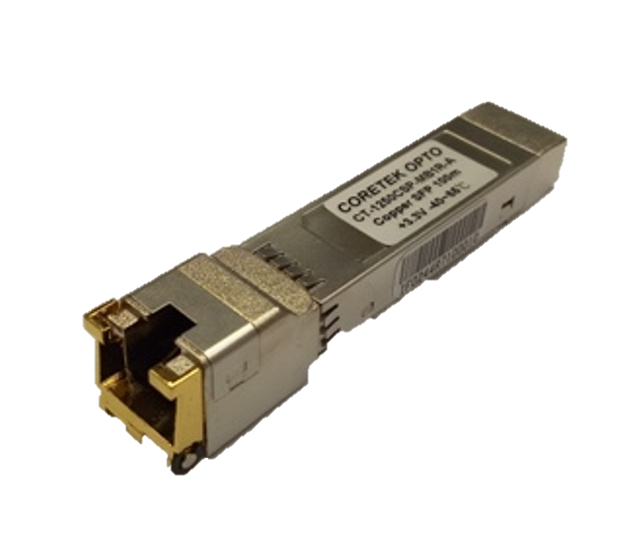
The CT-1250CSP-MB1R-A is a Small Form-factor Pluggable (SFP) transceiver module that provides a standard RJ-45 Gigabit Ethernet interface over copper cabling. It’s designed for network equipment with SFP slots, enabling direct 10/100/1000Base-T connections up to 100 m without needing separate media converters. This module supports auto-negotiation, so it can adapt to 10 Mbps, 100 Mbps, or 1 Gbps link speeds automatically, ensuring compatibility with a range of network devices and legacy infrastructure.
An integrated LOS (Loss of Signal) feature informs the host system when the Ethernet link is down, helping network engineers quickly diagnose link issues. Built to meet Gigabit Ethernet IEEE 802.3 standards and the SFP MSA (Multi-Source Agreement), the CT-1250CSP-MB1R-A offers plug-and-play interoperability with a wide variety of switches and routers. Its industrial operating temperature range of -40 °C to 85 °C makes it suitable for deployment in harsh environments, such as outdoor telecom cabinets, factory floors, or other temperature-critical installations.
Range features
A high level overview of what this range offers
- 1000BASE-T RJ-45 interface – Enables direct copper Ethernet links up to 100 m on Cat5e/Cat6 cables for flexible network connectivity.
- Auto-negotiation (10/100/1000 Mbps) – Automatically adjusts to the highest supported speed, ensuring compatibility with legacy 10 Mbps and 100 Mbps devices and optimal link performance.
- LOS (Loss of Signal) indication – Provides a signal to the host when the network link is lost, aiding in quick troubleshooting and improving network reliability.
- Hot-pluggable SFP form factor – Allows insertion and removal without needing to power down equipment, simplifying upgrades and maintenance.
- Industrial temperature range (-40 °C to +85 °C) – Designed for reliable operation in extreme environments and outdoor installations.
- Single +3.3 V power supply – Operates using standard SFP slot power, easing integration with any compatible networking equipment.
- IEEE 802.3 compliance – Fully compliant with Gigabit Ethernet standards (IEEE 802.3ab for 1000Base-T and backwards-compatible with 802.3u/802.3i), ensuring interoperability with standard network gear.
- Compact all-in-one design – Integrates the RJ-45 connector and transceiver electronics in one module, eliminating the need for external converters and reducing cabling complexity.
Downloads
for CT-1250CSP-MB1R-A Copper RJ-45 100 m SFP Transceiver w. LOS/Auto Neg
What’s in this range?
All the variants in the range and a comparison of what they offer
| Specification | CT-1250CSP-MB1R-A (RJ45 Copper SFP) |
|---|---|
Ethernet Interface | RJ-45, 10/100/1000Base-T (auto-negotiation) |
Max Data Rate | 1.25 Gbps (Gigabit Ethernet line rate) |
Max Cable Distance | 100 m (328 ft) over Cat5e/Cat6 UTP cable |
Compatibility | SFP MSA compliant (works in standard SFP slots) |
LOS Function | Yes (Loss of Signal indication to host) |
DDM/DOM | Not supported (no digital diagnostics) |
Supply Voltage | +3.3 V DC (typical) |
Power Consumption | < 1 W (typical max. power draw) |
Operating Temperature | -40 °C to +85 °C (industrial range) |
Storage Temperature | -40 °C to +85 °C |
Form Factor | SFP (Small Form-factor Pluggable) module, metal housing |
Hot Plug Support | Yes, hot-swappable |
Standards | IEEE 802.3i (10BASE-T), 802.3u (100BASE-TX), 802.3ab (1000BASE-T) |
Compliance | RoHS compliant (lead-free) |
FAQs
for CT-1250CSP-MB1R-A Copper RJ-45 100 m SFP Transceiver w. LOS/Auto Neg
Yes, this module supports 10 Mbps, 100 Mbps, and 1000 Mbps link speeds. It uses auto-negotiation to detect and match the speed of the connected device. That means you can plug it into a network with older Fast Ethernet (100 Mb) or even 10 Mb equipment, and it will step down accordingly to establish a link. Of course, for the full 1.25 Gbps throughput, both ends need to support Gigabit, but it’s fully backwards-compatible with lower speeds for maximum flexibility.
The CT-1250CSP-MB1R-A is designed for standard copper Ethernet cabling. It works with Category 5e or Category 6 twisted-pair cables (or better). The maximum reach is 100 metres (about 328 feet), which is the standard limit for 1000BASE-T Gigabit Ethernet. In practice, any good-quality Cat5e/Cat6 cable up to 100 m will allow the module to communicate at full Gigabit speed. There’s no need for special cabling beyond what is normally used for LAN connections.
Yes, this model does support LOS (Loss of Signal). In a copper SFP module, the LOS function typically means the module can indicate to the host device when there is no valid Ethernet link on the RJ-45 port. In practical terms, if the cable is unplugged or the far-end device is down, the module will toggle the LOS status (often via the SFP’s output pin towards the host). This helps network equipment detect link loss quickly and can be used for triggering alarms or redundant switching. It’s a useful feature for network reliability, especially in critical applications.
Yes, the module is fully hot-pluggable. You can insert or remove it from an SFP slot while the switch or router is powered on (of course, ensure no network traffic is actively using that port to avoid interruptions). There is no special setup required – it’s a plug-and-play device. The host equipment will typically recognize it as a 1000BASE-T interface automatically. Just make sure to insert it firmly and lock the module’s bail latch for a secure connection. No additional drivers or configuration steps are needed on standard networking hardware.
The CT-1250CSP-MB1R-A is designed to be compliant with the SFP multi-source agreement (MSA), which means electrically and physically it adheres to the standard that most vendors support. In general, it should work in any standard SFP slot for Gigabit Ethernet. However, some network equipment manufacturers implement vendor lock or require vendor-specific coding on SFP modules. This transceiver is not tied to a specific brand, so as long as your switch does not enforce proprietary restrictions, it will function normally. It’s always a good idea to verify whether your switch/router allows third-party SFPs. In most open systems and industrial devices, it will be recognized with no issues.
This particular model is rated for an industrial temperature range of -40 °C to +85 °C. That means it can handle harsh conditions – from below-freezing outdoor climates to high-heat environments – without performance degradation. It’s suitable for industrial networking, roadside cabinets, or factory settings where commercial temperature range modules might fail. In terms of reliability, the module is solid-state with no moving parts, and it follows industry standards for Ethernet transceivers. It is also typically certified to meet electromagnetic interference and safety standards (like CE and FCC), and being RoHS compliant means it’s manufactured with lead-free processes. The expected lifetime (MTBF) is usually very high (many hundreds of thousands of hours) for SFP modules.
No, the module itself does not source or sink PoE power. It’s a transceiver intended to pass data signals only. Standard SFP ports on network switches are data-only interfaces and are not designed to provide PoE to connected devices. If you require PoE on an RJ-45 connection, that needs to be provided by the network switch’s port or a PoE injector/midspan, not by the SFP module. The CT-1250CSP-MB1R-A will happily pass data on a link that has PoE, but it will neither generate PoE nor be powered by PoE from the cable. Always ensure your network design accounts for PoE at the switch or injector if needed, rather than through the SFP transceiver.
All variants in this series are copper RJ-45 SFP transceivers for Gigabit Ethernet, but they have slight functional differences. The CT-1250CSP-MB1R-A is the fully featured version that supports both auto-negotiation and provides an LOS signal. In comparison, the variant ending in MK1R-A does support auto-negotiation but does not have the LOS indication feature. On the other hand, the SB1R-A variant has the LOS function but does not support auto-negotiation (meaning it likely operates at a fixed 1000 Mbps). So, the MB1R-A model offers the best of both features (LOS + auto-neg), making it the most versatile for general use. Choosing between them depends on whether your application requires the LOS feedback or the ability to link at 100 Mb/10 Mb speeds. The CT-1250CSP-MB1R-A covers both needs in one unit.