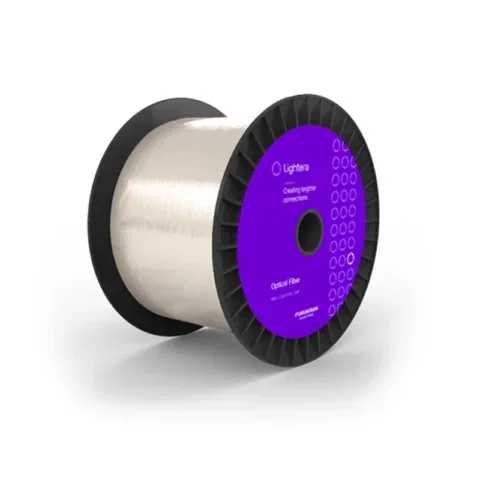
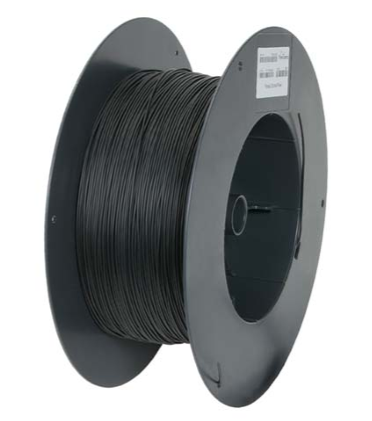
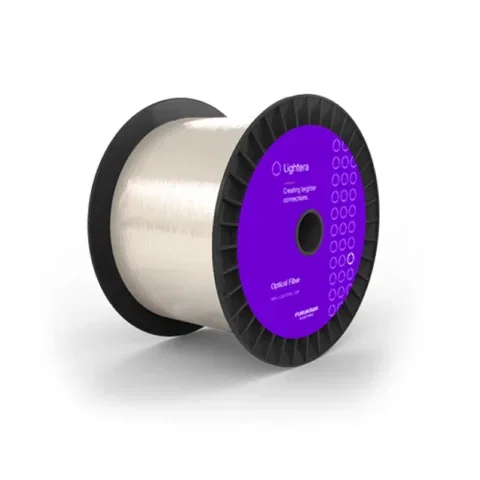
HCS® All Silica 200 µm 0.22 NA Step-Index Low OH Optical Fibre
- Technology
- Speciality fibre
- Partner
- Lightera (formerly OFS)
This HCS® All Silica 200 µm Low OH Step-Index Optical Fibre is a large-core multimode fibre designed for challenging industrial and medical uses. It features an all-silica core and cladding with a special hard polymer coating (HCS®) and an ETFE buffer, combining high optical performance with rugged durability. With a 0.22 numerical aperture and step-index profile, it efficiently transmits light in the near-infrared range, making it ideal for high-power lasers, spectroscopy systems and optical sensors. The fibre’s low OH formulation minimises absorption losses at IR wavelengths, while its biocompatible materials make it suitable for medical devices such as surgical lasers.
Built for harsh environments, it operates reliably from –65 °C to 125 °C and withstands mechanical stresses like tight bending and vibration. Typical application areas include aerospace cabling and engine controls, industrial laser welding and cutting machines, near-IR analytical instruments, radiation monitoring equipment, and other demanding fibre-optic installations where standard telecom fibres might not survive.
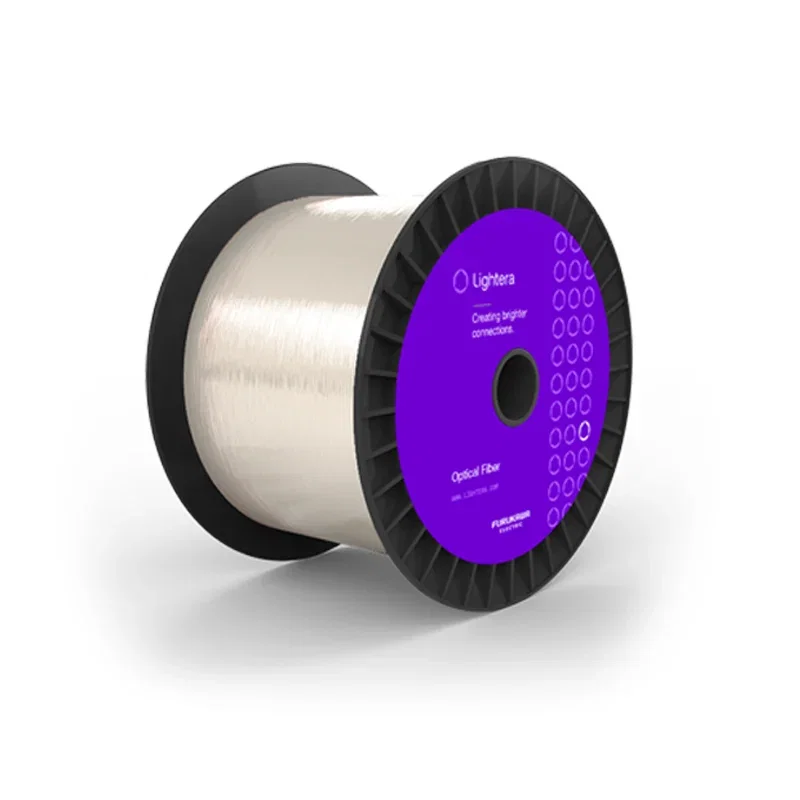
Designed for rugged light delivery, this fibre combines a 200 µm silica core, 0.22 NA, and low OH transmission performance in a durable HCS® construction. It is particularly well suited to demanding near-infrared applications where high power handling, mechanical resilience, and reliable operation across harsh temperature and chemical environments are required.
Typical use cases include industrial laser systems, spectroscopy, optical sensing, aerospace equipment, radiation monitoring, and medical laser delivery assemblies.
Range features
A high level overview of what this range offers
- Large 200 µm core – Supports high optical power throughput and easier coupling to light sources.
- Low OH silica design – Reduces absorption losses at near-infrared wavelengths.
- All-silica optical structure – Delivers strong optical stability and high damage resistance under intense light.
- Hard polymer cladding (HCS®) – Improves toughness, handling strength, and durability.
- ETFE buffer jacket – Provides resistance to heat, chemicals, and abrasion in harsh environments.
- 0.22 numerical aperture – Offers broad light acceptance for simpler coupling from LEDs and laser diodes.
- Biocompatible materials – Suitable for medical and surgical laser system integration.
- Proof-tested to 200 kpsi – Supports reliable long-term mechanical performance under strain.
Downloads
for HCS® All Silica 200 µm 0.22 NA Step-Index Low OH Optical Fibre
What’s in this range?
All the variants in the range and a comparison of what they offer
Specification | Value |
Product Description | 200 µm All Silica Low OH Step-Index |
Core Diameter | 200 ± 5 µm |
Cladding Diameter | 240 ± 5 µm |
Coating Diameter | 260 ± 5 µm |
Buffer Diameter | 375 ± 30 µm |
Core/Clad Offset | ≤ 7 µm |
Crimp & Cleave Compatible | No |
Cladding Material | HCS (Hard polymer) |
Buffer Material | ETFE |
Standard Buffer Colour | Natural (clear) |
Fibre Type | Multimode Step-Index |
Numerical Aperture (NA) | 0.22 |
Attenuation @ 850 nm | ≤ 8 dB/km |
Water Content | Low OH (low hydroxyl) |
Operating Temperature | –65 °C to +125 °C |
Short-Term Bend Radius | ≥ 9 mm |
Long-Term Bend Radius | ≥ 14 mm |
Proof Test Level | ≥ 200 kpsi (1.38 GPa) |
FAQs
for HCS® All Silica 200 µm 0.22 NA Step-Index Low OH Optical Fibre
A larger core diameter allows the fibre to capture and carry more light, making it ideal for high-power laser delivery and easier coupling to LEDs, laser diodes, or lamp sources. It is less sensitive to alignment than smaller telecom fibres and better suited to industrial and laboratory setups focused on power delivery rather than high-speed long-distance data transmission.
Low OH means the silica contains very little hydroxyl content. This reduces absorption losses in the near-infrared range, helping the fibre transmit IR wavelengths more efficiently. It is especially beneficial for applications such as IR lasers, spectroscopy, and sensing systems operating around the 800–1300 nm region.
Yes. The large 200 µm core, all-silica structure, and HCS® design help the fibre manage high optical power densities effectively. These characteristics make it suitable for industrial laser delivery and medical laser systems, provided correct handling practices are followed, such as maintaining clean terminations and avoiding excessive bending under full power.
This fibre is rated for operation from –65 °C to +125 °C. Its ETFE buffer provides good resistance to chemicals, oils, abrasion, and heat, making it a strong choice for harsh industrial, aerospace, and machinery environments where conventional fibres may be too fragile.
Yes. Its biocompatible material system and efficient near-infrared transmission make it well suited to medical laser delivery, surgical probes, and biomedical devices. It is particularly appropriate where reliable transmission of common medical laser wavelengths and robust physical handling are required.
This fibre typically requires connector systems designed for 200/240 µm dimensions rather than standard telecom hardware. Common options include SMA or ST-style industrial connectors. Termination usually involves stripping the buffer and then cleaving or polishing the fibre, often using epoxy-and-polish ferrule methods for a low-loss finish.
The recommended short-term bend radius is ≥ 9 mm, while the long-term bend radius is ≥ 14 mm. Staying within these limits helps preserve optical performance and long-term reliability. Although the construction is more bend-tolerant than many standard fibres, sharp bends and kinks should still be avoided.
An HCS (Hard-Clad Silica) fibre uses a silica core with a hard polymer cladding rather than a conventional glass cladding. This results in a larger, tougher, and more flexible fibre that is better suited to rugged environments, laser delivery, sensing, and short-distance signal transmission. Compared with standard telecom fibres, it prioritises durability and optical power handling over high-bandwidth communication performance.