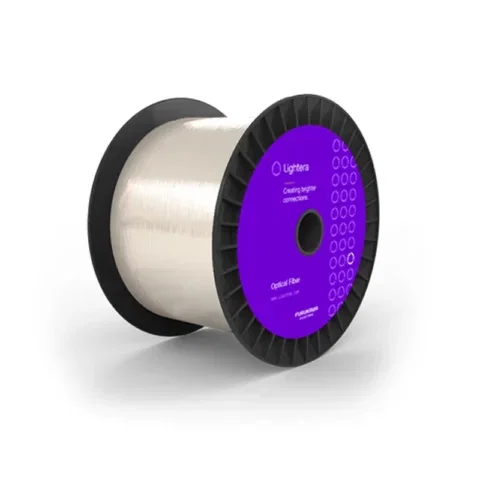
50/125 µm Multi-mode Graded-Index OM2 Optical Fibre
- Technology
- Speciality fibre
- Partner
- Lightera (formerly OFS)
This 50/125 µm OM2 multi-mode graded-index optical fibre is engineered for use in modern enterprise and industrial networks that require dependable high-speed links over moderate distances. OM2 denotes that the fibre meets recognised standards for multimode performance, providing a balance of bandwidth and range suitable for typical LAN and data centre needs. With its graded-index core design, the fibre minimises modal dispersion, meaning signals arrive with better timing and less spread out, which supports clearer data transmission compared to basic step-index fibres.
Network engineers choose this fibre for building backbones, campus network interconnections, and other short-haul links where Gigabit Ethernet and even limited-distance 10 Gigabit Ethernet are deployed. The standard 50 µm core and 125 µm cladding dimensions ensure it works seamlessly with common connectors such as SC, ST, and LC plus widely available transceivers. In practice, this OM2 fibre can be paired with cost-effective VCSEL laser or LED light sources, typically at 850 nm and 1300 nm, providing a cost-efficient yet robust solution for high-throughput data networks. Overall, it is a trusted optical fibre type for reliable, high-capacity communication in local networks, offering easy integration and proven performance under widely accepted standards.
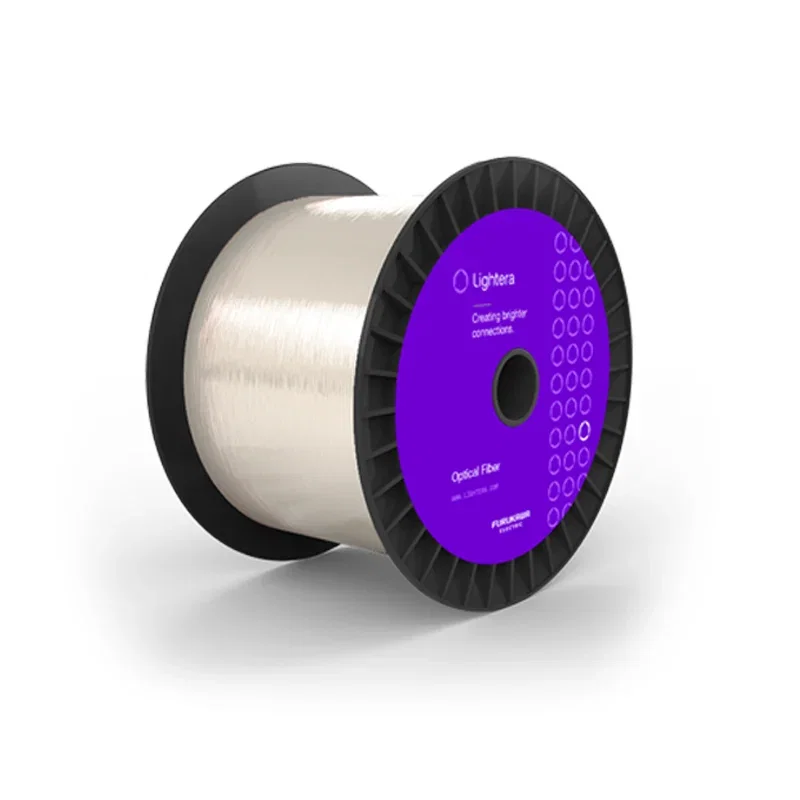
Designed for dependable short- to medium-range optical links, this 50/125 µm OM2 multi-mode optical fibre supports enterprise, campus, and industrial network installations where stable bandwidth and interoperability matter. Its graded-index construction helps reduce modal dispersion, while the standard OM2 format ensures compatibility with common multimode connectivity ecosystems, including widely used connectors and transceiver technologies.
Range features
A high level overview of what this range offers
- OM2 graded-index design – Delivers high modal bandwidth of approximately 500 MHz·km for reliable Gigabit Ethernet performance over typical building and campus link lengths.
- Low optical attenuation – Minimises signal loss at 850 nm and 1300 nm, helping maintain signal quality across local network environments.
- Standard 50/125 µm geometry – Supports compatibility with common fibre connectors and transceivers, simplifying splicing, termination, and integration.
- Graded-index core profile – Reduces modal dispersion by balancing light path speeds for clearer transmission than basic step-index multimode fibre.
- OM2 standard compliance – Ensures interoperability and predictable performance across OM2-based network infrastructure.
- Proof-tested durability – Built to withstand installation and handling stresses for dependable long-term cabling performance.
What’s in this range?
All the variants in the range and a comparison of what they offer
Specification | Value |
Fibre type (category) | OM2 50/125 µm graded-index multi-mode |
Core diameter | 50 µm |
Cladding diameter | 125 µm |
Coating diameter | ~245 µm (acrylate buffer coating) |
Numerical aperture | 0.20 (typical) |
Attenuation @ 850 nm | ≤ 3.0 dB/km (maximum) |
Attenuation @ 1300 nm | ≤ 1.0 dB/km (maximum) |
Bandwidth (OFL @ 850 nm) | ≥ 500 MHz·km |
Bandwidth (OFL @ 1300 nm) | ≥ 500 MHz·km |
Operating wavelengths | 850 nm and 1300 nm |
Proof test level | ≥ 0.7 GPa tensile stress (≈100 kpsi) |
FAQs
for 50/125 µm Multi-mode Graded-Index OM2 Optical Fibre
OM2 is an industry designation for 50/125 µm multimode fibre that indicates a defined minimum performance level. It typically supports high data rates such as Gigabit Ethernet and offers modal bandwidth of around 500 MHz·km at 850 nm. In practical terms, OM2 is suitable for intermediate-length links in local networks and provides better performance than OM1, while offering less bandwidth than newer OM3 or OM4 fibre types.
For Gigabit Ethernet, OM2 multimode fibre can typically support links up to around 550 metres. For 10 Gigabit Ethernet, the effective range is much shorter, usually around 80 to 100 metres depending on the transceivers, installation quality, and applicable networking standards. For longer distances or higher bandwidth requirements, OM3, OM4, or single-mode fibre is generally preferred.
Step-index multimode fibre has a uniform core refractive index with an abrupt change at the cladding, which causes stronger modal dispersion. Graded-index multimode fibre gradually changes the refractive index from the centre outward, helping different light modes arrive closer together in time. This reduces dispersion and allows higher bandwidth and longer transmission distances than step-index multimode designs.
They are mechanically compatible because the connector formats are similar, but mixing OM2 50 µm fibre with OM1 62.5 µm fibre can introduce insertion loss and reduced link performance. While direct connection is physically possible, it is generally not recommended for demanding or high-speed links unless the design specifically accounts for the mismatch.
OM2 is typically used for short to medium link lengths in buildings, campuses, and data environments where cost-effective multimode optics are desirable. It is a practical choice for Ethernet links up to 1 Gb/s and limited-distance 10 Gb/s deployments. Single-mode fibre is usually selected for much longer distances or very high-capacity links where multimode reach becomes insufficient.
OM3 and OM4 are enhanced 50/125 µm multimode fibres with significantly higher bandwidth than OM2. That allows them to support 10 Gb/s, 40 Gb/s, and 100 Gb/s links over longer distances with suitable optics. OM2 remains a reliable and economical option for less demanding short-range applications, while OM3 and OM4 are better suited to more performance-intensive infrastructure.