FR00AxAR 650 nm Analogue DC-125 MHz RedLink® POF Receiver
- Technology
- Fibre optic transceivers
- Partner
- Firecomms
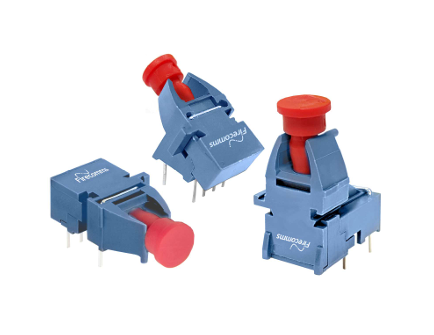
FR00AxAR is an analogue fibre-optic receiver module designed for 1 mm plastic optical fibre applications. It incorporates a silicon photodiode that generates a current proportional to the incoming 650 nm red light, which can be fed into an external transimpedance amplifier for conversion to a useable voltage signal. With a broad frequency response from DC up to 125 MHz, this receiver supports data rates approaching 250 Mbps when used in high-speed communication links. The device is housed in a robust blue RedLink® package that is fully compatible with standard Versatile Link connectors and cables, simplifying integration into existing POF systems.
It is built to operate over an industrial temperature range of –40 °C to +85 °C, ensuring dependable performance in harsh or extreme environments. Typical use cases include isolated command and control signals, industrial sensor interfaces, and other communication links in settings with high electromagnetic interference (EMI), where the inherent electrical isolation of fibre is advantageous.
Range features
A high level overview of what this range offers
- High-reliability silicon photodiode – Provides consistent optical-to-electrical conversion for 650 nm POF signals
- Integrated 1 mm POF lens – Ensures efficient light coupling from standard plastic optical fibre
- Wide bandwidth (DC to 125 MHz) – Supports data rates up to ~250 Mbps for high-speed data links
- Industrial temperature range (–40 °C to +85 °C) – Maintains performance in extreme temperatures and harsh environments
- Standard RedLink form factor – Fully compatible with Versatile Link fibre connectors for easy system integration
- Multiple mounting orientations – Available in horizontal, vertical, or 30° angled versions to fit various PCB layouts
- UL 94 V-0 flame-retardant housing – Meets stringent flammability standards for safety in industrial installations
- RoHS-compliant design – Free of hazardous substances, meeting global environmental regulations
Downloads
for FR00AxAR 650 nm Analogue DC-125 MHz RedLink® POF Receiver
What’s in this range?
All the variants in the range and a comparison of what they offer
| Parameter | Value |
|---|---|
Operating wavelength (peak) | 650 nm (red light) |
Analogue bandwidth (–3 dB) | DC to 125 MHz |
Maximum data rate | ~250 Mbps (with suitable external TIA) |
Photodiode type | Silicon PIN photodiode (analogue output) |
Fibre core size supported | 1 mm plastic optical fibre (POF) |
Connector compatibility | RedLink® (Versatile Link style plug) |
Package orientations | Horizontal, Vertical, 30° tilt (FR00AHAR/AVAR/ATAR) |
Operating temperature range | –40 °C to +85 °C |
Reverse voltage (max) | 25 V |
Power dissipation (max) | 100 mW |
Compliance | RoHS (Lead-free), UL 94 V-0 housing |
FAQs
for FR00AxAR 650 nm Analogue DC-125 MHz RedLink® POF Receiver
This module is used to receive optical signals over plastic optical fibre and convert them into electrical form. In practice, the FR00AxAR is ideal for short-distance data links and sensor connections in industrial systems, especially where electrical isolation or EMI immunity is required.
Yes. The FR00AxAR itself is a passive photodiode receiver that outputs a small photocurrent. For most applications, you will need to use an external transimpedance amplifier (TIA) or similar circuit to convert this current to a voltage and amplify the signal to logic levels. The receiver does not contain a built-in amplifier or comparator, giving you the flexibility to design a custom analogue or digital signal conditioning stage as needed.
The photodiode in the FR00AxAR can operate without a bias (in photovoltaic mode), but applying a reverse bias (typically a few volts, up to a maximum of 25 V) is often recommended to achieve the full 125 MHz bandwidth and faster response. The photodiode itself doesn’t need a dedicated power supply to generate a signal from incoming light – it produces current when illuminated. However, any external amplifier or processing electronics you use with the receiver will require its own power supply.
All three versions of the FR00AxAR series have the same optical and electrical performance; the difference lies in the orientation of the fibre port relative to the PCB. The horizontal package (FR00AHAR) has the fibre plug in-line with the board (parallel to the PCB plane), the vertical package (FR00AVAR) has the fibre entering from the top (perpendicular to the PCB), and the 30° tilted package (FR00ATAR) presents the fibre port at an angle. These options let you choose the module that best fits your board layout and mechanical constraints while using the same receiver technology.
The FR00AxAR is designed for 1 mm core Plastic Optical Fibre (POF). It uses the RedLink form factor, which is mechanically compatible with the industry-standard Versatile Link connectors. In other words, any simplex connector that works with Broadcom/Avago Versatile Link components will also mate with this receiver. This makes it easy to incorporate the FR00AxAR into existing POF systems using standard fibre cables and connector housings.
The analogue receiver supports a wide frequency range from DC up to about 125 MHz. In terms of digital data signals, this means it can handle bit rates on the order of 200–250 Mbps (assuming a suitable transmitter and a properly designed amplifier and comparator stage on the receive side). Keep in mind that achieving the higher end of this data rate range will require a good optical link (strong optical power, low noise) and a carefully designed high-speed amplifier circuit.
Typical link distances for 1 mm step-index POF with red LED transmitters are on the order of tens of meters. In many industrial applications, you can expect up to around 50 m of reliable transmission with standard POF at lower or moderate data rates. At the maximum data rate (hundreds of Mbps), the distance might be shorter (several meters to a few tens of meters) due to higher attenuation and signal bandwidth limits. Using a larger-core polymer-clad silica fibre (200 µm PCS/HCS) or a more powerful optical transmitter can extend the range (for example, up to about 100 m in some cases). Ultimately, the achievable distance will depend on the link budget – the transmitter output power, the receiver’s sensitivity (with your amplifier), fiber losses (~0.2 dB/m for POF), and any connectors or splices in the path.
Yes. The receiver module is built for industrial environments: it operates from –40 °C to +85 °C and comes in a durable plastic housing rated UL 94 V-0 for flame retardance. It is also RoHS compliant, meaning it’s free of lead and other restricted substances. These qualities make it well-suited for use in industrial control systems, factory automation, and other applications that demand reliable, standards-compliant components.