FB00AKAR 650 nm Analogue DC-125 MHz OptoLock® POF Transceiver
- Technology
- Fibre optic transceivers
- Partner
- Firecomms
The FB00AKAR OptoLock POF transceiver is a compact duplex optical module designed for easy integration into industrial and embedded systems. It features a 650 nm resonant-cavity LED transmitter and a matching high-speed photodiode receiver, enabling reliable data or analogue signal transfer over standard plastic optical fibre.
Thanks to the patented OptoLock® interface, no special fibre connectors are required – you can simply cut a POF cable to length and insert the bare fibre, which greatly simplifies installation and maintenance. The module’s wide analogue bandwidth (DC to 125 MHz) means it can carry everything from DC sensor signals to high-frequency analog waveforms, or even high-speed digital data with appropriate interfacing. Using fibre optics for these links provides inherent immunity to EMI and electrical isolation, making the FB00AKAR well-suited to harsh or noise-sensitive environments where copper connections fall short.
This transceiver offers a convenient, plug-and-play optical link for any application needing fast, reliable communication over plastic optical fibre.
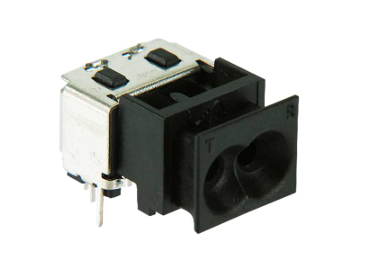
Range features
A high level overview of what this range offers
- Plugless OptoLock® interface – Allows bare 2.2 mm POF cable to be inserted directly, eliminating traditional fibre connectors and simplifying installation.
- 650 nm visible RCLED source – High-efficiency red LED transmitter offers strong optical output and a visible light for easy link alignment and troubleshooting.
- Broad 125 MHz analogue bandwidth – Supports DC to 125 MHz signal frequencies, enabling transmission of DC levels, fast analog waveforms, or high-speed digital data as needed.
- Duplex transceiver module – Integrates both optical transmitter and receiver in one unit, providing bidirectional communication over a dual-fibre POF link with a single compact module.
- 50 Ω linear output – The receiver’s analog output has a 50-ohm impedance, allowing direct interfacing with standard RF/analogue inputs or coaxial lines for minimal signal conditioning.
- Single-supply operation – Designed to run from a standard 5 V DC supply (and compatible with 3.3 V systems), offering flexibility to work with common power rails in modern electronics.
- EMI immunity & galvanic isolation – Fibre-optic communication provides excellent resistance to electromagnetic interference and inherent electrical isolation, improving reliability in noisy industrial environments.
- Standard POF compatibility – Optimised for 1 mm core plastic optical fibre, a widely available and low-cost medium, making it easy to source cabling and implement optical links up to tens of metres.
What’s in this range?
All the variants in the range and a comparison of what they offer
| Parameter | Value / Description |
|---|---|
Optical wavelength | 650 nm (visible red) |
Optical source | Resonant Cavity LED (RCLED) |
Optical interface | OptoLock® duplex port (accepts standard 2.2 mm POF cable) |
Supported fibre | 1 mm core plastic optical fibre (PMMA step-index POF) |
Signal bandwidth | DC to 125 MHz (analogue -3 dB bandwidth) |
Receiver output | Analogue voltage output (linear, ~50 Ω source impedance) |
Supply voltage | 5 V DC (typical) – also supports operation at 3.3 V DC |
Mounting / form factor | PCB through-hole module (board-mount transceiver) |
FAQs
for FB00AKAR 650 nm Analogue DC-125 MHz OptoLock® POF Transceiver
No special connectors are needed. The FB00AKAR uses a plugless OptoLock® interface, so you simply insert a standard 1 mm plastic optical fibre directly into the transceiver’s port. The fibre is held in place by an internal latch, eliminating the need for pre-terminated connectors or polishing. This makes fibre installation and replacement very quick – just cut the POF cable to the required length, cleanly trim the end, and push it into the OptoLock transceiver.
Yes, it can transmit digital data up to high speeds, but the output remains analogue. In practice the FB00AKAR can handle digital signal rates approaching 125 Mbaud (equivalent to around 100 Mbps Ethernet). However, because the receiver’s output is a linear analog voltage (not a logic-level signal), you would need additional circuitry to convert that output into digital logic levels for a standard interface.
In summary, the module can carry high-speed digital information, but you will typically use a comparator or interface chip at the receiver side to interpret the data as logic 0/1. For true plug-and-play digital use (with built-in logic output), the manufacturer offers dedicated digital POF transceivers, but the FB00AKAR gives you the flexibility to pass the raw signal for custom processing.
The receiver provides an analogue voltage output that is proportional to the incoming optical signal intensity. It does not internally digitise or threshold the signal. This means the output will be a continuous voltage waveform (for example, an analogue waveform if you sent an audio signal, or a fast varying voltage if you sent digital pulses). The output behaves like a high-speed photodiode with a transimpedance amplifier, presented with around 50 Ω impedance. If a digital output is required, you would add a comparator or amplifier circuit to convert this analogue output to the desired logic levels.
The FB00AKAR’s transmitter consists of a high-speed RCLED, and it requires an external drive or bias circuit for proper operation. In other words, you will provide the LED with a forward bias and modulate it with your signal. For analogue use, this usually means setting up a bias current through the LED and AC-coupling your input signal or using a current source driver to linearise the LED’s response. The exact driver design can depend on your application (for instance, for an audio signal you might use a simple transistor bias network, while for high-speed data you might use a dedicated LED driver). The device documentation provides guidance on biasing – but generally, expect to design a small driving circuit so that the LED operates in its linear region and faithfully converts your electrical signal to optical intensity variations.
There is no built-in logic or modulation driver in this module, which is by design to keep it versatile for different analogue uses.
The reliable range depends on several factors (fiber quality, alignment, and the signal bandwidth), but generally POF links with this transceiver are useful for tens of metres. In many cases you can achieve around 30–50 m distance with standard 1 mm core POF while maintaining a strong signal, especially for lower-frequency or moderate-speed data. At shorter distances (a few metres) the transceiver will have a very large safety margin, even at the full 125 MHz bandwidth. As you approach the upper end of the distance (tens of metres), the optical attenuation of the fibre (and the LED’s power and receiver sensitivity) become the limiting factors. For example, at 50 m you might need to limit the frequency or use a higher drive current to compensate for loss.
Overall, FB00AKAR is ideal for short-run links in the range of a few metres up to around 50 m. If you require significantly longer runs, other fiber types (like large-core PCS or glass fibre) or repeaters would be needed, as standard POF inherently has attenuation on the order of 0.2 dB/m at 650 nm.
Yes – the FB00AKAR is well suited for analogue media signals such as video and audio. Its bandwidth of 125 MHz is more than enough for composite video (which typically requires only a few MHz) or high-fidelity audio (which is in the kHz range). In fact, one common use of analogue POF transceivers is to send composite CCTV camera video or stereo audio over fibre to avoid electrical interference. When using it for such signals, you would bias the LED in a linear region and feed the video or audio waveform into the transmitter. On the receiving end, you get an analogue output that can be fed into a monitor, amplifier or ADC as needed. The transmission will preserve the analogue nature of the signal, and because it’s optical, the link won’t add electrical noise or create ground loops. It’s essentially like using an ‘optical cable’ for your analogue signal. Just ensure to follow good practices for biasing and coupling (so you don’t distort the signal by over-driving the LED), and you can expect very clean transmission of video, audio, or other broadband analogue signals.
The module is designed to run from a single DC supply, typically 5 V. It’s quite flexible, and in fact the device can also operate at 3.3 V if that is what your system uses – this might result in a slightly lower optical output or reduced headroom on the receiver output, but it remains operational. The ability to work with either 5 V or 3.3 V means it can be dropped into both newer low-voltage designs and older 5 V systems. Power consumption is modest (on the order of tens of milliamps for the LED driver and receiver amplifier, depending on how hard you drive the LED). There’s no complex power sequencing or multiple rails required – just provide a stable supply in the recommended range (refer to the datasheet for exact limits, e.g. 3.0–5.5 V) and the transceiver will perform. This makes it easy to integrate into your PCB: you can often run it from the same 5 V rail that might already be powering other interface components, or from a 3.3 V regulator if your design is all low-voltage.
It’s also worth noting that it has on-board decoupling and is designed to tolerate the normal noise on supply lines in industrial environments, but as always, good power supply decoupling near the module is recommended.
Yes, the FB00AKAR’s optical output is generally considered eye-safe under normal operating conditions. The module uses an LED (not a laser), and its output power is limited. It falls under Class 1 LED safety regulations, meaning it does not pose a hazard to the eye during intended use. In practical terms, the light emitted from the fibre is of low enough intensity that occasional or brief exposure is not harmful.
Of course, it’s still good practice not to stare directly into the fibre or LED from a very close distance when it’s powered, especially with magnification, as with any bright light source. But for everyday handling and operation, you can be confident that the red light it emits won’t cause eye damage. This is one of the advantages of POF systems at 650 nm – they are safe and user-friendly to work with, even for non-technical personnel, which is one reason they’re used in consumer and industrial products alike. There’s no special training or safety equipment needed to connect or disconnect these optical links.