365/400 µm Multi-mode Step-Index Reduced Buffer HCS® Optical Fibre
- Technology
- Speciality fibre
- Partner
- Lightera (formerly OFS)
This 365/400 µm multi-mode step-index HCS optical fibre is engineered for applications where ordinary fibres may not withstand the environment or handling. It features a large 365 µm silica core surrounded by a hard polymer cladding, which together provide robust performance and high light-carrying capacity. Because of its Hard Clad Silica (HCS) construction, the fibre resists breakage and can be handled more easily during installation and field use.
The reduced buffer coating gives the fibre a smaller overall diameter than standard buffered fibres, helping it fit into tight spaces, compact connectors, and dense routing paths. This design is well suited to industrial automation, optical sensing systems, laboratory equipment, and other harsh environments where vibration, dust, or rough handling are common. The multi-mode step-index profile supports dependable short-distance transmission across broad wavelength ranges, making the fibre versatile for sensing, illumination, and industrial optical links.
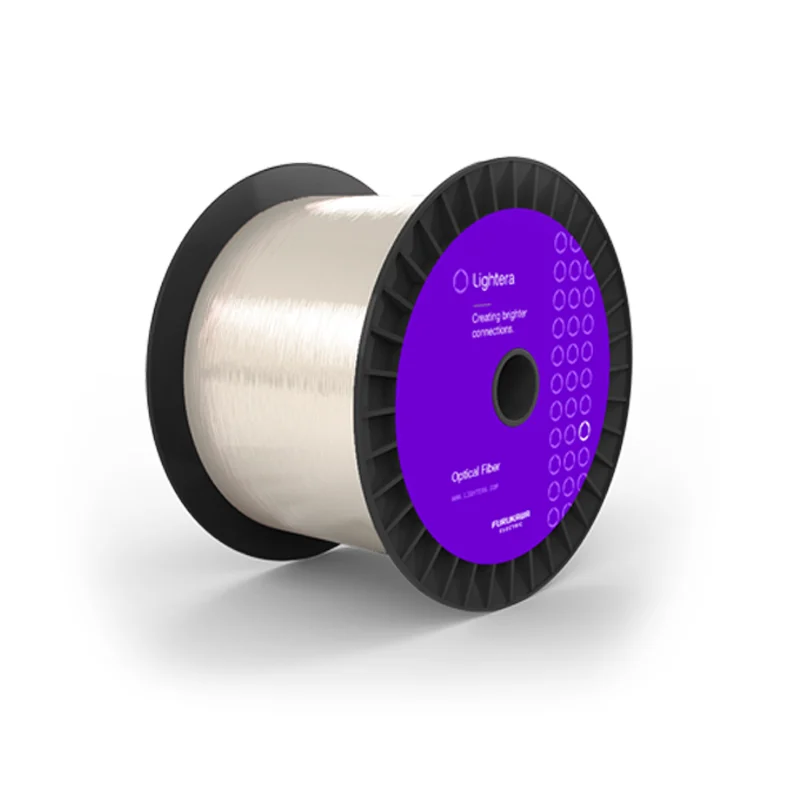
This 365/400 µm HCS optical fibre combines a large silica core, hard polymer cladding, and reduced buffer design for reliable operation in demanding environments. It is designed for engineers who need a durable, easy-to-route fibre for industrial automation, optical sensing, illumination, and other short-range optical transmission tasks where ruggedness and efficient light coupling matter most.
Range features
A high level overview of what this range offers
- Large 365 µm core – Supports high light input and simplifies alignment with LED and broad-area light sources.
- Hard polymer cladding (HCS) – Improves durability and handling resistance compared with more fragile fibre constructions.
- Multi-mode step-index design – Suitable for short-range communication, sensing, and light delivery across broad wavelength ranges.
- Reduced buffer coating – Keeps the overall diameter compact for tight installations and specialty connector systems.
- High numerical aperture – Accepts light over a wider angle, helping with coupling efficiency and alignment tolerance.
- Easy termination – Can be field-terminated with practical methods such as crimp-and-cleave connectors.
- Low attenuation for its class – Supports dependable performance over short distances in industrial and sensor applications.
Downloads
for 365/400 µm Multi-mode Step-Index Reduced Buffer HCS® Optical Fibre
What’s in this range?
All the variants in the range and a comparison of what they offer
Specification | Value |
Core diameter (silica) | 365 µm (nominal) |
Cladding diameter | 400 µm (nominal) |
Outer diameter (buffered) | ~430 µm (reduced buffer design) |
Numerical aperture (NA) | ~0.37 |
Attenuation @ 650 nm | ≤ 8 dB/km |
Attenuation @ 850 nm | ≤ 5 dB/km |
Operating temperature | –40 °C to +85 °C |
Core material | Silica glass |
Cladding material | Hard polymer (HCS) |
Buffer material | Thin polymer protective coating (ETFE) |
Proof test level | ≥ 100 kpsi (≥ 0.7 GPa) |
FAQs
for 365/400 µm Multi-mode Step-Index Reduced Buffer HCS® Optical Fibre
It refers to the fibre’s core and cladding diameters. The 365 µm value is the diameter of the silica core that carries the light, while 400 µm is the diameter including the hard polymer cladding. This gives the fibre a large light-guiding core with a compact overall glass-plus-cladding size.
HCS stands for Hard Clad Silica. In this design, a tough polymer cladding is bonded to the silica core, helping protect it from handling damage, nicks, and micro-cracks. This makes the fibre more durable and easier to work with in industrial and field environments.
A large-core fibre can collect and transmit much more light than standard smaller-core telecom fibres. That makes it especially useful with LEDs, broad-area emitters, sensing systems, and illumination tasks where easy light coupling and higher optical power matter more than long-distance, high-speed bandwidth.
The reduced buffer is a thinner outer protective coating than you would find on a standard heavily buffered fibre. This results in a smaller overall diameter, which helps when routing through tight spaces, integrating into compact assemblies, or using specialty connectors while still maintaining basic protection.
This fibre can be terminated using methods suitable for large-core polymer-clad fibres, including crimp-and-cleave approaches. Connectors such as SMA 905/906 or ST may be used when matched with ferrules sized appropriately for approximately 400 µm cladding.
This step-index multimode fibre is intended for shorter-distance applications, often up to a few hundred metres depending on the source, signal type, and system design. It is well suited to moderate data rates, analog transmission, sensing, and light delivery, but not to long-distance high-speed telecom networking.
Typical uses include industrial automation, factory sensors, instrumentation links, medical and laboratory light delivery, spectroscopy, and other rugged optical systems where durability, efficient light capture, and reliable short-range transmission are important.
Compared with POF, this HCS fibre generally offers lower attenuation, better temperature resistance, and improved long-term performance because it uses a silica glass core. POF may be more flexible and lower cost for very short links, while HCS is typically chosen for more demanding industrial and technical applications.
Because it uses a silica core, the fibre can support a broad spectral range from the visible into the near-infrared, including common wavelengths such as 650 nm and 850 nm. It can also support some near-UV applications over practical lengths, depending on the exact source and system requirements.
Although more robust than many standard glass fibres, this fibre should still be routed with gentle bends. A practical guideline is to maintain a bend radius of around 50 mm or more to reduce mechanical stress and help preserve long-term optical performance.