ALM3 1310 nm 1 GHz 31 mW Butterfly Analogue DFB Laser
- Technology
- Analogue fibre optical devices
- Partner
- AGx Technologies
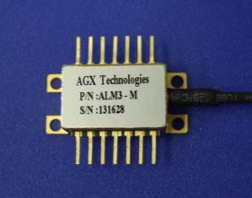
The ALM3 1310 nm analogue DFB laser module is a high-performance fibre-optic transmitter designed for broadband analog communications. It incorporates a distributed feedback laser diode engineered for high linearity, which makes it especially suitable for cable television (CATV) forward-path links and other RF-over-fibre systems that demand low distortion. Housed in a 14-pin butterfly package, the module integrates critical components internally – including a thermoelectric cooler (TEC), thermistor, optical isolator, and monitor photodiode – to ensure stable and reliable operation. With an optical output of up to 31 mW at 1310 nm, the ALM3 provides a strong signal that can drive extended fibre link distances or multiple optical splits without significant loss.
The 1 GHz modulation bandwidth supports transmission of wide-frequency analogue signals (for example, the full cable TV channel spectrum) directly over fibre without the need for external modulation. The built-in TEC actively stabilises the laser temperature, maintaining consistent wavelength and output power over varying ambient conditions. Overall, this module enables low-noise, low-distortion analogue signal delivery in telecom, broadcasting, and instrumentation environments where performance and stability are critical.
Range features
A high level overview of what this range offers
- Up to 31 mW output power – Provides a strong optical signal for extended fibre link range or distribution across multiple receivers.
- Wide 1 GHz modulation bandwidth – Supports broadband analogue signal transmission (e.g. full CATV spectrum) without requiring an external optical modulator.
- High linearity DFB laser design – Minimises distortion for multi-channel analogue broadcasts, preserving signal quality in CATV and RF-over-fibre links.
- 1310 nm (O-band) wavelength – Offers low chromatic dispersion in standard single-mode fibre, ideal for intermediate-distance links with high signal fidelity.
- 14-pin butterfly package with TEC & isolator – Integrates thermal stabilisation and optical isolation, ensuring consistent output and preventing feedback-induced noise over temperature variations.
- Internal monitor photodiode – Enables active output power monitoring and feedback control to maintain stable laser output over time.
- Single-mode or PM fibre pigtail – Comes with an integrated fibre pigtail (standard single-mode or optional polarisation-maintaining) for easy integration into existing fibre networks or specialised setups.
- Directly modulated DFB – Can be driven directly by an analogue RF signal, eliminating the need for a separate external modulator and simplifying system design.
Downloads
for ALM3 1310 nm 1 GHz 31 mW Butterfly Analogue DFB Laser
What’s in this range?
All the variants in the range and a comparison of what they offer
| Specification | Value |
|---|---|
Centre wavelength | 1310 nm (DFB laser) |
Optical output power | Up to 31 mW (approx. +15 dBm) |
Analogue modulation bandwidth | 1 GHz (small-signal bandwidth) |
Laser type | Cooled DFB laser diode, directly modulated |
Package format | 14-pin butterfly (integrated TEC, isolator, thermistor, monitor PD) |
Fibre pigtail | Single-mode SMF-28 (optional PM fibre available) |
Connector | FC/PC standard (others on request, e.g. FC/APC) |
Operating case temperature | 0 °C to +70 °C (with TEC regulation) |
Storage temperature | –40 °C to +85 °C |
FAQs
for ALM3 1310 nm 1 GHz 31 mW Butterfly Analogue DFB Laser
The ALM3 module is designed for broadband analogue fibre-optic transmission, making it ideal for CATV (cable television) distribution networks and other RF-over-fibre links. Typical applications include forward-path CATV transmitters, where numerous television channels or RF signals are carried over a single fibre, as well as analog signal repeaters, telemetry, and broadband wireless communication systems that require high linearity over optical links. Essentially, any application that needs to send wideband analogue RF or video signals over fibre (up to ~1 GHz) with low distortion can benefit from this module.
This laser module uses a DFB (Distributed Feedback) laser diode known for single-frequency operation and low noise, which is crucial for analogue signal fidelity. The DFB design prevents mode-hopping and reduces frequency chirp, resulting in a cleaner signal under modulation. Additionally, the ALM3 integrates an optical isolator to block reflections and a TEC-based temperature stabiliser to maintain a steady laser temperature. These features together ensure that the output remains stable and linear, minimising distortion (such as composite second-order or third-order distortions in CATV applications) even when carrying multiple analogue channels. The high linearity of the laser means that even with complex analogue modulation, the signal integrity is preserved across the fibre link.
The ALM3 is designed for direct modulation, so no external modulator is needed. You can drive the laser diode with an analogue electrical signal (superimposed on a DC bias current), and it will directly convert that into a modulated optical output. This simplifies system architecture compared to using an external LiNbO₃ modulator, for example. The module’s internal design and high bandwidth (1 GHz) support fast analogue modulation, so it can carry wideband signals directly. Direct modulation is one of the key advantages of this product, enabling more compact and cost-efficient analogue optical transmitters.
The built-in Faraday optical isolator protects the laser diode from back-reflections and feedback coming from the fibre or downstream components. In fibre-optic systems, any reflected light that re-enters the laser can cause noise, mode instabilities, or even damage. This is especially problematic in analogue links, as reflections can introduce interference and distortion into the signal. The isolator in the ALM3 provides a one-way light path, preventing reflected light from reaching the laser cavity. This ensures the laser operates in a stable, low-noise condition, which in turn maintains the clarity and linearity of the analogue signal being transmitted. It also helps to protect the laser diode, contributing to the module’s overall reliability.
The thermoelectric cooler (TEC), paired with a thermistor for temperature sensing, actively regulates the laser diode’s temperature. DFB laser performance (wavelength, output power, and linearity) can vary with temperature, so keeping the laser at a constant optimal temperature is important. The ALM3’s TEC can heat or cool the laser mount to maintain a set-point (usually around 25 °C), compensating for changes in ambient temperature. This temperature stabilisation ensures that the wavelength stays centered at 1310 nm and that the output power remains steady over time. For analogue applications, a stable operating point means the modulation characteristics (like bandwidth and distortion levels) remain consistent. The built-in thermistor provides feedback for precise temperature control. Overall, the TEC/thermistor combination in the ALM3 guarantees consistent performance and prevents thermal drift, which is crucial for long-term reliable operation in the field.
The ALM3 comes with a pigtailed fibre already attached to the laser module. By default this is a single-mode fibre (SMF-28 or equivalent) which is standard for 1310 nm transmission. In addition, the manufacturer offers an option for a polarisation-maintaining (PM) fibre pigtail if the application requires preserving a particular polarisation state (useful in some sensor or interferometric systems). The fibre pigtail is typically about 1 meter long and is terminated with a connector for easy integration. The standard connector is often FC/PC (fibre connector with a flat polished end), but other connector types such as FC/APC (angled polish) or SC can usually be requested to match the system requirements. The use of a pre-attached fibre ensures low coupling loss and convenience, so the module can be directly spliced or connected into the user’s fibre network.
31 mW is the maximum rated optical output power for the ALM3 module, but the actual output is adjustable based on the drive current you supply to the laser. In practice, engineers will set a bias current (DC drive current) for the laser – this bias can be anywhere above the threshold current (the point at which the laser begins to emit) up to the current that yields 31 mW output. By driving at a lower current, you can operate the laser at a reduced output power if the full 31 mW is not needed. Moreover, in analogue modulation, the output power will fluctuate around the bias point according to the modulation signal, so typically the bias is chosen to be a few milliwatts below the maximum to allow “headroom” for modulation peaks. The key is that the ALM3’s output is analogue and controllable – you have the flexibility to tune the output power to your system’s requirements, within the safe operating range specified.
Operating the ALM3 laser module requires some standard laser diode handling and usage precautions. Firstly, the laser diode inside is sensitive to ESD (electrostatic discharge), so proper ESD protection (wrist straps, grounded work surfaces) should be used when installing or handling the module to avoid damaging the device. Secondly, the drive electronics should provide a low-noise, current-regulated supply – transient spikes in current or voltage can harm the laser, so using a dedicated laser diode driver and a PID-controlled TEC driver for temperature is recommended. In terms of safety, a 31 mW output at 1310 nm is classed as a Class 3B laser, which can cause eye injury if the beam or fibre output is viewed directly. Even though the light is infrared and invisible, it can damage eyesight, so one should never stare into the fibre end and should use proper laser safety measures (such as protective eyewear or fiber caps) when the device is operational. Finally, ensure good thermal management: while the module has an internal TEC, it’s important to mount the butterfly package on a heat-sinking surface to help dissipate waste heat. By following these precautions – ESD safety, using proper drivers, observing laser safety, and mounting the module appropriately – you can reliably operate the ALM3 and achieve its full performance over a long lifetime.