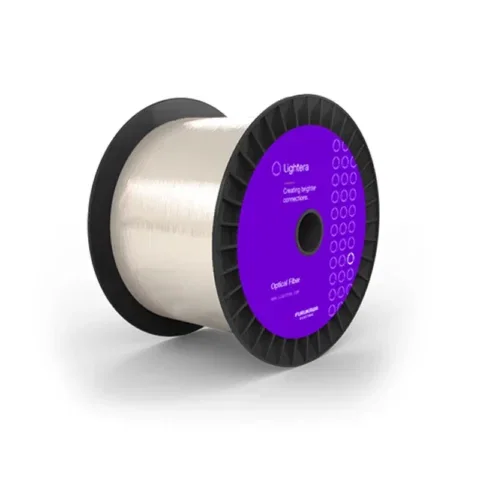
HCS® 125 µm 0.37 NA Low OH Optical Fibre
- Technology
- Speciality fibre
- Partner
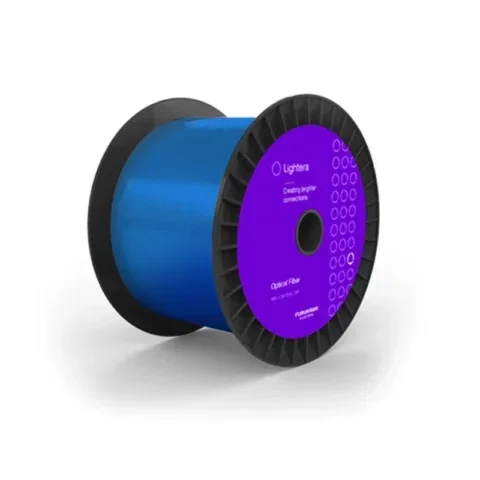
- Lightera (formerly OFS)
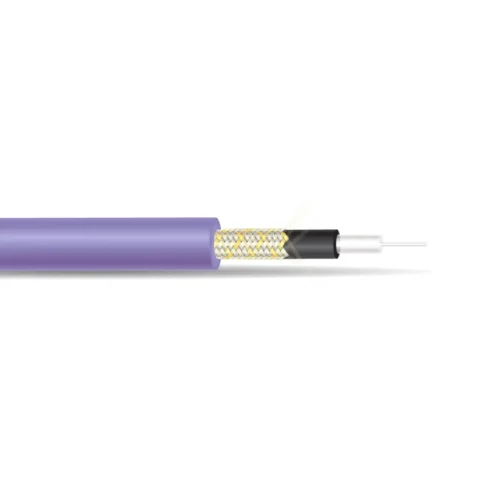
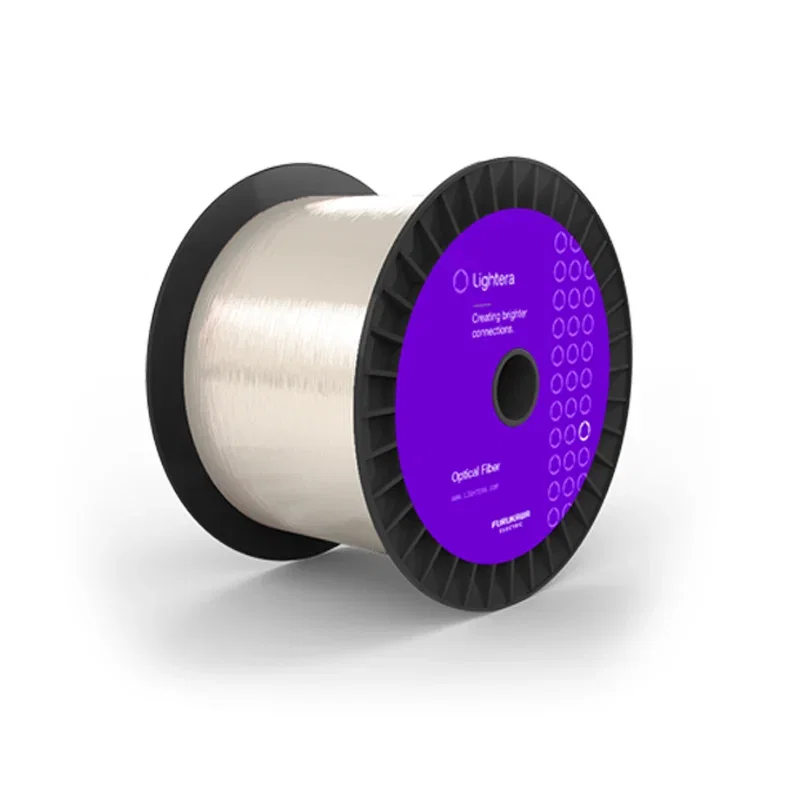
The CF01493-09 HCS 125 µm Low OH optical fibre is a rugged multimode step-index fibre built for demanding operating conditions. It combines a pure silica core with hard polymer cladding and an ETFE buffer to improve durability, handling, and chemical resistance. The 125 µm core and 0.37 numerical aperture support efficient light capture from LEDs and laser diodes, helping simplify coupling and connector choices.
The fibre is optimised for 650 nm and 850 nm applications while also supporting broader visible-to-near-IR transmission thanks to its low OH composition. This makes it suitable for factory automation, avionics communications, medical sensing, spectroscopy, and laser delivery. Its mechanical robustness supports use in environments with bending, vibration, crushing, and repeated handling. The wide operating temperature range of -65 °C to +125 °C also makes it suitable for harsh industrial and aerospace settings. Overall, it offers a practical balance of optical performance, field durability, and application flexibility.
Range features
A high level overview of what this range offers
- High mechanical strength – Rugged HCS construction helps resist cracking and breakage during installation and use.
- Bend-insensitive performance – Maintains signal integrity in tighter routing conditions and helps minimise bend-related loss.
- Chemical-resistant design – Fluoroacrylate cladding and ETFE buffer improve resistance to oils, solvents, and other harsh industrial chemicals.
- Wide operating temperature range – Designed for reliable operation from -65 °C to +125 °C.
- Strong crush, twist, and flex durability – Suitable for harsh environments where vibration, movement, and rough handling are common.
- Large core with high NA – The 125 µm core and 0.37 NA support efficient light capture and easier coupling from lower-cost sources.
- Broad application range – Optimised for 650 nm and 850 nm while remaining useful for sensing, spectroscopy, and near-IR laser delivery.
- Ease of handling – The buffered construction makes the fibre more practical for field deployment and connectorization than bare glass fibre.
Downloads
for HCS® 125 µm 0.37 NA Low OH Optical Fibre
What’s in this range?
All the variants in the range and a comparison of what they offer
Parameter | Value |
Product Description | 125 0.37 NA Low OH |
Core Diameter | 125 ± 5 µm |
HCS Cladding Diameter | 140 +2/-5 µm |
ETFE Buffer Diameter | 250 +50/-0 µm |
Core/Clad Offset | ≤ 5.0 µm |
Crimp & Cleave Compatible | No |
Cladding Material | HCS fluoroacrylate |
Buffer Material | ETFE |
Fibre Type | Multimode, Step-Index |
Numerical Aperture | 0.37 |
Attenuation @ 850 nm | ≤ 12 dB/km |
Water Content | Low OH |
Operating Temperature | -65 to +125 °C |
Short-Term Bend Radius | ≥ 9 mm |
Long-Term Bend Radius | ≥ 15 mm |
Proof Test Level | ≥ 100 kpsi (0.689 GPa) |
Orderable Part Number | CF01493-09 |
Description Code | HCP-M0125T |
Available Options | Buffer colour, buffer diameter, buffer material, proof test level |
FAQs
for HCS® 125 µm 0.37 NA Low OH Optical Fibre
Hard-Clad Silica (HCS) optical fibre uses a pure silica core with a tough polymer cladding instead of a conventional all-glass structure. This makes it more rugged, easier to handle, and better suited to harsh environments. Compared with standard glass fibre, HCS fibre offers improved resistance to bending, crushing, and rough handling, which is especially valuable in industrial, aerospace, and field-installed systems.
A 0.37 numerical aperture means the fibre can accept light over a relatively wide input angle. In practice, this improves coupling efficiency from LEDs and laser diodes, makes alignment less critical, and supports reliable operation in compact or mechanically demanding installations. The high NA also contributes to good performance in short- to medium-distance multimode links.
Low OH means the silica core contains low hydroxyl impurity levels, which reduces attenuation in parts of the near-infrared region. This fibre is optimised for 650 nm and 850 nm, making it well suited for industrial communications and sensing. It can also support broader visible-to-near-IR transmission for applications such as spectroscopy and laser delivery.
This fibre is designed for short- to medium-distance links, with typical use cases extending to around up to 3 km, depending on the transmitter power, receiver sensitivity, wavelength, and system loss budget. Because it is a multimode step-index fibre, practical distance will also depend on modal dispersion and the performance requirements of the application.
Yes. The fibre is specified for operation from -65 °C to +125 °C and is designed for environments involving bending, vibration, and rough handling. Its HCS fluoroacrylate cladding and ETFE buffer also improve resistance to chemicals commonly found in industrial settings, helping maintain long-term durability and stable performance.
No. For this specific 125 µm core version, the specification states Crimp & Cleave Compatible: No. That means it is generally terminated using more traditional fibre termination methods rather than the simplified crimp-and-cleave approach used with some larger-core HCS fibres.
Yes. The combination of a 125 µm core, 0.37 NA, and low OH transmission characteristics makes it suitable for applications such as high-power laser delivery, medical sensing, near-IR spectroscopy, optical pyrometry, avionics communications, and factory automation. Its rugged construction also makes it a good fit for harsh or vibration-prone environments.
Available options include buffer colour, buffer diameter, buffer material, and proof test level. These options allow the fibre to be adapted for different handling preferences, identification schemes, environmental requirements, or qualification needs.