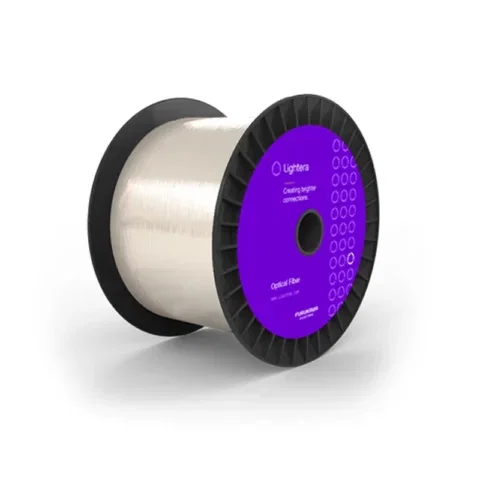
HCS® 200 µm 0.43 NA Step-Index Low OH Optical Fibre
- Technology
- Speciality fibre
- Partner
- Lightera (formerly OFS)
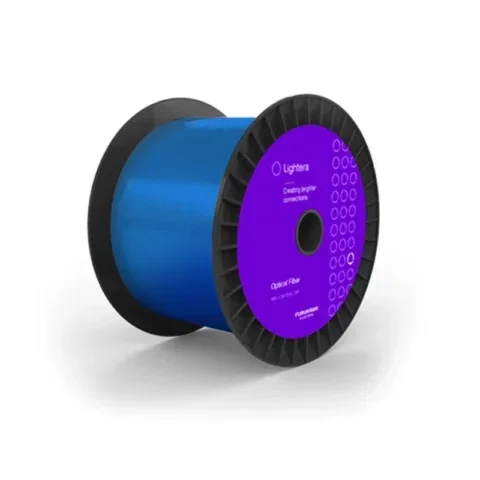
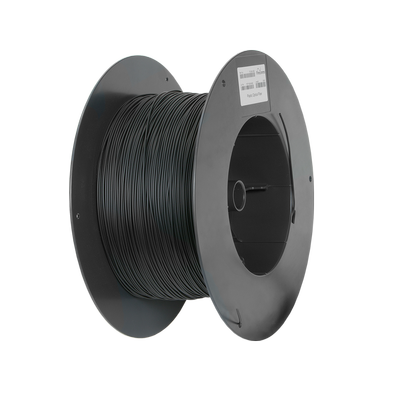
This 200 µm HCS (Hard-Clad Silica) optical fibre is a large-core, step-index multimode fibre designed for high light throughput and rugged performance. Its polymer cladding provides a high numerical aperture of 0.43, helping the fibre capture and transmit more light even under bending or slight misalignment. The low-OH pure silica core reduces absorption losses in the near-infrared range, especially around 650–850 nm, for efficient laser delivery and optical sensing. Built for industrial and medical use, it is designed to withstand wide temperature swings and exposure to demanding environments. The 200 µm core supports high optical power transmission and reliable coupling to LEDs and laser sources. Its durable construction makes it suitable for laser delivery, short-to-medium range data links, and precision sensor systems. The fibre can be terminated in the field using a simple crimp-and-cleave process, avoiding epoxy and polishing. This combination of optical efficiency, mechanical toughness, and installation convenience makes it well suited to demanding B2B applications.
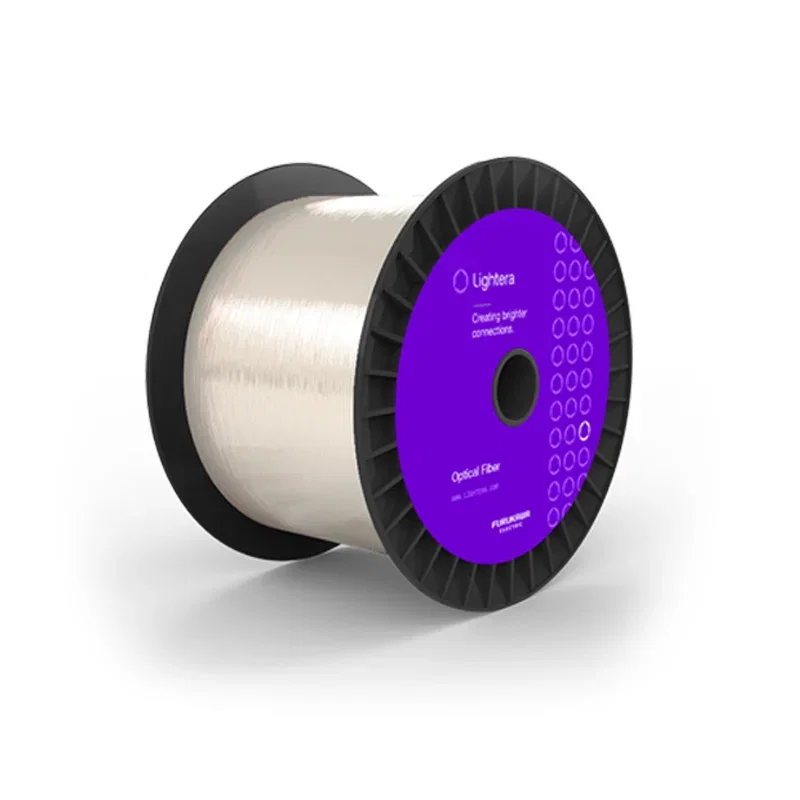
This hard-clad silica fibre is engineered for applications that need high optical throughput, robust handling, and dependable performance in challenging environments. With its 200 µm large core, 0.43 NA, and low-OH silica core, it is especially suitable for industrial laser delivery, medical instrumentation, optical sensing, and short-to-medium range data transmission.
The polymer-clad step-index construction combines strong light acceptance with practical field usability, including crimp-and-cleave termination for faster installation and maintenance.
Range features
A high level overview of what this range offers
- 200 µm large core – Supports high optical power and easier coupling to LED or laser sources for strong light throughput
- High NA of 0.43 – Wide acceptance angle improves coupling efficiency and reduces sensitivity to misalignment and bending
- Polymer-clad HCS design – Increases mechanical toughness and impact resistance for industrial use
- Low-OH silica core – Optimised for near-infrared transmission with low attenuation around 850 nm
- Crimp-and-cleave field termination – Enables quick on-site connectorisation without epoxy or polishing
- Wide operating temperature range – Designed for use from −65 °C to +125 °C in demanding environments
- Chemical-resistant ETFE buffer – Helps protect the fibre in harsh industrial, automotive, and factory settings
- Bend-tolerant construction – Maintains signal integrity under routing stress, twisting, or handling
- Reliable for laser delivery and sensing – Suitable for high-power laser transmission, optical sensors, and rugged multimode links
Downloads
for HCS® 200 µm 0.43 NA Step-Index Low OH Optical Fibre
HCS 200 µm 0.43 NA Low OH Optical Fibre – Datasheet
DownloadWhat’s in this range?
All the variants in the range and a comparison of what they offer
Specification | Value |
Product Description | 200 µm core Low OH Step-Index Fibre (Polymer-Clad) |
Core Diameter | 200 ± 4 µm |
HCS® Cladding Diameter | 230 +0/–10 µm |
ETFE Buffer Diameter | 500 ± 30 µm |
Core/Clad Offset | ≤ 5.0 µm |
Crimp & Cleave Compatible | Yes |
Cladding Material | HCS fluoroacrylate (polymer) |
Buffer Material | ETFE (thermoplastic polymer) |
Type | Multimode Step-Index |
Numerical Aperture (NA) | 0.43 |
Attenuation @ 850 nm | ≤ 6 dB/km |
Water Content | Low OH |
Operating Temperature | –65 °C to +125 °C |
Short-Term Bend Radius | ≥ 10 mm |
Long-Term Bend Radius | ≥ 16 mm |
Proof Test Level | ≥ 150 kpsi (1.03 GPa) |
Order by Part Number | CF01493-20 |
Product Description Code | HCP-H0200T |
Available Options | Buffer colour, buffer diameter, buffer material, proof test level |
FAQs
for HCS® 200 µm 0.43 NA Step-Index Low OH Optical Fibre
A numerical aperture of 0.43 means the fibre has a wide light acceptance angle. In practical use, this makes it easier to couple light from LEDs or laser diodes into the 200 µm core, while also improving tolerance to bending and input misalignment. This is especially valuable in sensing, laser delivery, and industrial data links where maintaining coupled power is important.
Because the core is low OH silica, the fibre is optimised for the near-infrared region, especially around 650 nm to 850 nm where attenuation is low. It can also be used up to roughly 900–1000 nm with reasonable efficiency, depending on the application and system tolerance.
Yes. This fibre supports crimp-and-cleave field termination, allowing technicians to install connectors quickly without epoxy, curing, or polishing. Common connector styles for large-core fibre applications include ST and SMA types, depending on the system design.
Hard-clad silica (HCS) fibre uses a hard polymer cladding over the silica core, while conventional fibres typically use glass cladding. This gives HCS fibre greater ruggedness, easier field termination, and a higher numerical aperture, although all-silica fibre may offer lower attenuation and higher temperature capability in some specialist applications.
This fibre is built for demanding environments. Its hard polymer cladding and ETFE buffer help resist chemicals, oils, solvents, bending, twisting, and handling stress. It also supports operation from –65 °C to +125 °C, making it suitable for industrial, automotive, aerospace, and outdoor installations.
The specified attenuation is ≤ 6 dB/km at 850 nm. In practical use, this makes the fibre well suited to short-to-medium distance links, including runs of a few hundred metres with low loss and longer spans of up to a few kilometres where the system can tolerate higher attenuation or uses stronger optical power.
Yes. The 200 µm core and pure silica core make the fibre suitable for relatively high optical powers. The large core helps reduce power density compared with smaller-core fibres, which supports laser delivery in industrial and medical systems when the fibre is properly coupled, terminated, and handled.
Available customisation options include buffer colour, buffer diameter, buffer material, and proof test level. These options allow the fibre to be adapted for specific cabling, identification, environmental, or mechanical requirements.