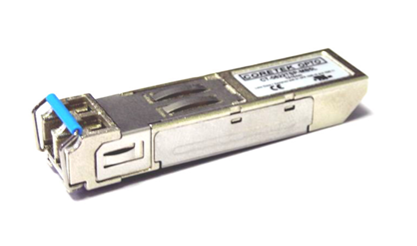
CT-2500TSP-NB6L-E 1310 nm DFB 40 km SFP Transceiver w. DDMI
- Technology
- Fibre optic transceivers
- Partner
- Coretek
The CT-2500TSP-NB6L-E is a high-speed SFP transceiver designed for optical networks requiring up to 2.5 Gbps throughput. It supports long-distance 40 km transmission over single-mode fibre using a 1310 nm DFB laser, which is well-suited for SONET OC-48/STM-16 and similar high-bandwidth links. This compact hot-pluggable module integrates seamlessly into standard SFP ports, providing quick installation or replacement without downtime.
With its digital diagnostic monitoring feature, network engineers can monitor real-time parameters (like optical power and module temperature) to ensure optimal link performance and simplify maintenance. The transceiver’s industrial temperature range (-40°C to +85°C) and robust design allow it to operate reliably in harsh or outdoor environments, such as roadside cabinets or factory settings. Overall, the CT-2500TSP-NB6L-E offers a combination of multi-rate flexibility and long-haul capability for modern telecom and data communication networks.
Range features
A high level overview of what this range offers
- Multi-rate up to 2.5 Gbps – Supports OC-48/STM-16 and lower data rates (e.g. OC-12, OC-3), allowing one module to cover multiple network standards.
- 1310 nm DFB laser transmitter – Provides stable output power for 40 km reach, ensuring reliable long-distance fibre links.
- 40 km single-mode fibre range – Suitable for metro and access networks, connecting distant sites without signal regeneration.
- Digital diagnostic monitoring (DDMI) – Enables real-time monitoring of transmit power, receive power, temperature, and voltage for proactive maintenance and fault detection.
- Extended temperature (-40°C to +85°C) – Industrial-grade design for dependable operation in extreme cold or hot environments.
- Duplex LC optical interface – Uses a standard LC connector for easy integration with existing single-mode fibre infrastructure.
- Hot-pluggable SFP form factor – Simplifies installation or upgrades; modules can be swapped in the field without powering down equipment.
- MSA and standards compliant – Built to the SFP Multi-Source Agreement and relevant SONET/SDH/Fibre Channel specs, ensuring interoperability and safety (Class 1 laser, RoHS compliant).
Downloads
for CT-2500TSP-NB6L-E 1310 nm DFB 40 km SFP Transceiver w. DDMI
What’s in this range?
All the variants in the range and a comparison of what they offer
| Parameter | Value |
|---|---|
Form factor | SFP (Small Form-Factor Pluggable) transceiver module |
Data rate support | Up to 2.5 Gbps (OC-48/STM-16 line rate; backward compatible with OC-3/OC-12) |
Wavelength | 1310 nm DFB laser transmitter, PIN receiver (single-mode) |
Reach (distance) | 40 km over 9/125 µm single-mode fibre |
Fiber type | Single-mode fibre (duplex) |
Connector | Duplex LC optical connector |
Transmit power | Approx. -5 dBm to 0 dBm output power (typical) |
Receiver sensitivity | Better than -22 dBm for 2.5 Gbps (BER 1×10^-10) |
Digital diagnostics | Yes (supports DDMI per SFF-8472 standard) |
Operating temperature | -40 °C to +85 °C (industrial extended range) |
Supply voltage | 3.3 V DC |
Power consumption | < 1 W (typical) |
Standards compliance | SFP MSA compliant, SONET OC-48 IR-2/LR-1, SDH STM-16 L-16.2, RoHS compliant |
FAQs
for CT-2500TSP-NB6L-E 1310 nm DFB 40 km SFP Transceiver w. DDMI
This transceiver is designed for SONET OC-48 and SDH STM-16 links (2.488 Gbps), but it is multi-rate. That means it can also operate at lower rates like OC-12 (622 Mbps) or OC-3 (155 Mbps), as well as comparable data communications standards (e.g. 1.25 Gbps Gigabit Ethernet or 2.125 Gbps Fibre Channel). Its multi-rate capability makes it flexible for use across different network equipment and legacy rates.
The module can reach distances up to 40 kilometres when used over standard single-mode optical fibre (9/125 μm). It uses a 1310 nm wavelength DFB laser, which is optimised for long-distance single-mode fibre links. To achieve the full 40 km, the fibre link should have low attenuation (typical of single-mode) and minimal splices or connectors to stay within the power budget.
Yes, the CT-2500TSP-NB6L-E includes digital diagnostic monitoring (DDMI) as per the SFF-8472 standard. This feature allows the host system to read module parameters in real time—such as transmit optical power, received optical power, laser bias current, supply voltage, and internal temperature. Having these diagnostics helps with preventative maintenance and troubleshooting, as an engineer can detect fiber link issues (like loss of signal or aging optics) before they lead to failures.
This model is an industrial-temperature SFP, meaning it operates reliably from -40°C to +85°C. It’s suitable for outdoor installations or unheated indoor locations. For example, it can be used in base station equipment cabinets, roadside telecom cabinets, or factory floor switches where temperatures may vary widely. The module’s design and components are chosen to withstand these extreme conditions without performance degradation.
The module is a standard hot-pluggable SFP unit. To install, you simply insert it into an available SFP slot (ensuring the latch is upright), and it will click into place. The host device should recognise it immediately. To remove or replace it, you would disengage the latch (flip it down or pull the bail latch outward) and then gently pull the module out. You do not need to power off the switch or router – the hot-swap capability allows you to add or replace modules on the fly. Always protect the laser connectors with dust caps when not connected to fibre, and ensure you plug in the correct duplex LC fibre patch cable corresponding to the TX/RX ports.
Yes. The CT-2500TSP-NB6L-E is compliant with the SFP Multi-Source Agreement (MSA), which means it adheres to the industry-standard form factor and electrical interface for SFP modules. As a result, it can be used in any switch, router, media converter, or optical transport equipment that supports generic SFP modules for OC-48/STM-16 or Gigabit-class optical interfaces. Always check that the target device’s OS or firmware does not restrict third-party optics; otherwise, this SFP should function identically to equivalent modules from other manufacturers.
This transceiver uses a high-sensitivity receiver (typically a PIN photodiode with transimpedance amplifier) to detect the incoming 1310 nm optical signal. The typical receive sensitivity is around -22 dBm at 2.5 Gbps for a BER of 1×10^-10. With a typical transmit power around 0 dBm, the link budget is on the order of 22 dB. This supports the specified 40 km reach, assuming about 0.4 dB/km fiber attenuation plus some margin for connectors and splices. For very long or older fibre runs approaching the limit, it’s important to measure the fibre attenuation to ensure the link budget is not exceeded.
It is primarily intended for telecom networks (SONET/SDH at 2.5 Gbps), but thanks to its multi-rate capability it can also work in some data networking scenarios. For instance, it can carry Gigabit Ethernet traffic (1.25 Gbps) over long distance if your equipment allows a non-standard 40 km SFP for GigE. However, 1.25 Gbps Ethernet typically has its own 1310 nm LX SFP modules specified to 10 or 20 km; using this OC-48 module for Gigabit won’t harm the equipment, but the reach would simply be extended. Always ensure the device recognizes the module and that the link negotiates at the intended speed.
DDMI stands for Digital Diagnostic Monitoring Interface. It is effectively the same concept as DDM (Digital Diagnostic Monitoring). Different vendors or documents may use one term or the other, but both refer to the SFP’s built-in diagnostics feature. This interface provides a way for the module to report its operating conditions (like temperature, voltage, optical power, etc.) to the host device, typically via I²C. In short, DDMI/DDM is a standard feature on “with DDM” SFP modules like this one, giving network managers greater visibility into the fiber link’s health.
There are a few considerations for long-reach SFPs: First, always use single-mode fibre patch cords and cabling; multi-mode fibre is not suitable for 40 km distances. Second, ensure proper handling of the connectors – cleanliness is crucial for optical links, especially at long distances where signal levels are low. Use clean dust-free caps and fibre cleaning tools. Also, check that the total optical loss of your link (fibre attenuation plus connectors/splices) is within the module’s budget. Lastly, as with any Class 1 laser device, avoid looking into the fibre connectors when the module is operating, as invisible laser radiation can be harmful to eyes. Other than these standard practices, the module is straightforward to use and will adjust its output power so as not to saturate receivers on shorter links (within its operating range).