AccuRoll® Rollable Ribbon 200 µm Dry Core
- Technology
- Fibre optic cables, connectors and assemblies
- Partner
- Lightera (formerly OFS)
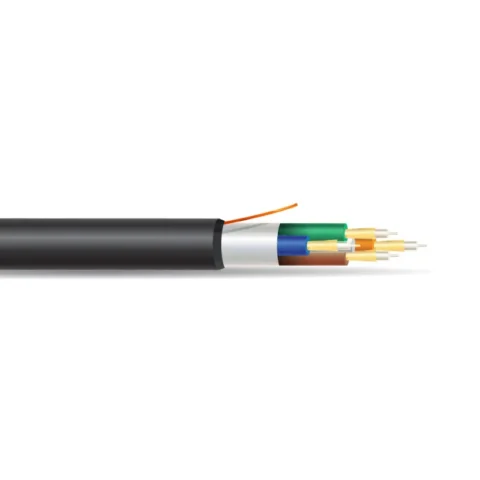
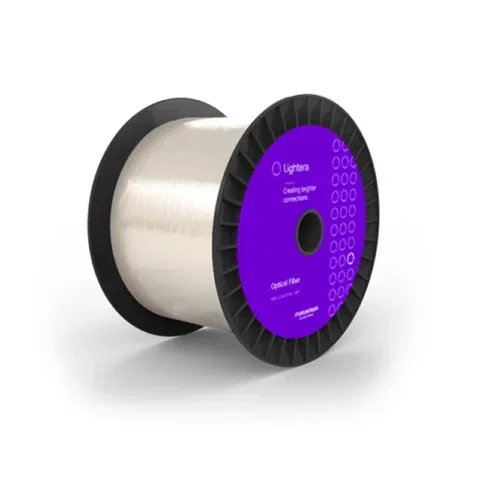
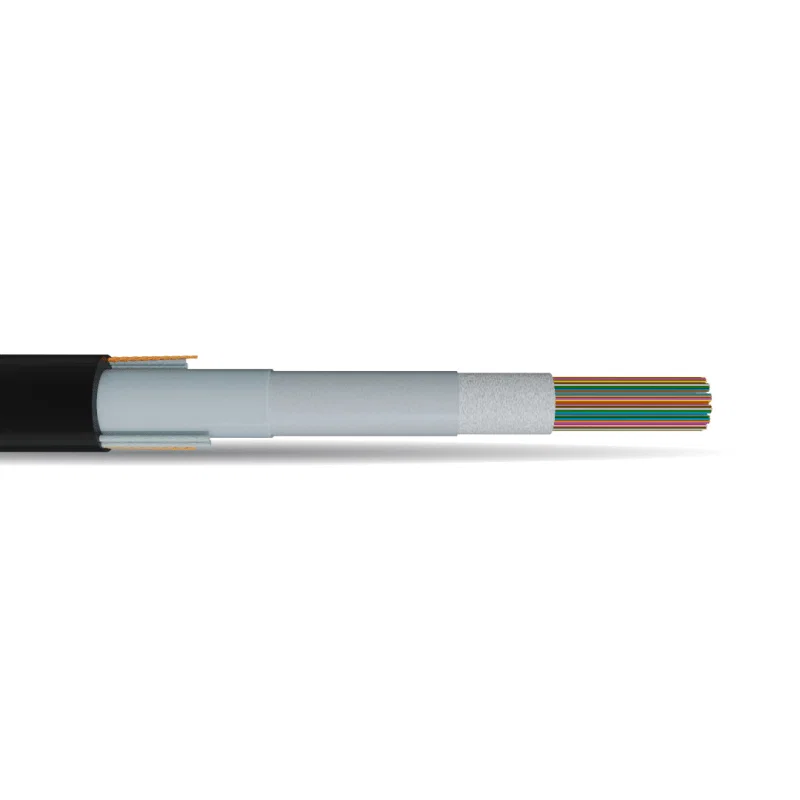
The AccuRoll 200 µm Dry Core Rollable Ribbon Cable is an advanced high-fibre-count outdoor fibre optic cable engineered for telecom and data network providers seeking maximum density in their infrastructure. It uses innovative rollable ribbon technology, where 12-fibre ribbons are intermittently bonded, allowing them to be rolled into tight bundles or laid flat for mass fusion splicing. With 200 micron fibre strands (smaller than the standard 250 µm), the cable achieves roughly double the fibre density of conventional flat ribbon cables of similar size. The core is entirely gel-free (dry block design), which means no messy gel to clean off – speeding up preparation and splicing work in the field.
A robust central core tube with water-swellable tape protects the loosely bonded ribbon units, all encased in a durable polyethylene jacket with built-in dielectric strength members. Optimised for typical outside plant installations, this cable can be pulled into ducts or blown through microducts and offers excellent resistance to kinks and crushing. It’s suitable for a wide range of deployments including underground conduit runs, direct-buried lines, and lashed aerial spans, making it a versatile choice for high-capacity metro, access, and transport networks.
Range features
A high level overview of what this range offers
- Unique central core ribbon design – First rollable ribbon cable with a central core tube and linear strength elements, providing extra protection for fibres and high pulling strength.
- Robust & familiar construction – Central tube cable format is optimised for strength and cost-effectiveness, using proven materials for reliable outdoor performance.
- Long continuous lengths – Can be supplied in extended cable lengths (subject to manufacturing limits), potentially reducing the number of splices and joints needed in long runs.
- Mid-span access friendly – Designed to be opened easily at mid-sheath for branch splicing, simplifying access network installations in any outside plant scenario.
- High fibre counts available – Supports 288, 432, or 864 fibre configurations in one cable, offering scalable capacity options for different network needs.
- Gel-free dry core – Completely gel-free interior for quicker cable preparation and cleaner splicing, since no gel removal is required on the ribbons or buffer tubes.
- Smaller, lighter reels – The compact design and absence of gel yield a thinner, lighter cable, cutting shipping volume and weight. (On high fibre-count cables, this rollable ribbon design can reduce shipping-related CO₂ emissions by up to ~50% compared to equivalent flat ribbon cables.)
- Material and eco efficiency – Requires less raw material and fits on smaller drums, which helps lower the overall carbon footprint of production and transport.
What’s in this range?
All the variants in the range and a comparison of what they offer
Fibre Counts & Dimensions (All-Dielectric Cable)
| Fibre Count | 288 | 432 | 864 |
|---|---|---|---|
Outer Diameter – mm (in) | 12.6 (0.50) | 13.9 (0.55) | 16.5 (0.65) |
Weight – kg/km (lb/kft) | 130 (85) | 130 (88) | 205 (138) |
Handling & Mechanical Ratings (common to all fibre counts)
| Parameter | Value |
|---|---|
Minimum Bend Radius (Under Load) | 15 × cable diameter |
Minimum Bend Radius (No Load) | 15 × cable diameter |
Minimum Bend Radius (Coiled) | 15 × cable diameter (min. coil radius ≈ 23 cm) |
Maximum Tensile Load (Short-Term) | 2700 N (600 lbf) |
Maximum Tensile Load (Long-Term) | 800 N (180 lbf) |
Operating Temperature Range | –40 °C to +70 °C (–40 °F to +158 °F) |
Installation Temperature Range | –40 °C to +70 °C (–40 °F to +158 °F) |
Storage Temperature Range | –30 °C to +70 °C (–22 °F to +158 °F) |
Industry Standards Compliance | Meets ANSI/ICEA S-87-640; Telcordia GR-20 Issue 4 |
Optical Fibre Specifications
Fibre Type (Single-mode) | S1 code | S2 code | SF code | Fibre Standard | Wavelengths (nm) | Typical Attenuation (dB/km) | Max. Attenuation (dB/km) |
AllWave FLEX ZWP (200 µm) Bend-Insensitive SMF | 8 | G | E | ITU-T G.652.D / G.657.A1 | 1310 / 1385 / 1550 | 0.35 / 0.30 / 0.22 | 0.40 / 0.40 / 0.30 |
Typical attenuation values are for reference; actual maximum cable attenuation is shown in the last column at key wavelengths.
Ordering Information – Part Number Configuration
| Example (all-dielectric) | AT-3GE8W3X-NNN (e.g. 288 f cable = AT-3GE8W3X-288) |
|---|---|
Format |
|
S1 | Fibre type selection (see fibre type table above for code) |
S2 | Fibre performance category (see fibre spec table for code) |
SF | Fibre type code (see fibre spec table above) |
S3 | Sheath construction (e.g. 8 = central core design) |
S4 | Cable core design (e.g. W = 200 µm gel-free rollable ribbon) |
S5 | Sheath design (e.g. 3 = totally dry, all-dielectric) |
S6 | Outer protection / oversheath (e.g. X = no oversheath) |
NNN | Fibre count (Three-digit code for 288, 432, or 864) |
Note: The above part number format is for the standard configuration using 200 µm AllWave® FLEX ZWP fibres. Other fibre types or custom designs may use different code values – consult the manufacturer’s full catalogue for variations.
FAQs
for AccuRoll® Rollable Ribbon 200 µm Dry Core
Rollable ribbon technology is a way of arranging optical fibres where groups of fibres (typically 12) are lightly bonded together at intervals. This forms a ribbon that can be rolled or flexed similar to loose fibres. The benefit is that you can splice 12 fibres at once like a conventional flat ribbon (for fast mass fusion splicing), but the ribbon remains flexible, allowing it to be rolled into a smaller bundle. In the AccuRoll cable, this means very high fibre counts can fit into a smaller diameter, improving density without sacrificing the ability to do efficient ribbon splices.
Standard optical fibres have a 250 µm outer coating diameter, whereas this cable uses thinner 200 µm coated fibres. The reduced fibre thickness allows more fibres to pack into the same space. In practical terms, using 200 µm fibres enables roughly a two-fold increase in fibre density compared to cables using 250 µm fibres. This is a key reason the AccuRoll cable can contain up to 864 fibres in a manageable size. The smaller fibres still meet all the standard optical performance specifications (e.g. single-mode G.657.A1), but they allow a more compact cable construction.
A dry core cable uses water-swellable tapes and yarns for water blocking instead of the thick gel found in traditional cables. The benefits are mostly to do with handling and installation speed. Gel-free means there’s no sticky gel to clean off the fibres during splicing, which significantly reduces prep time and cleanup. It also makes the cable lighter (since there’s no heavy gel filling) and even slightly smaller in diameter. Technicians generally find it faster and more pleasant to work with dry core cables, especially when doing many splice connections, as it keeps equipment and work areas much cleaner.
This particular AccuRoll dry core rollable ribbon cable is offered in 288-fibre, 432-fibre, or 864-fibre configurations. All versions use the same design concept (a central core tube containing multiple 12-fibre rollable ribbon units). The 288 and 432 fibre cables have 12-fibre ribbons arranged in up to 36 ribbon units within the core. The 864-fibre cable achieves its high count by essentially stacking more ribbons (it contains twelve sets of 12 ribbons, properly organised in the core). Despite the different fibre counts, the overall construction remains similar, and each is all-dielectric (no metallic armor) by design. These options allow network planners to choose an appropriate cable size based on the needed fibre capacity.
The AccuRoll dry core cable is designed as an outside plant (OSP) cable suitable for a variety of installations. It can be pulled through underground ducts and conduits or blown into microduct systems due to its relatively small size and flexibility. It is also robust enough for direct-buried applications, where the cable is placed directly into the ground, because the polyethylene jacket and water-blocking elements protect it from moisture and environmental conditions. Additionally, the cable can be lashed to aerial messenger wires for above-ground runs. However, it is not a self-supporting aerial cable (there’s no built-in messenger strand), so it typically would be lashed onto a support wire if used in aerial spans.
This cable has been engineered for good mechanical performance. The minimum bend radius is 15 times the cable’s outer diameter during installation or when under tensile load. This radius guideline also applies when coiling the cable (for storage loops), which works out to a minimum coil radius of roughly 23 cm for this design. In terms of tensile strength, the cable’s Maximum Rated Cable Load (short-term) is about 2700 N (approximately 600 pounds-force). This is the limit tension for pulling the cable during installation. The long-term allowed load (after installation, for ongoing support) is much lower, about 800 N (≈180 lbf), to prevent any permanent strain. Staying within these limits ensures the cable won’t be damaged during deployment or while in service.
Yes, they can. One of the advantages of rollable ribbons is that they are compatible with standard mass fusion splicing equipment used for flat ribbon fibres. Each 12-fibre rollable ribbon can be spliced as a group just like a traditional ribbon, which speeds up the splicing of high fibre counts. At the same time, if needed, the partially bonded design lets you gently separate individual fibres from the ribbon. This makes it easier to route or re-route single fibres in a closure or splice tray (for example, when not all fibres need to be spliced at once). So in summary, you get the benefit of rapid ribbon splicing when you want it, and more flexibility for single-fibre handling when you need it – the best of both worlds.
The 200 µm AccuRoll Dry Core cable described here is an all-dielectric cable, meaning it has no metal components (no built-in armour). It relies on its strong jacket and dielectric strength members for tensile strength. In many scenarios – especially duct or conduit installations – a non-metallic cable is preferred for ease of handling and to avoid grounding issues. If rodent protection or ruggedness is a concern, one option is to install the cable inside innerduct or conduit for extra physical protection, or consider other cable variants. The manufacturer offers related designs (for example, a flame-rated “AccuRoll DC TL” version with dual indoor/outdoor rating and presumably armored options), but those are different products. For this specific product range, armour is not listed as an option – it’s intended to be lightweight and high-density, primarily for OSP deployments where all-dry, non-armored construction is sufficient.
This cable uses single-mode optical fibres that meet ITU G.652.D and G.657.A1 standards for compatibility and bend insensitivity. In fact, the fibre is a bend-optimised single-mode type (often referred to by the trade name used in specifications, which indicates low water-peak attenuation). In terms of performance, the fibres have typical attenuation of around 0.35 dB/km at 1310 nm wavelength and about 0.22 dB/km at 1550 nm. These values are on par with standard single-mode fibres or better. The cable’s guaranteed maximum attenuation is slightly higher (for example, ≤0.40 dB/km at 1310 nm), to account for any length and environmental factors. In practice, this means the cable can deliver low loss over long distances, suitable for high-speed optical links. Each fibre also supports the full wavelength range including 1385 nm (the “water peak” region), making it useful for CWDM and other wavelength-division multiplexing applications without high loss in that band.
Generally, no – not by itself. The AccuRoll Dry Core cable is designed for outside plant use and does not have an indoor fire-resistance rating (such as a UL riser or plenum rating). Its polyethylene outer jacket is ideal for outdoors but not flame-retardant for indoor safety codes. If you need to route fibres indoors, typically you would terminate or transition this cable to an indoor-rated cable near the entry point (for example, at an outdoor splice closure or demarcation box). Alternatively, there is a related cable variant mentioned by the manufacturer (AccuRoll DC TL cable) which has a dual indoor/outdoor rating with a fire-resistant construction for use through building risers, eliminating the need for splicing at the entrance. However, that is a separate product. The standard AccuRoll 200 µm Dry Core rollable ribbon cable should be confined to outdoor installations or pulled in conduit up to a transition point in order to meet safety regulations.