Cassette Modular HDX 12 Fibres (MPO/MTP – LC)
- Technology
- Fibre optic cables, connectors and assemblies
- Partner
- Lightera (formerly OFS)
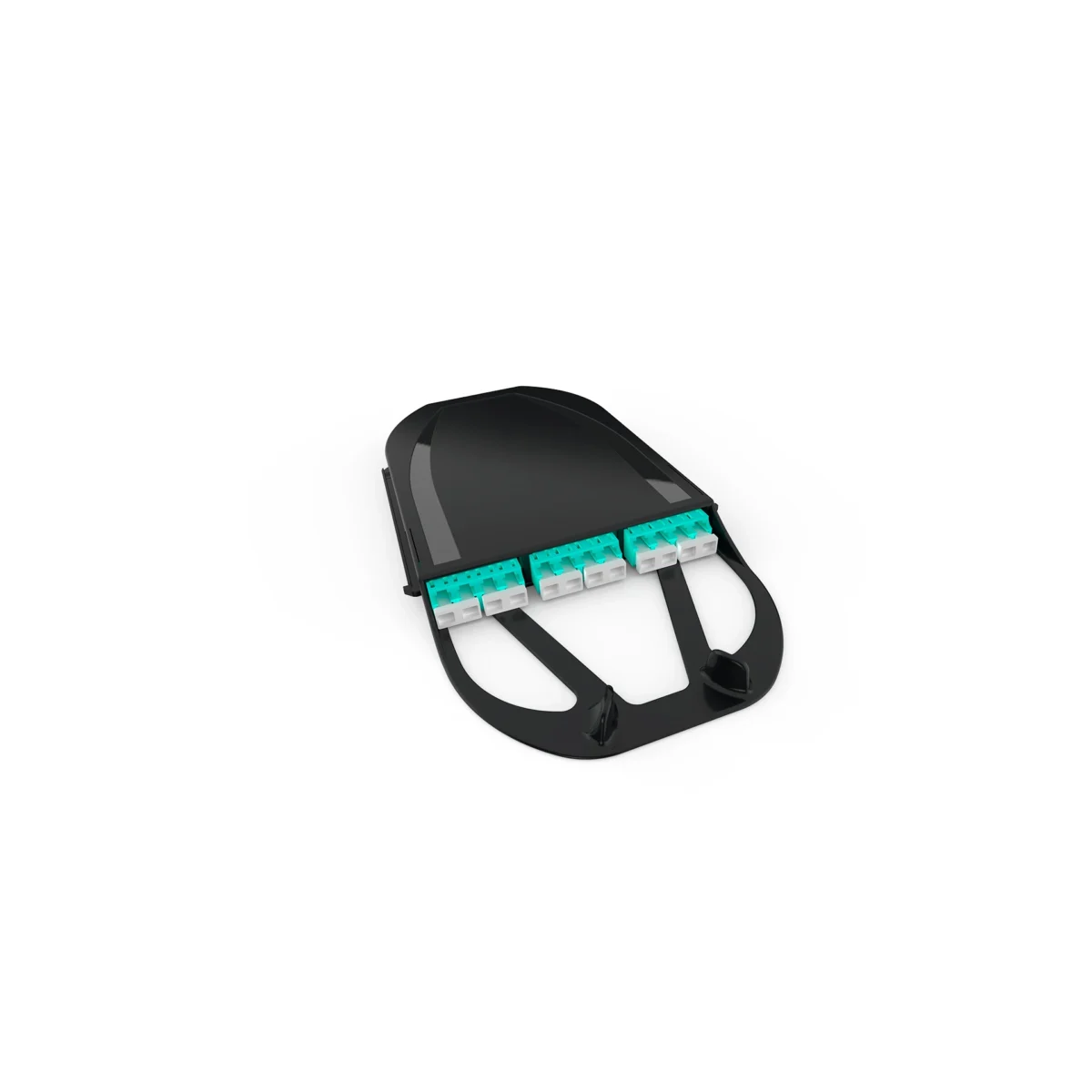
The HDX 12F MPO/MTP to LC cassette module is designed for high-density fibre optic networking environments such as data centres and telecom rooms. It provides an easy way to transition between multi-fibre backbone cables and standard LC patch leads by enclosing a factory-terminated 12-fibre MPO connector at the rear and six duplex LC adapters at the front. Installers can quickly plug a trunk cable into the back and immediately gain twelve usable LC fibre connections at the front, eliminating any need for field termination or splicing. This modular cassette approach ensures consistent quality (each unit is thoroughly tested in the factory) and significantly reduces installation time.
The compact cassette fits into compatible optical distribution frames or patch panels, allowing a dense aggregation of fibre ports while keeping cable management tidy. Multimode OM4 and single-mode OS2 versions are available, supporting both short-range intra-facility links and longer-distance connections as needed. The design meets the requirements of 10G and 40G Ethernet (e.g. 10GBASE-SR, 40GBASE-SR4) as well as Fibre Channel standards, enabling organisations to upgrade network bandwidth without changing their existing cabling infrastructure.
Range features
A high level overview of what this range offers
- Pre-terminated module – Delivered ready to use with MPO-to-LC internal wiring, enabling true plug-and-play installation with no on-site fibre splicing.
- High-density form factor – Slim cassette (only 12.5 mm high) maximises panel capacity, allowing more fibre connections per rack unit for space-saving patching.
- Factory-tested assembly – Each cassette is fully tested for optical performance and compliance, ensuring reliable low-loss connections from day one.
- Multimode & single-mode options – Available in OM4 multimode or OS2 single-mode versions to support both short-distance data centre links and long-distance network channels as required.
- Polarity Type A & B versions – Offered in both straight-through (Type A) and flipped-pair (Type B) configurations to maintain correct transmit/receive polarity. Module body and adapter colours are used for quick identification (e.g. different colours for straight vs. reverse orientation).
- MPO rear & LC front connectivity – Features a 12-fibre MPO female connector at the rear and six LC duplex ports at the front. This provides a universal interface: high-count MPO/MTP trunk cables on the back end and standard LC patch cords on the front end for easy equipment connections.
- Indoor-rated design – Intended for indoor, non-aggressive environments (such as controlled server rooms and telecom closets) to ensure stable long-term performance. The robust module construction protects fibres and connectors, while the closed cassette keeps dust and handling to a minimum.
Downloads
for Cassette Modular HDX 12 Fibres (MPO/MTP - LC)
HDX 12F MPO/MTP-LC Cassette Module – Datasheet
DownloadWhat’s in this range?
All the variants in the range and a comparison of what they offer
| Specification | OM4 Type A | OM4 Type B Straight | OM4 Type B Reverse | SM (UPC) Type B Straight | SM (UPC) Type B Reverse | SM (APC) Type B Straight |
|---|---|---|---|---|---|---|
Fibre type | Multimode OM4 (50/125 µm) | Multimode OM4 (50/125 µm) | Multimode OM4 (50/125 µm) | Single-mode OS2 (G.652.D) | Single-mode OS2 (G.652.D) | Single-mode OS2 (G.652.D) |
Front connectors | 6 × LC duplex (UPC, multimode) | 6 × LC duplex (UPC, multimode) | 6 × LC duplex (UPC, multimode) | 6 × LC duplex (UPC, single-mode) | 6 × LC duplex (UPC, single-mode) | 6 × LC duplex (APC, single-mode) |
Rear connector | MPO female (12-fibre, UPC, no pins) | MPO female (12-fibre, UPC, no pins) | MPO female (12-fibre, UPC, no pins) | MPO female (12-fibre, APC, no pins) | MPO female (12-fibre, APC, no pins) | MPO female (12-fibre, APC, no pins) |
Polarity type | Type A | Type B | Type B | Type B | Type B | Type B |
Internal orientation | Straight | Straight | Reverse | Straight | Reverse | Straight |
Module body colour | Black | Black | White | Black | White | Black |
MPO adapter colour (key) | Black (Type A) | Grey (Type B) | Grey (Type B) | Grey (Type B) | Grey (Type B) | Grey (Type B) |
Dimensions (H × W × D) | 12.5 mm × 99 mm × 187.3 mm | 12.5 mm × 99 mm × 187.3 mm | 12.5 mm × 99 mm × 187.3 mm | 12.5 mm × 99 mm × 187.3 mm | 12.5 mm × 99 mm × 187.3 mm | 12.5 mm × 99 mm × 187.3 mm |
Installation environment | Indoor | Indoor | Indoor | Indoor | Indoor | Indoor |
Operation environment | Non-aggressive | Non-aggressive | Non-aggressive | Non-aggressive | Non-aggressive | Non-aggressive |
FAQs
for Cassette Modular HDX 12 Fibres (MPO/MTP – LC)
Type A cassettes have a straight-through internal wiring, meaning fibre 1 at the MPO goes to the first LC port, fibre 2 to the second, and so on (maintaining the same order). Type B cassettes have a flipped pair wiring – they reverse the fibre order internally (fibre 1 at the MPO goes to the last LC port, etc.). In practice, Type A and Type B are used in pairs to ensure that transmit and receive lanes line up correctly in multi-cassette links. The HDX modules are colour-coded for easy identification: a black cassette body typically indicates straight (Type A or Type B Straight) orientation, while a white body denotes a reversed orientation cassette. Additionally, the MPO adapter on a Type A module is black, versus grey on Type B modules, to signify the polarity type. This way, installers can visually confirm they are using the correct cassette type to maintain proper fibre polarity.
Yes. The HDX 12F cassette comes in multimode OM4 versions as well as single-mode OS2 versions. The multimode model uses OM4 fibre and typically has aqua or beige LC adapters (UPC polish) suitable for short-distance high-bandwidth links (such as within a data centre). The single-mode models use OS2 (G.652.D) fibre and come with either blue LC/UPC adapters or green LC/APC adapters, depending on the variant – these are intended for longer distance links and have low optical loss. Both types have the same physical dimensions and MPO-LC interface, so they install the same way. Be sure to choose the cassette that matches your cable type and network requirements (for example, OM4 for 850 nm VCSEL-based 10/40G links, or OS2 for 1310 nm/1550 nm long-haul links).
You will need a 12-fibre MPO/MTP trunk cable with a male MPO connector (pins protruding) to mate with the cassette’s MPO female port. The cassette’s rear MPO is unpinned (female), so the mating cable must provide guide pins to ensure proper alignment. Also pay attention to the polarity of the MPO cable. For instance, if you are using Type B cassettes on both ends, you would typically use a Type B (pair-flipped) MPO patch cord. If you’re connecting a Type A cassette to a Type B cassette, a Type A (straight-through) MPO cable may be required in one segment of the link. In short, use a high-quality MPO cable of the appropriate length that matches the fibre type (OM4 or OS2) and has the correct pin/out arrangement for the cassette type you’ve deployed. This will ensure that all 12 fibres link the intended transmit/receive channels between your devices.
The cassette is designed as a low-loss passive component. In practical terms, the typical insertion loss of an MPO-LC cassette is around 0.5 dB or less per fibre channel. This figure includes the loss of one MPO mated pair and multiple LC connections inside the module. The exact loss can vary slightly by cassette variant (and whether standard or “low-loss” MPO connectors are used), but generally it stays well within industry standards for multi-fibre connectivity. Using good quality patch cords and keeping connectors clean will help ensure the loss remains low. Always consult the official datasheet for precise specifications – but as a rule, the HDX cassette’s added loss is minimal and will not significantly impact your link budget in typical short-distance deployments.
HDX 12F cassettes are made to be installed in compatible high-density patch panels or optical distribution frames (ODFs). Typically, the manufacturer offers enclosures (for example, a 1U or 3U rack-mount chassis) that hold a certain number of cassette modules side by side. In many designs, a 1U panel might accommodate 3 or 4 HDX cassettes, and larger enclosures can hold more (the exact number depends on the panel model and the cassette width). To install, you simply insert the cassette from the front of the panel and secure it – the LC ports will then be accessible at the front and the MPO connection at the rear inside the panel. The result is a very tidy and modular fibre patching system: you can populate the frame with as many cassettes as needed, and add more later as your network grows. If you have an existing standard ODF or enclosure, check its specifications to see if it accepts HDX-format cassettes (99 mm width modules). It’s recommended to use the matching HDX series patch panels or frames to ensure a perfect fit and proper support for the modules.
No – this product is intended for indoor use only. The cassette and its components are not weather-proof or sealed against moisture. “Non-aggressive” indoor environments (like offices, labs, data centres, or telecom closets) are ideal. This means a location without excessive dust, humidity, chemical fumes, or extreme temperatures. In such environments the cassette can perform reliably over the long term. If you need to deploy fibre connections outdoors or in industrial areas, you would have to place this cassette inside a properly rated outdoor enclosure or use solutions specifically designed for outdoor/harsh conditions (such as weatherproof sealed connectors or splice closures). In summary, treat the HDX 12F cassette as an indoor-only component for best results.
Not in any significant way. The cassette itself is passive and only contributes a small insertion loss (typically well under 1 dB). As long as your overall link loss budget isn’t exceeded, the presence of the cassette won’t noticeably shorten the achievable distance. The maximum link distance is primarily determined by your fibre type and the transceiver optics in use, rather than the cassette. For example, using OM4 multimode fibre, 40 GbE signals can reach around 100–150 metres regardless of whether a cassette is in line; using OS2 single-mode fibre, links can span several kilometres with appropriate lasers. The cassette’s low loss ensures you can still approach those distance limits. It’s always good practice to account for the cassette’s insertion loss in your link budget calculation, but if designed correctly, your network will meet distance requirements with the cassette installed.