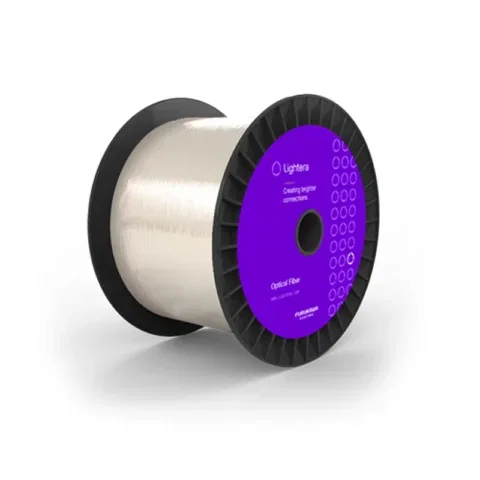
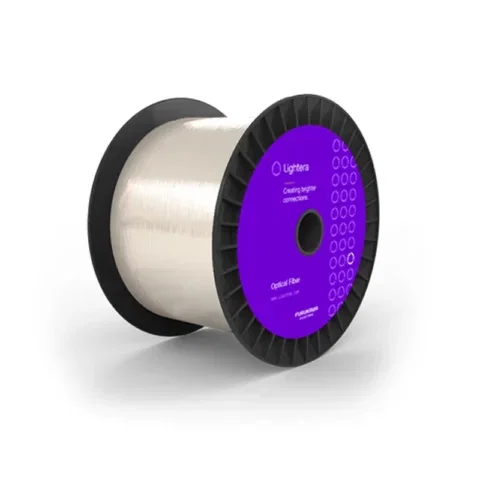
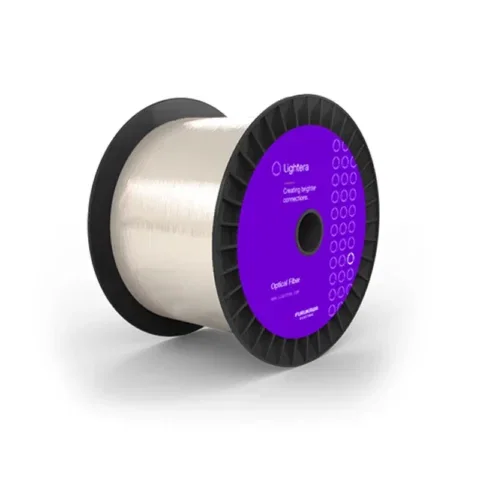
ClearLite® 1310/1550 nm 0.11 NA MICRO Optical Fibre
- Technology
- Speciality fibre
- Partner
- Lightera (formerly OFS)
The BF06257-01 ClearLite Micro 1310/1550 nm 0.11 NA Single-Mode Optical Fibre is designed for dual-wavelength single-mode operation at 1310 nm and 1550 nm. Its ultra-small 80 µm cladding diameter enables very tight coiling in space-constrained assemblies. This makes it well suited for fibre-optic gyroscopes, compact sensor coils, and precision coupler modules. Despite its reduced size, it offers low attenuation and stable optical performance across both key wavelengths.
The fibre can be spliced to standard 125 µm single-mode fibres for easier integration into conventional systems. A dual-layer UV acrylate coating supports reliable handling and operation from –40 °C to +85 °C. With a proof test rating of at least 200 kpsi, it also delivers strong mechanical reliability. Custom options such as alternate coatings, buffer variations, colours, metallisation, and terminations are available for specialised applications.
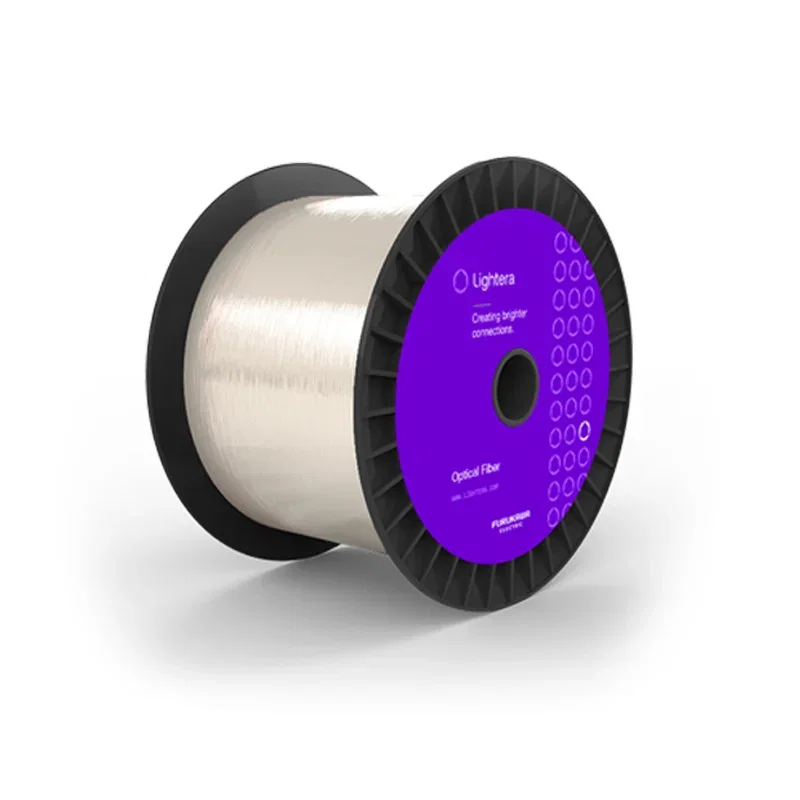
The ClearLite Micro 1310/1550 nm optical fibre is engineered for applications that require tight bend radius performance, compact packaging, and reliable single-mode transmission at two widely used wavelengths. Its reduced 80 µm cladding diameter allows significantly tighter coils than standard 125 µm fibres, making it especially valuable in fibre-optic sensors, gyroscope coils, and compact coupler designs.
The fibre combines miniature geometry with practical integration benefits, including compatibility with standard single-mode splicing workflows, low attenuation at 1310 nm and 1550 nm, and a durable dual acrylate coating for dependable use in demanding environments.
Range features
A high level overview of what this range offers
- 80 µm micro cladding: Enables very tight fibre coils for compact instruments such as fibre-optic gyroscopes and precision sensor assemblies.
- Dual-wavelength operation at 1310 nm and 1550 nm: Supports low-loss transmission across key telecom and sensing bands.
- 0.11 numerical aperture: Provides tight optical mode confinement for efficient coupling in single-mode systems.
- Standard single-mode compatibility: Can be spliced to conventional 125 µm fibres for easier integration with existing components.
- Dual-layer UV acrylate coating: Protects the fibre while supporting reliable handling and operation from –40 °C to +85 °C.
- High proof test strength: Proof-tested to at least 200 kpsi for strong mechanical reliability.
- Low attenuation: Delivers losses of ≤ 0.75 dB/km at 1310 nm and ≤ 0.5 dB/km at 1550 nm.
- Customisable configuration: Available with options for buffer colour, material, size, metallisation, proof test level, cutoff wavelength, and termination.
Downloads
for ClearLite® 1310/1550 nm 0.11 NA MICRO Optical Fibre
What’s in this range?
All the variants in the range and a comparison of what they offer
Physical Characteristics | Value |
Coating Material | Dual UV acrylate |
Core Diameter (nominal) | 8.3 µm |
Cladding Diameter | 80 ± 2 µm |
Coating/Buffer Diameter | 165 ± 10 µm |
Cladding Non-Circularity | ≤ 2.0% |
Core/Cladding Offset | ≤ 0.5 µm |
Optical Characteristics | Value |
Fibre Type | Single-mode |
Operating Wavelength | 1310/1550 nm |
Cutoff Wavelength | ≤ 1310 nm |
Mode Field Diameter @ 1310 nm | 9.3 ± 0.5 µm |
Mode Field Diameter @ 1550 nm | 10.5 ± 1.0 µm |
Attenuation @ 1310 nm | ≤ 0.75 dB/km |
Attenuation @ 1550 nm | ≤ 0.5 dB/km |
Numerical Aperture (NA) | 0.11 (nominal) |
Induced Attenuation @ 1560 nm | ≤ 0.3 dB |
Mechanical & Environmental | Value |
Operating Temperature | –40 to +85 °C |
Short-Term Bend Radius | ≥ 4 mm |
Long-Term Bend Radius | ≥ 6 mm |
Proof Test Level | ≥ 200 kpsi (1.38 GPa) |
Ordering Information | Value |
Part Number | BF06257-01 |
Product Code | SMM-A1310B |
Available Options | Buffer colour, buffer material, buffer size, cutoff wavelength, metallisation, proof test level, termination |
FAQs
for ClearLite® 1310/1550 nm 0.11 NA MICRO Optical Fibre
Standard single-mode fibres typically use a 125 µm cladding, while the ClearLite Micro fibre uses a much smaller 80 µm cladding diameter. This micro design allows the fibre to be coiled much more tightly, helping engineers fit longer fibre lengths into compact devices such as fibre-optic gyroscopes and sensor coils. Despite the reduced size, it still provides single-mode operation at 1310 nm and 1550 nm.
Yes. The fibre is designed for compatibility with standard single-mode systems in terms of core and optical behaviour, so it can be fusion spliced to conventional 125 µm single-mode fibre. In practice, specialised splice holders or adapters are typically used to accommodate the smaller cladding, while maintaining low-loss alignment.
A 0.11 numerical aperture indicates a relatively narrow light acceptance angle, which is typical for single-mode fibre. This helps keep the optical mode tightly confined in the core, supporting clean signal transmission, efficient coupling to other single-mode components, and reliable performance in couplers and sensor systems.
The fibre offers attenuation of ≤ 0.75 dB/km at 1310 nm and ≤ 0.5 dB/km at 1550 nm. These low-loss values help preserve signal quality over practical working lengths used in sensing, gyroscope, and compact photonic assemblies.
The minimum recommended bend radius is 4 mm for short-term handling and 6 mm for long-term installation. This tight bend capability is a key advantage of the 80 µm cladding design, allowing compact coiling with minimal induced optical loss when used within specification.
With its standard dual acrylate coating, the fibre is rated for operation from –40 °C to +85 °C. For more demanding thermal environments, alternate coating options such as polyimide may be specified for higher-temperature applications.
Available options include buffer colour, buffer material, buffer size, cutoff wavelength, metallisation, proof test level, and termination. The fibre may also be specified with alternate coatings, including high-temperature variants, depending on the application.
This fibre is commonly used in fibre-optic gyroscopes, precision fibre sensors, and compact optical couplers or splitters where long fibre lengths must be packaged into a limited space. Its small cladding diameter and tight bend radius make it particularly suitable for miniature photonic and sensing systems.