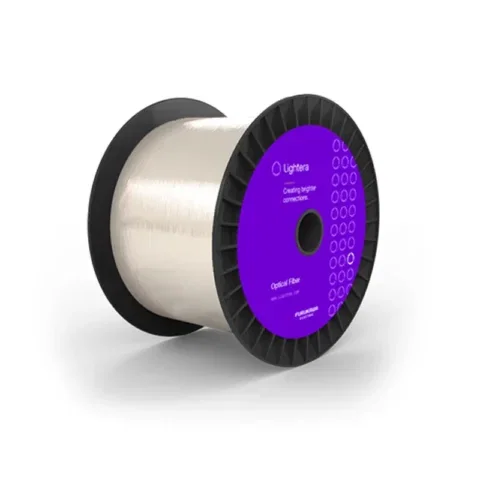
HCS® 800 µm 0.37 NA Step-Index Low OH Optical Fibre
- Technology
- Speciality fibre
- Partner
- Lightera (formerly OFS)
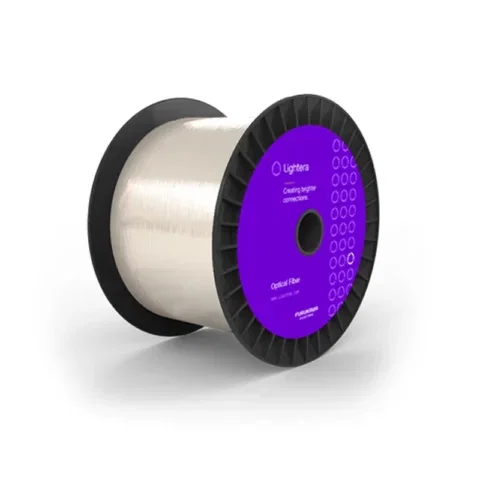
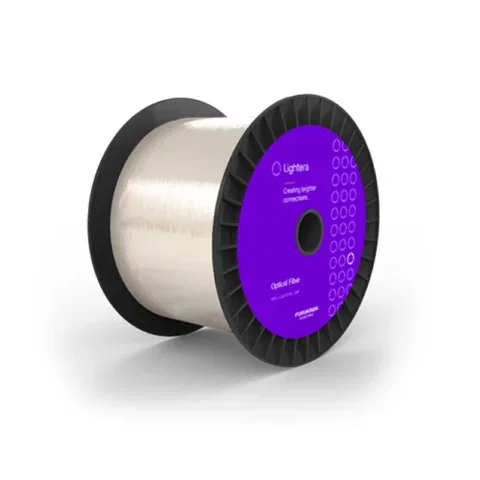
The HCS 800 µm 0.37 NA Step-Index Low OH Optical Fibre is a large-core multimode fibre built for demanding industrial and specialty applications. It combines an 800 µm pure silica core with hard polymer cladding for strong optical performance and improved mechanical ruggedness. Its 0.37 numerical aperture supports efficient light capture and easier coupling with LEDs, laser diodes, and other light sources. The low OH silica core helps minimise attenuation in the near-infrared range, making the fibre suitable for visible red, 850 nm, and extended IR use cases. A durable ETFE buffer supports reliable handling and protection in harsh operating conditions. The fibre is well suited to factory automation, sensing, medical instrumentation, laser delivery, and short-to-medium distance industrial links.
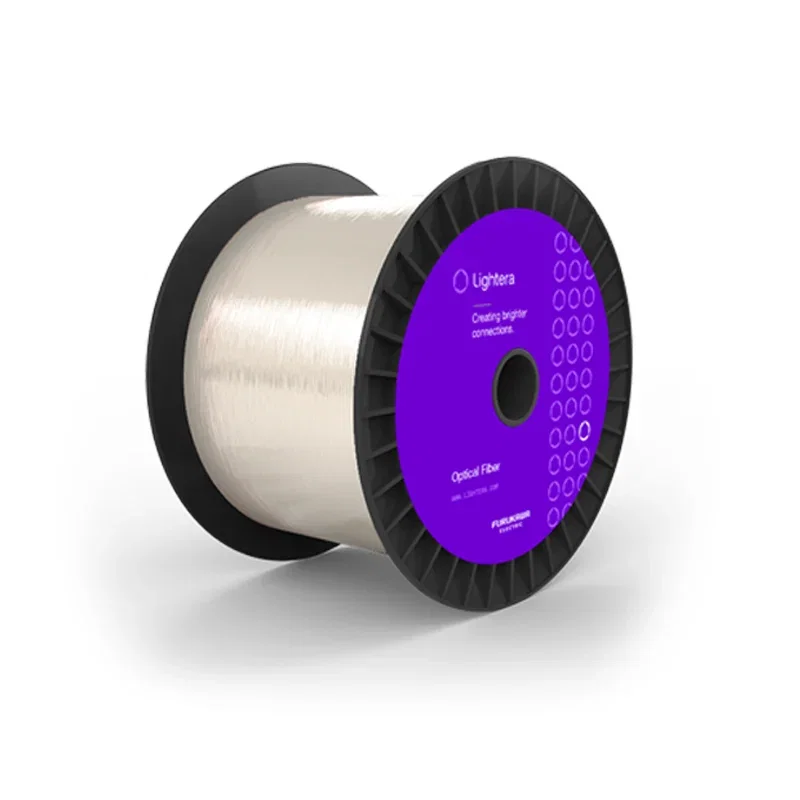
The HCP-M0800T is a large-core multimode Hard-Clad Silica optical fibre engineered for applications where durability, light-gathering capability, and easy handling are critical. Its 800 µm pure silica core, 0.37 NA, and low OH composition make it a practical choice for industrial sensing, machine integration, medical systems, and high-power laser delivery.
The hard polymer cladding and ETFE buffer help the fibre withstand challenging environments, including wide temperature swings, tight installation spaces, and exposure to industrial chemicals. This combination of optical efficiency and mechanical toughness makes it especially useful where conventional glass fibre may be too delicate or difficult to deploy.
Range features
A high level overview of what this range offers
- Large 800 µm core with 0.37 NA: Captures more light and accepts wider launch angles for easier coupling and alignment.
- Low OH pure silica core: Reduces attenuation in near-infrared ranges, supporting applications at 650 nm, 850 nm, and beyond.
- Rugged hard polymer cladding: Improves mechanical strength and supports reliable use in industrial environments.
- Bend-resistant design: Maintains optical integrity in constrained routing conditions when installed within recommended bend limits.
- Wide environmental tolerance: Operates from –65 °C to +125 °C and resists many industrial chemicals.
- Long service life: Built for stable optical performance and reduced maintenance in long-term use.
- Straightforward handling and termination: The ETFE buffer and large-core format support easier installation and compatibility with suitable large-core connector solutions.
Downloads
for HCS® 800 µm 0.37 NA Step-Index Low OH Optical Fibre
What’s in this range?
All the variants in the range and a comparison of what they offer
Specification | Value |
Product Description | 800 µm 0.37 NA Low OH |
Core Diameter | 800 ± 15 µm |
HCS® Cladding Diameter | 830 ± 15 µm |
ETFE Buffer Diameter | 1040 ± 30 µm |
Core/Clad Offset | ≤ 9.0 µm |
Crimp & Cleave Compatible | Yes |
Cladding Material | HCS fluoroacrylate (polymer) |
Buffer Material | ETFE (thermoplastic polymer) |
Type | Multimode Step-Index |
Numerical Aperture (NA) | 0.37 |
Attenuation @ 850 nm | ≤ 8 dB/km |
Water Content | Low OH (low hydroxyl) |
Operating Temperature | –65 °C to +125 °C |
Short-Term Bend Radius | ≥ 73 mm |
Long-Term Bend Radius | ≥ 118 mm |
Proof Test Level | ≥ 100 kpsi (≈0.689 GPa) |
Order Part Number | CF01493-65 |
Description Code | HCP-M0800T |
Options | Buffer Colour, Alternate Buffer Diameter or Material, Custom Proof Test levels |
FAQs
for HCS® 800 µm 0.37 NA Step-Index Low OH Optical Fibre
The 800 µm core diameter allows the fibre to capture and transmit a high amount of light, while the 0.37 numerical aperture accepts light at wider angles. Together, these features make coupling easier, reduce alignment sensitivity, and support simpler, lower-cost optical system design in industrial environments.
Low OH means the silica core contains very low hydroxyl impurity levels, which helps reduce absorption losses in the near-infrared region. This makes the fibre suitable not only for visible red and 850 nm operation, but also for extended IR applications such as spectroscopy, sensing, and laser delivery.
This fibre is intended for harsh and industrial conditions. Its hard polymer cladding and ETFE buffer support resistance to chemicals, oils, solvents, vibration, and demanding mechanical handling. With an operating temperature range of –65 °C to +125 °C, it is suitable for both extreme cold and elevated-temperature environments.
The fibre can be terminated using specialised large-core connector hardware such as suitable SMA or custom industrial connector solutions. Its robust buffered construction helps make handling easier during assembly, and it may also be integrated through manufacturer-recommended connector systems or appropriate pigtail arrangements.
The specified attenuation is ≤ 8 dB/km at 850 nm. In practice, the fibre is generally best suited to short-to-medium distance links, typically from a few hundred metres up to a few kilometres depending on source power, receiver sensitivity, and total system optical budget.
Yes. The large core helps lower optical power density compared with smaller-core fibres, which supports high-power laser delivery in industrial and medical systems. As with any laser application, installation quality, bend management, and compatibility with the intended power level should be considered carefully.
In an HCS fibre, the core is silica while the cladding is a hard polymer rather than glass. This enables greater mechanical ruggedness, larger practical core sizes, and a relatively high numerical aperture. Compared with conventional all-glass fibres, HCS designs are often easier to handle and better suited to demanding industrial and sensor applications over shorter distances.
The recommended minimum bend radius is about 73 mm for short-term bends and about 118 mm for long-term routing. Staying within these limits helps preserve optical performance, minimise stress, and maintain long-term reliability.