100/140 µm Multi-mode Graded-Index High Temperature Optical Fibre
- Technology
- Speciality fibre
- Partner
- Lightera (formerly OFS)
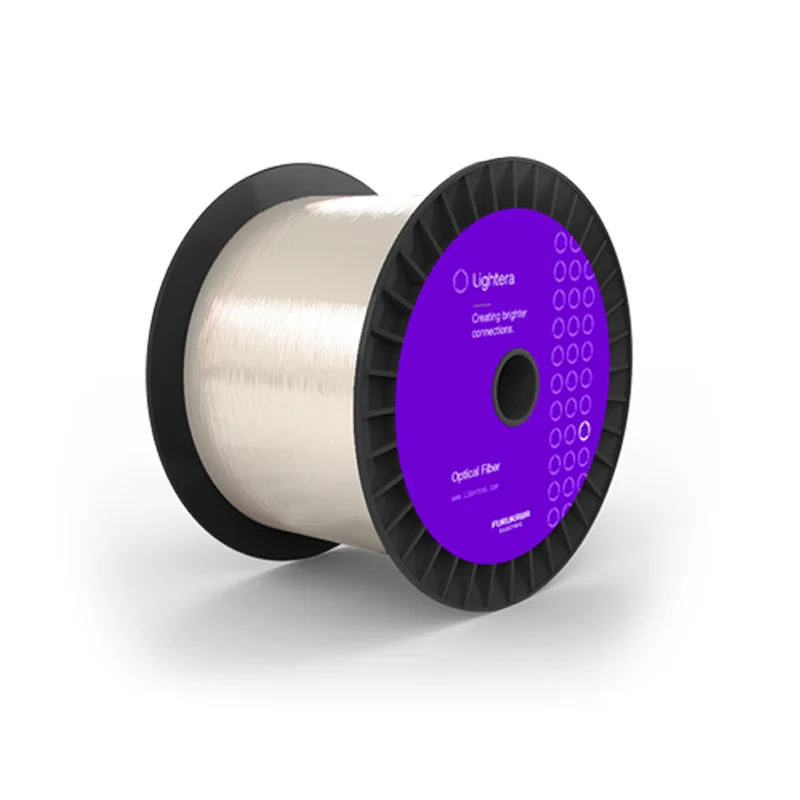
This specialty multimode optical fibre is designed for reliable data links and sensing in exceptionally hot and demanding environments. It features a 100 µm core diameter and 140 µm cladding with a graded-index profile for controlled multimode signal transmission at 850 nm and 1300 nm. The PYROCOAT® polyimide coating supports continuous operation from –65 °C to +300 °C, making it suitable for conditions beyond the limits of standard optical fibres. Its large core and 0.29 numerical aperture help improve coupling efficiency from LEDs, VCSELs, and other optical sources. The fibre also combines strong optical performance with mechanical robustness for harsh industrial, aerospace, and high-temperature sensor applications.
Range features
A high level overview of what this range offers
- High-temperature polyimide coating: Operates from –65 °C to +300 °C for reliable use in furnaces, engines, downhole systems, and other extreme environments.
- Large 100 µm core with 0.29 NA: Supports easier alignment and higher light capture from LEDs, lasers, and other optical sources.
- Graded-index multimode performance: Provides bandwidth of ≥100 MHz·km at both 850 nm and 1300 nm with reduced modal dispersion.
- Harsh environment durability: Built to maintain optical performance under wide temperature swings and demanding industrial or aerospace conditions.
- Flexible deployment options: Available with cabling options and supports tight installation with ≥11 mm short-term and ≥19 mm long-term bend radius guidance.
Downloads
for 100/140 µm Multi-mode Graded-Index High Temperature Optical Fibre
What’s in this range?
All the variants in the range and a comparison of what they offer
Specification | Value |
Product Description | 100/140 High-Temperature Optical Fibre (Graded-Index Multimode) |
Coating Material | PYROCOAT® polyimide |
Core Diameter | 100 ± 4 µm |
Cladding Diameter | 140 ± 3 µm |
Coating Diameter | 170 ± 5 µm |
Core/Clad Offset | ≤ 3 µm |
Core Non-Circularity | ≤ 5 % |
Clad Non-Circularity | ≤ 2.0 % |
Crimp & Cleave Compatible | No |
Type | Multimode (graded-index) |
Numerical Aperture | 0.29 |
Bandwidth @ 1300 nm | ≥ 100 MHz·km |
Bandwidth @ 850 nm | ≥ 100 MHz·km |
Attenuation @ 1300 nm | ≤ 3 dB/km |
Attenuation @ 850 nm | ≤ 5 dB/km |
Operating Temperature | –65 °C to +300 °C |
Short-Term Bend Radius | ≥ 11 mm |
Long-Term Bend Radius | ≥ 19 mm |
Proof Test Level | 100 kpsi (0.689 GPa) |
Order by Part Number | BF04436 |
Product Description Code | TCU-MC100H |
Options | Cabling |
FAQs
for 100/140 µm Multi-mode Graded-Index High Temperature Optical Fibre
This fibre is designed for extreme conditions and supports operation from –65 °C to +300 °C. Its high-temperature polyimide coating helps preserve mechanical integrity and optical performance in environments such as furnaces, engines, and other high-heat systems.
The 100 µm core combined with a 0.29 numerical aperture captures more light from LEDs, VCSELs, and other sources. This makes alignment easier and improves coupling efficiency, helping deliver stronger signal input into the fibre.
Yes. This graded-index multimode fibre is designed for use at both 850 nm and 1300 nm. It provides bandwidth of ≥100 MHz·km at each wavelength, making it suitable for optical sensing and short-to-moderate distance data transmission.
The specified attenuation is ≤ 5 dB/km at 850 nm and ≤ 3 dB/km at 1300 nm. This provides relatively low signal loss for this fibre type, supporting reliable use in many industrial sensing and communication applications.
This fibre is not crimp and cleave compatible, so quick mechanical termination methods are not suitable. The polyimide coating typically requires thermal or chemical stripping before splicing or epoxy-polish connector termination. Standard fusion splicing can be used once the coating is properly removed.
Yes. The fibre is available with cabling options, allowing integration into more rugged deployment formats for industrial handling and installation where additional protection is required.
The specified short-term bend radius is ≥ 11 mm, while the long-term bend radius is ≥ 19 mm. Following the long-term bend guidance helps reduce the risk of added attenuation or mechanical damage over time.