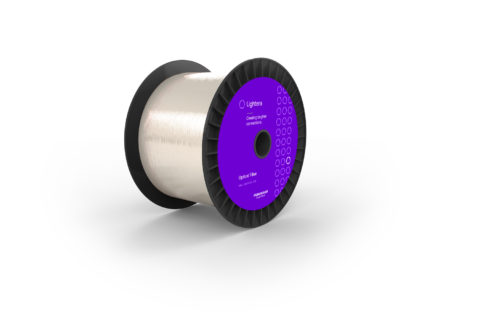
ClearLite® 820 / 850 nm 0.15 NA MICRO Optical Fibre
- Technology
- Speciality fibre
- Partner
- Lightera (formerly OFS)
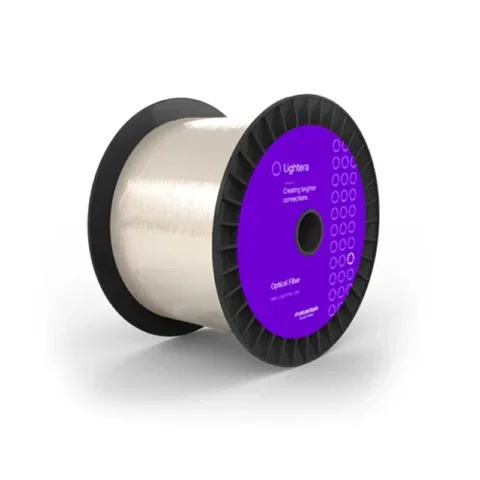
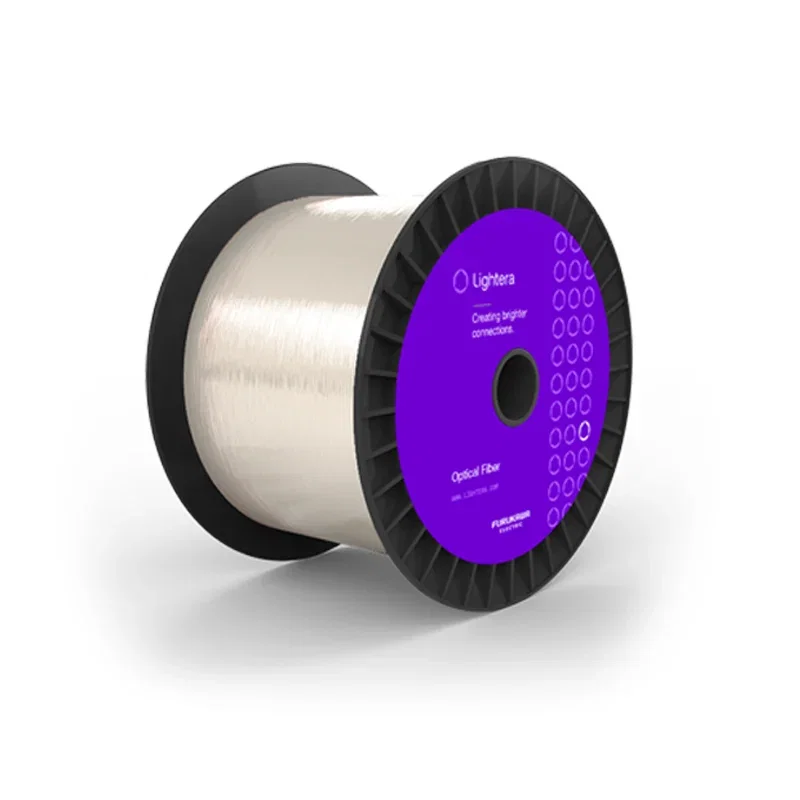
The ClearLite 820/850 nm 0.15 NA Micro Optical Fibre is a single-mode fibre optimised for short-wavelength applications around 820 nm and 850 nm. It uses a small core of approximately 3.7 µm and a tailored index profile to support reliable single-mode transmission where standard telecom fibres would normally be multi-mode. Its nominal numerical aperture of 0.16 helps with efficient coupling from LED and laser diode sources while maintaining strong mode confinement. The reduced 80 µm cladding diameter supports tight routing and compact coiling in miniature assemblies. A single UV-cured acrylate coating provides flexibility and dependable protection in operating temperatures from –40 °C to +85 °C. The fibre is well suited to fibre-optic gyroscopes, integrated photonic devices, laser diode pigtails, and compact sensor modules. Low attenuation at 820 nm and a 200 kpsi proof test support stable long-term performance in demanding photonic systems.
Range features
A high level overview of what this range offers
- Single-mode at 820 nm and 850 nm – Supports stable propagation at short wavelengths with no modal dispersion, helping preserve signal quality in near-IR systems.
- 80 µm reduced cladding diameter – Enables tighter coils and more compact routing than standard 125 µm fibre, ideal for miniature photonic assemblies and sensor coils.
- Nominal 0.16 NA – Balances easier source coupling with strong optical confinement to reduce bend-related loss.
- Low attenuation at 820 nm – Specified at ≤ 5 dB/km, helping maintain optical power over typical instrument and sensor coil lengths.
- Tight bend capability – Supports a 5 mm short-term and 9 mm long-term bend radius for installation in confined spaces.
- Single UV acrylate coating – Provides a practical combination of flexibility, protection, and straightforward handling for stripping, splicing, or termination.
- 200 kpsi proof tested – Indicates strong mechanical robustness for installation and long-term use.
- Customisable options – Available with choices such as buffer colour, buffer material, buffer size, metallisation, proof test, cutoff wavelength, and termination.
Downloads
for ClearLite® 820 / 850 nm 0.15 NA MICRO Optical Fibre
What’s in this range?
All the variants in the range and a comparison of what they offer
Parameter | Value |
Coating Material | Single UV Acrylate |
Core Diameter (Nominal) | 3.7 µm |
Cladding Diameter | 80 ± 1 µm |
Coating/Buffer Diameter | 135 ± 5 µm |
Clad Non-Circularity | ≤ 2.0 % |
Core/Clad Offset | ≤ 0.5 µm |
Type | Single-Mode |
Operating Wavelength | 820 nm & 850 nm |
Cutoff Wavelength | 770 ± 40 nm |
Mode Field Diameter @ 820 nm | 4.1 ± 0.75 µm |
Attenuation @ 820 nm | ≤ 5 dB/km |
Numerical Aperture (Nominal) | 0.16 |
Operating Temperature | –40 °C to +85 °C |
Short-Term Bend Radius | ≥ 5 mm |
Long-Term Bend Radius | ≥ 9 mm |
Proof Test Level | 200 kpsi (1.38 GPa) |
Order by Part Number | CF04246-03 |
Product Description Code | SMM-D0820A |
Options | Buffer Colour, Buffer Material, Buffer Size, Cutoff Wavelength, Metallisation, Proof Test, Termination |
FAQs
for ClearLite® 820 / 850 nm 0.15 NA MICRO Optical Fibre
This fibre is designed with a small core size and a tailored refractive index profile so that its cutoff wavelength is around 770 nm. As a result, at 820 nm and 850 nm it supports only the fundamental mode, delivering clean single-mode performance at wavelengths where standard telecom fibres would typically become multi-mode.
A numerical aperture of about 0.16 provides a practical balance between coupling efficiency and mode confinement. It gives the fibre a moderately wide acceptance angle, making it easier to couple light from laser diodes or LEDs, while still helping to keep bending losses low.
The reduced 80 µm cladding diameter allows the fibre to be coiled more tightly and routed through smaller spaces. This is especially useful in compact devices such as fibre-optic gyroscopes, integrated photonic packages, and other miniature optical assemblies where space is limited.
The 5 mm short-term bend radius means the fibre can tolerate very tight bends temporarily during handling or installation. The 9 mm long-term bend radius is the recommended minimum for continuous use, helping maintain reliable performance and reducing long-term mechanical stress.
Yes. In addition to the standard single UV acrylate coating, the fibre can be customised with alternative buffer materials, buffer sizes, buffer colours, metallisation, and termination options to better suit specific integration or environmental requirements.
A 200 kpsi proof test indicates that each fibre has been mechanically stress-tested to a high level during manufacturing to screen out flaws. This demonstrates strong mechanical robustness and gives confidence in durability during handling, installation, and long-term operation.
No. This is a standard single-mode fibre, not a polarization-maintaining fibre. It is suitable for applications that do not require fixed polarization control, but applications needing stable polarization would require a dedicated PM fibre.
Typical applications include fibre-optic gyroscopes, laser diode pigtails around 820–850 nm, integrated photonic devices, and compact optical sensors. It is particularly well suited to systems that need single-mode performance at short wavelengths in a compact form factor.