PYROCOAT Multi-mode Step-Index 200 µm Core Optical Fibre
- Technology
- Fibre optic cables, connectors and assemblies
- Partner
- Lightera (formerly OFS)
The CF04406 Series PYROCOAT 200 µm Multimode Step-Index Optical Fibre is designed for demanding optical systems that must operate reliably under extreme thermal and environmental conditions. Its 200 µm core supports efficient coupling and high-power throughput, making it suitable for lasers, spectroscopy systems, and illumination sources. The all-silica core and cladding provide a high damage threshold and stable optical performance across UV, visible, and near-IR wavelengths.
A PYROCOAT polyimide coating enables continuous operation up to 300 °C with short-term excursions up to about 400 °C. The range is available in High OH and Low OH variants to optimise transmission for UV-visible or near-IR use cases. Its chemically resistant, rugged construction also supports use in medical, aerospace, industrial, sensing, and other harsh-environment applications.
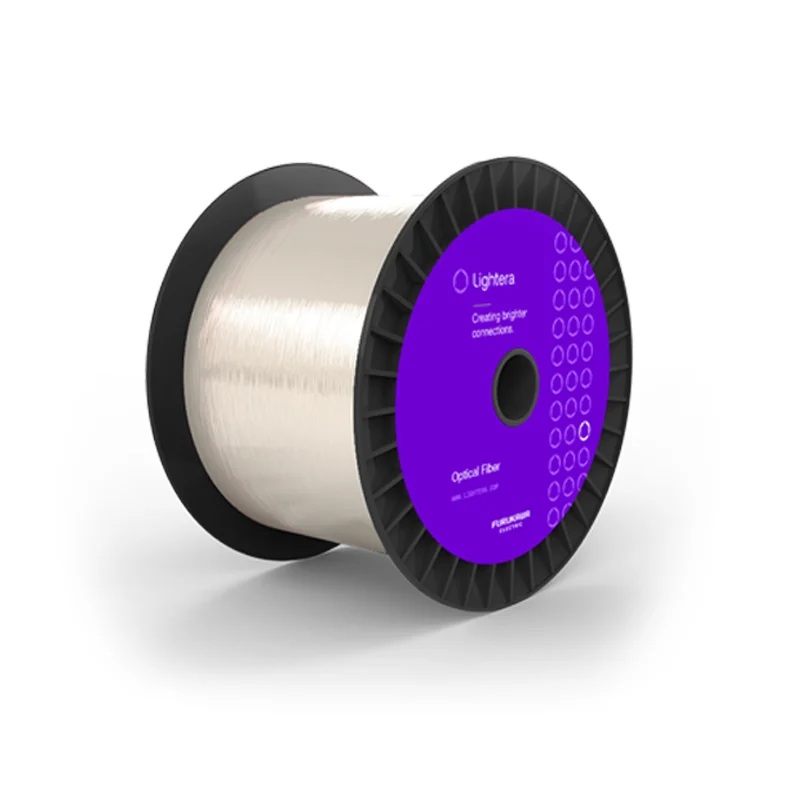
The CF04406 Series PYROCOAT 200 µm optical fibre is a specialty multimode step-index fibre built for applications where standard coated fibres cannot survive. Its all-silica construction, large 200 µm core, and polyimide PYROCOAT coating combine broad spectral performance with excellent durability in high-temperature and chemically challenging environments.
Available in both High OH and Low OH versions, the range can be selected to suit UV-visible or near-IR transmission needs. This makes it a strong choice for laser delivery, spectroscopy, medical instrumentation, aerospace sensing, and industrial systems that demand reliable optical performance under harsh conditions.
Range features
A high level overview of what this range offers
- All-silica core and cladding: High damage threshold and stable optical performance for demanding light-delivery applications.
- 200 µm large core: Easier light coupling and higher power throughput than smaller-core alternatives.
- 0.22 numerical aperture: Wide acceptance angle for efficient coupling to lasers, LEDs, and other sources.
- PYROCOAT polyimide coating: Supports continuous operation up to 300 °C and brief exposure up to 400 °C.
- High OH and Low OH options: Choose optimised performance for UV-visible or near-IR wavelength ranges.
- Biocompatible and chemically resistant design: Suitable for medical, industrial, and harsh-environment use.
- Proof-tested strength: Rated to ≥ 100 kpsi (0.689 GPa) for dependable mechanical reliability.
- Customisation options available: Including connectorisation, metallisation, dimensional changes, NA adjustment, and proof-test options.
High-temperature performance Designed for continuous use from -65 °C to +300 °C, with short-term exposure up to +400 °C for demanding thermal environments.
Broad spectral usability Available in High OH for UV-visible transmission and Low OH for reduced near-IR attenuation.
Engineered for integration Supports custom connectorisation, metallisation, and other specification changes for specialised optical assemblies.
Downloads
for PYROCOAT Multi-mode Step-Index 200 µm Core Optical Fibre
What’s in this range?
All the variants in the range and a comparison of what they offer
| Specification | High OH Variant (CF04406-03) | Low OH Variant (CF04406-13) |
|---|---|---|
Product Description | 200 µm PYROCOAT Step-Index | 200 µm Low OH PYROCOAT Step-Index |
Core Diameter | 200 ± 5 µm | 200 ± 5 µm |
Cladding Diameter | 220 ± 5 µm | 220 ± 5 µm |
Coating Diameter | 250 ± 5 µm | 250 ± 5 µm |
Coating Concentricity | ≥ 80% | ≥ 80% |
Crimp & Cleave Compatible | No | No |
Coating Material | PYROCOAT (Polyimide) | PYROCOAT (Polyimide) |
Fibre Type | Multimode Step-Index | Multimode Step-Index |
Numerical Aperture (NA) | 0.22 | 0.22 |
Attenuation | ≤ 10 dB/km @ 820 nm | ≤ 8 dB/km @ 850 nm |
Water Content | High OH | Low OH |
Operating Temperature | –65 °C to +300 °C | –65 °C to +300 °C |
Short-Term Temp. Excursion | Up to +400 °C (brief) | Up to +400 °C (brief) |
Min. Bend Radius (short-term) | ≥ 17 mm | ≥ 17 mm |
Min. Bend Radius (long-term) | ≥ 28 mm | ≥ 28 mm |
Proof Test Level | ≥ 100 kpsi (0.689 GPa) | ≥ 100 kpsi (0.689 GPa) |
Orderable Part Number | CF04406-03 | CF04406-13 |
Product Description Code | TCG-MA200H | TCL-MA200H |
Available Options | Clad Diameter; Core Diameter; Connectorisation; Metallisation; Numerical Aperture; Proof Test | Clad Diameter; Core Diameter; Connectorisation; Metallisation; Numerical Aperture; Proof Test |
Note | Polyimide-coated fibres (PYROCOAT) are proven to operate in environments up to ~300 °C (application-dependent performance). | Polyimide-coated fibres (PYROCOAT) are proven to operate in environments up to ~300 °C (application-dependent performance). |
FAQs
for PYROCOAT Multi-mode Step-Index 200 µm Core Optical Fibre
The difference is the hydroxyl (OH) content in the silica. The High OH version is better suited to UV and visible-light transmission, while the Low OH version offers lower attenuation in the near-infrared range. In practical terms, High OH is typically chosen for UV-visible applications, while Low OH is preferred for IR lasers and near-IR optical systems.
A PYROCOAT polyimide coating is designed for high-temperature and harsh-environment use where standard coatings would degrade. It supports continuous operation up to 300 °C and short-term exposure up to about 400 °C, while also offering good chemical resistance. This makes it suitable for aerospace, industrial, medical, and sensing applications that would exceed the limits of conventional coated fibres.
The fibre is specified for continuous operation from -65 °C to +300 °C. It can also tolerate brief temperature excursions up to around +400 °C. Actual performance depends on the application and exposure duration, but the design is intended for reliable use in extreme thermal environments.
For reliable long-term installation, the recommended minimum bend radius is 28 mm. For short-term handling or installation, it can tolerate bends down to about 17 mm radius. Keeping within these limits helps minimise optical loss and mechanical stress.
This fibre is not crimp-and-cleave compatible, so it does not use the simplest quick-termination methods. However, it can still be terminated using proper epoxy and polish techniques, ferrules, or professionally prepared assemblies. Connectorisation is also available as a custom option for easier integration into finished systems.
Typical uses include medical lasers and illumination, industrial laser delivery, spectroscopy and sensing, aerospace and defence systems, and oil, gas, or energy-sector monitoring. It is especially suitable where high optical power, broad wavelength coverage, and thermal resilience are required.
Yes. The CF04406 series offers customisation options including alternative core or cladding diameters, connectorisation, metallisation, numerical aperture adjustment, and different proof-test levels. This flexibility helps adapt the fibre to specific integration, environmental, or performance requirements.