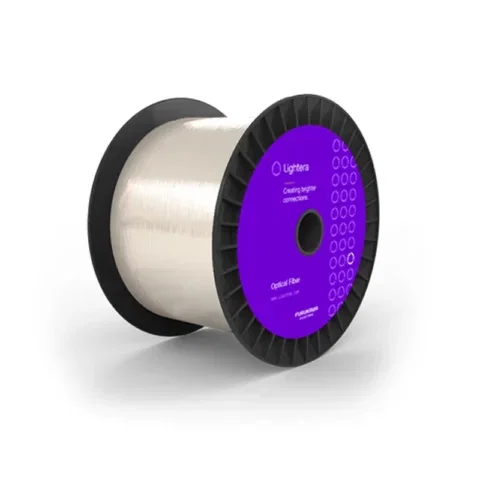
HCS® All Silica 365 µm 0.22 NA Step-Index Low OH Optical Fibre
- Technology
- Speciality fibre
- Partner
- Lightera (formerly OFS)
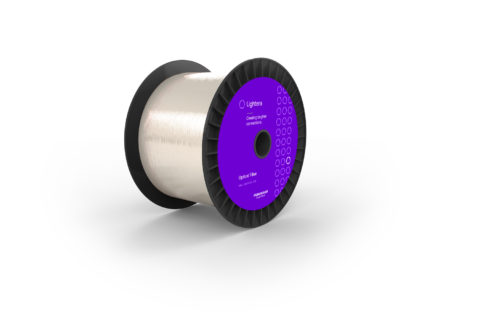
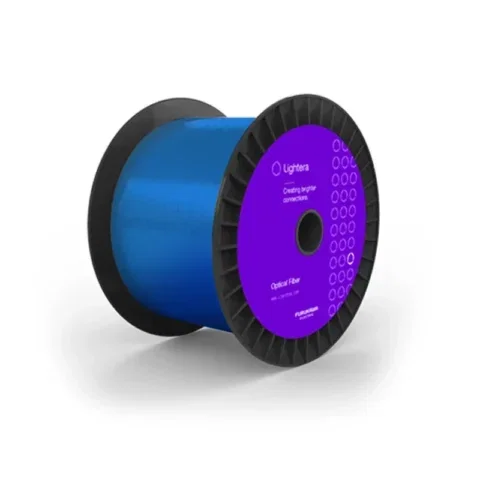
The CF01493-52 HCS All Silica 365 µm 0.22 NA Optical Fibre is a speciality multimode fibre engineered for demanding applications in industry, aerospace, and medical technology. It features a 365 µm diameter silica core with low OH content, optimised for near-infrared laser transmission with low attenuation. Its step-index design and 0.22 numerical aperture support easy light coupling and efficient power delivery from broad-beam sources. The combination of a pure silica core and hard polymer cladding provides strong optical performance with enhanced mechanical durability. This construction supports a high damage threshold for delivery of high-power laser energy in cutting, welding, and surgical processes. The fibre also uses biocompatible materials, making it suitable for medical devices and diagnostic systems. With an operating temperature range from -65°C to +125°C, it performs reliably in harsh industrial and aerospace environments. An optional polyimide coating can be specified for applications requiring even higher temperature resistance.
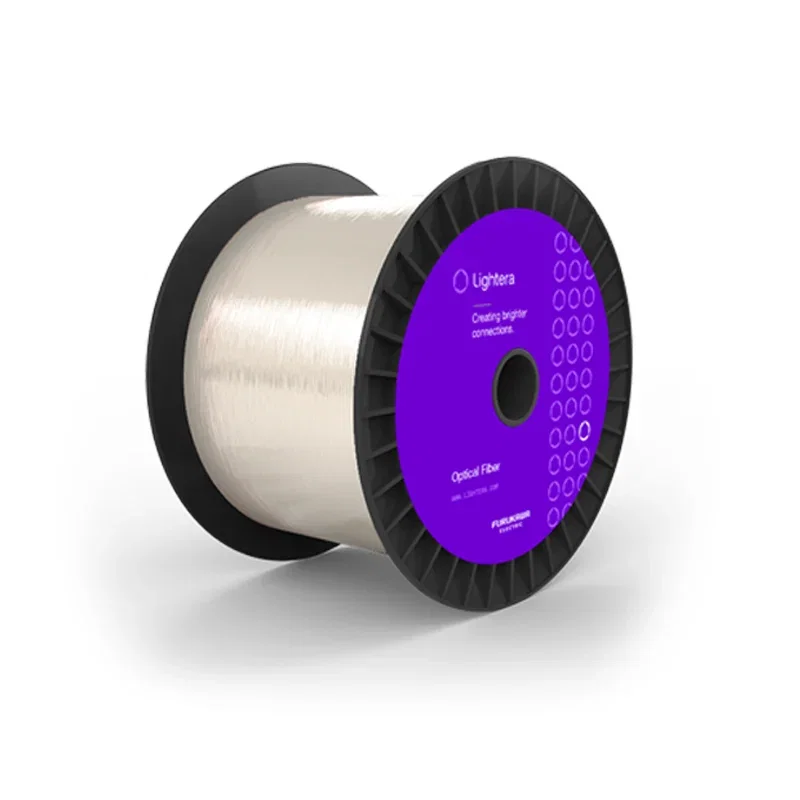
This hard-clad silica fibre is designed for organisations that need reliable high-power laser delivery in demanding environments. Its 365 µm core, low-OH silica composition, and 0.22 NA make it well suited to near-IR transmission in industrial, aerospace, and medical systems. The robust HCS construction combines strong optical throughput with mechanical resilience, while the ETFE buffer adds protection for routine handling and installation.
Range features
A high level overview of what this range offers
- Low-OH silica core – Minimises attenuation at near-infrared wavelengths for efficient IR laser transmission
- Large 365 µm core with 0.22 NA – Supports easy coupling and high optical throughput from broad-beam sources
- High damage threshold – Suitable for demanding high-power laser delivery applications
- Hard polymer cladding and ETFE buffer – Improves durability and resistance in industrial and aerospace environments
- Biocompatible material system – Appropriate for use in medical laser and diagnostic device applications
- Wide operating temperature range – Rated from -65°C to +125°C for reliable performance in harsh conditions
- Step-index multimode design – Optimised for practical power delivery rather than long-distance bandwidth
Downloads
for HCS® All Silica 365 µm 0.22 NA Step-Index Low OH Optical Fibre
What’s in this range?
All the variants in the range and a comparison of what they offer
Physical Characteristic | Value |
Core Diameter | 365 ± 10 µm |
Cladding Diameter | 400 ± 10 µm |
Coating Diameter | 430 +5/–10 µm |
Buffer Diameter | 730 ± 30 µm |
Core/Clad Offset | ≤ 9 µm |
Crimp & Cleave Compatible | No |
Cladding Material | HCS fluoroacrylate |
Buffer Material | ETFE (polymer) |
Standard Buffer Colour | Natural (clear) |
Optical Characteristic | Value |
Fibre Type | Multimode Step-Index |
Numerical Aperture | 0.22 |
Attenuation @ 850 nm | ≤ 8 dB/km |
Water Content | Low OH (low moisture) |
Mechanical & Environmental | Value |
Operating Temperature | –65°C to +125°C (Mid-Temp) |
Short-Term Bend Radius | ≥ 29 mm |
Long-Term Bend Radius | ≥ 47 mm |
Proof Test Level | ≥ 100 kpsi (0.689 GPa) |
Ordering Information | Value |
Order by Part Number | CF01493-52 |
Product Description Code | HCL-M0365T |
FAQs
for HCS® All Silica 365 µm 0.22 NA Step-Index Low OH Optical Fibre
“Low OH” means the silica core contains low hydroxyl ion content. This reduces absorption in the near-infrared range and helps the fibre achieve lower signal loss when transmitting IR laser light. Compared with high-OH fibres, low-OH variants are better suited to infrared transmission rather than UV-focused applications.
This fibre is optimised for the near-infrared region, approximately 0.4 µm to 2.2 µm, with strong performance at common IR laser wavelengths such as 808 nm and 1064 nm. It can also transmit visible light, but it is not specifically intended for UV use.
The light-guiding core is pure silica, but the fibre uses a hard polymer cladding rather than a traditional all-glass cladding. This HCS construction improves mechanical strength and flexibility. An ETFE buffer jacket adds a further protective outer layer.
The fibre has a numerical aperture of 0.22. This gives it a practical light acceptance angle that makes coupling easier than with lower-NA fibres. It is especially useful where efficient power injection from broader or less tightly focused sources is required.
The fibre is designed for high-power laser delivery and offers a high damage threshold thanks to its large 365 µm core and robust construction. Actual power capability depends on wavelength, beam quality, termination quality, and bend conditions, so application-level testing is recommended for critical use cases.
The specified minimum bend radius is 29 mm for short-term bends and 47 mm for long-term static bends. Keeping bends gentle helps prevent excess attenuation, stress, and long-term reliability issues.
Yes. In its standard configuration, the fibre is rated for -65°C to +125°C. For higher temperature requirements, a version with polyimide coating can be specified to extend suitability for more extreme environments.
This fibre is suitable for medical applications because it combines biocompatible materials, good near-IR transmission, high power-handling capability, and robust mechanical construction. These properties make it appropriate for medical laser delivery and diagnostic device integration.