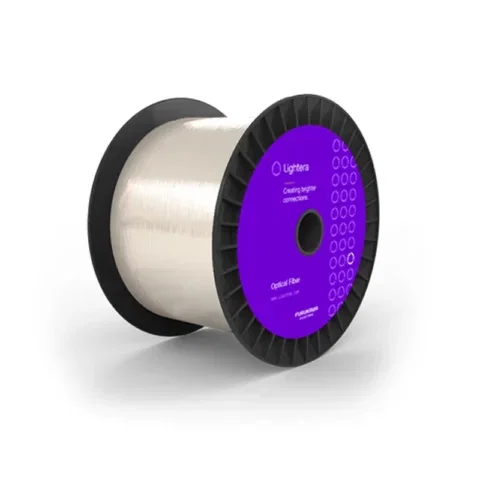
62.5/125 µm Multi-mode Graded-Index Optical Fibre
- Technology
- Speciality fibre
- Partner
- Lightera (formerly OFS)
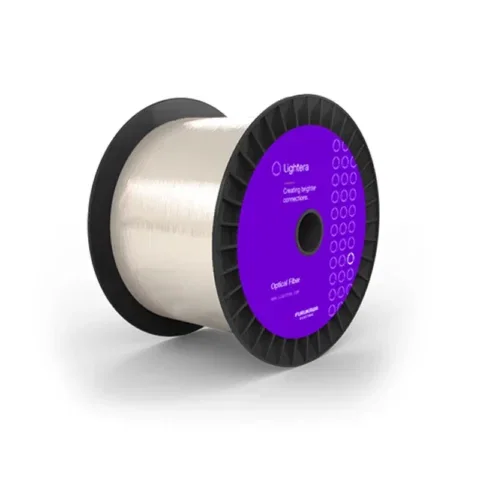
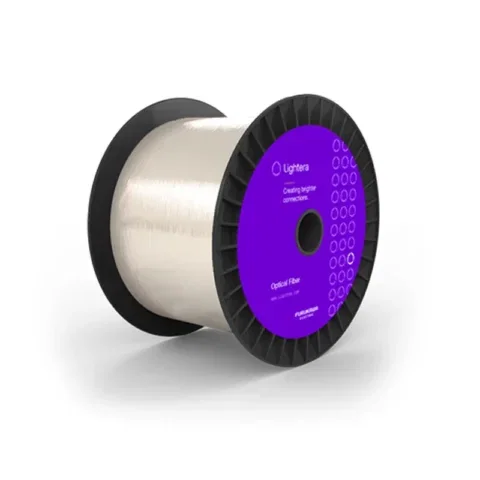
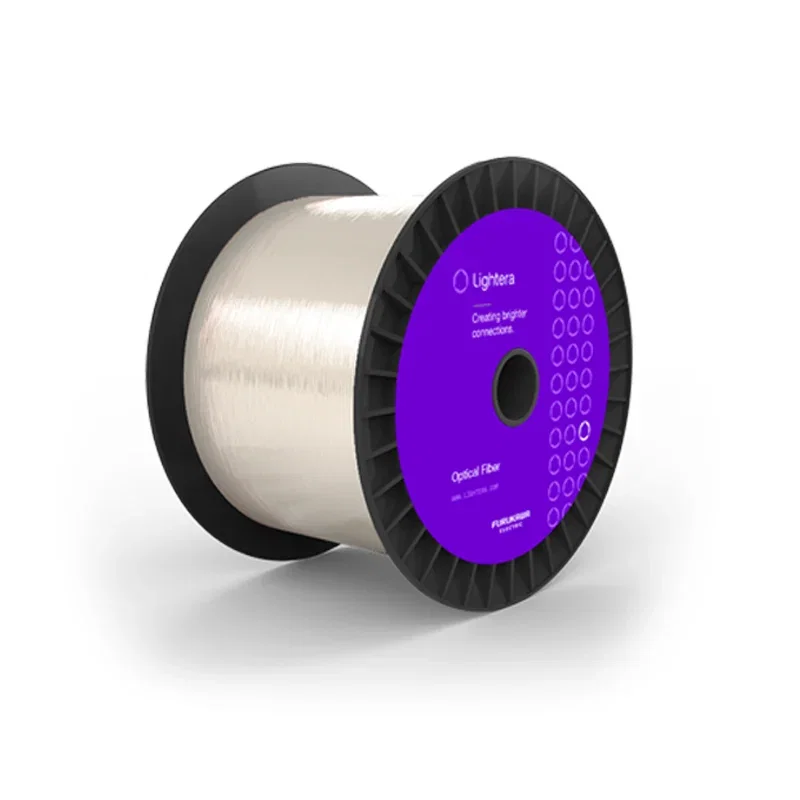
This 62.5/125 µm multimode graded-index optical fibre is designed for reliable, high-capacity data communications over short to medium distances. It features a large 62.5 µm core diameter with graded-index profile, which minimises modal dispersion to support the bandwidth needed for Gigabit Ethernet and other network protocols.
The fibre integrates easily into existing 62.5/125 µm fibre installations, allowing seamless upgrades of legacy networks to higher speeds. Manufactured using a Modified Chemical Vapour Deposition (MCVD) process, it achieves a precise refractive index profile for consistent optical performance. A tough dual-layer acrylate D-Lux® Shield coating protects the fibre from moisture, temperature extremes and mechanical stress, yet still strips cleanly for quick connector termination. Each fibre spool is 100% tested to TIA/EIA Fiber Optic Test Procedures (FOTP) and meets Telcordia GR-20-CORE and GR-409-CORE requirements, ensuring compliance with rigorous telecom industry standards.
Range features
A high level overview of what this range offers
- 62.5/125 µm graded-index core – Supports high optical bandwidth with reduced signal dispersion for reliable high-speed data transmission.
- Low attenuation (< 3 dB/km @ 850 nm) – Minimises signal loss over distance, preserving link performance and allowing longer cable runs.
- Dual-layer acrylate coating (D-Lux® Shield) – Provides robust protection against water, extreme temperatures and humidity, yet strips easily for rapid connector termination.
- High mechanical strength (100 kpsi proof test) – Fibre withstands demanding installation and handling conditions without performance degradation.
- Wide operating range (-60 °C to +85 °C) – Maintains stable optical performance across extreme temperature variations and high-humidity environments.
- Precision MCVD manufacturing – Yields a consistent refractive index profile and core geometry, enabling dependable Gigabit Ethernet performance under restricted launch conditions.
- Standards-compliant testing – Fully tested per TIA FOTP and Telcordia GR-20/GR-409 standards, assuring quality and reliability in mission-critical applications.
Downloads
for 62.5/125 µm Multi-mode Graded-Index Optical Fibre
What’s in this range?
All the variants in the range and a comparison of what they offer
Specification | Value |
Product Description | 62.5 µm Graded-Index Multimode Fibre |
Physical Characteristics | 62.5/125 |
Core Diameter | 62.5 ± 2.5 µm |
Core Non-Circularity | ≤ 5 % |
Cladding Diameter | 125 ± 1 µm |
Cladding Non-Circularity | ≤ 1 % |
Core/Clad Concentricity Error (Offset) | ≤ 1.0 µm |
Coating Diameter | 245 ± 10 µm |
Coating Non-Circularity | ≤ 5 % |
Coating–Cladding Concentricity Error (Offset) | ≤ 12 µm |
Tensile Proof Test | 100 kpsi (0.69 GPa) |
Coating Strip Force | Range: 0.22–2.0 lbf (1.0–8.9 N); Typical: 0.6 lbf (2.7 N) |
Standard Reel Lengths | 2.2–8.8 km |
Optical Characteristics | |
Attenuation | ≤ 2.9 dB/km @ 850 nm; ≤ 0.6 dB/km @ 1300 nm |
Overfilled Bandwidth | ≥ 200 MHz-km @ 850 nm; ≥ 500 MHz-km @ 1300 nm |
Attenuation @ 1380 nm minus @ 1300 nm | ≤ 1.0 dB/km |
Attenuation Uniformity / Point Discontinuities | ≤ 0.08 dB (at 850 nm & 1300 nm) |
Numerical Aperture | 0.275 ± 0.015 |
Zero Dispersion Wavelength (λ₀) | 1320–1365 nm |
Zero Dispersion Slope (S₀) | ≤ 0.11 ps/(nm²·km) for 1320 ≤ λ₀ ≤ 1348 nm; ≤ 0.001×(1458–λ₀) for 1348 ≤ λ₀ ≤ 1365 nm |
Group Refractive Index | 1.496 @ 850 nm; 1.491 @ 1300 nm |
Backscatter Coefficient | –68.4 dB @ 850 nm; –72.1 dB @ 1300 nm |
Macrobend Loss (100 turns on 75 mm mandrel) | ≤ 0.5 dB (at 850 nm & 1300 nm) |
Environmental Characteristics | |
Operating Temperature Range | –60 °C to +85 °C |
Temp.-Induced Attenuation (850/1300 nm, –60~+85 °C) | ≤ 0.1 dB/km (after 5 cycles) |
Temp. & Humidity Induced Attenuation (–10~+85 °C, 94% RH) | ≤ 0.1 dB/km (after 30 cycles) |
Accelerated Aging (85 °C, 30 days) – Attenuation | ≤ 0.1 dB/km |
Water Immersion (23 °C, 30 days) – Attenuation | ≤ 0.1 dB/km |
Dynamic Fatigue Stress Corrosion Parameter (nd) | ≥ 18 |
FAQs
for 62.5/125 µm Multi-mode Graded-Index Optical Fibre
It refers to the fibre’s core and cladding diameters. The core is 62.5 µm in diameter and the cladding is 125 µm. This geometry is a common multimode fibre size, often associated with OM1, and the larger core helps with light coupling and connector alignment.
In a graded-index fibre, the refractive index of the core gradually decreases from the centre outward instead of changing abruptly at the core-cladding boundary. This reduces modal dispersion, helping light pulses remain narrower over distance and supporting higher bandwidth and data rates than step-index multimode fibre.
Yes. This fibre is well suited for Gigabit Ethernet over typical LAN and campus link lengths. It can also support 10 Gigabit Ethernet over short distances, but longer 10 GbE runs generally require higher-bandwidth fibre types such as OM3 or OM4 for optimal performance.
D-Lux® Shield is the proprietary dual-layer acrylate coating applied to the fibre. It protects the glass from moisture, temperature extremes and mechanical stress while also helping to minimise microbending-related attenuation. Despite its durability, it is designed to strip cleanly for connector termination.
Each fibre spool is 100% tested according to TIA/EIA Fiber Optic Test Procedures (FOTP) for parameters such as attenuation, bandwidth, geometry and tensile strength. It also meets Telcordia GR-20-CORE and GR-409-CORE requirements, confirming compliance with recognised telecom industry standards.
Yes. The fibre is designed for operation from –60 °C to +85 °C and has been tested for temperature cycling, humidity exposure, accelerated ageing and water immersion with minimal attenuation change. This makes it suitable for demanding industrial, outdoor and high-humidity environments.
It is commonly used in enterprise LANs, campus backbones, data centre connections and industrial networks, especially where legacy 62.5 µm infrastructure is already installed. It remains a practical choice for reliable moderate-distance links and network upgrades without replacing existing cabling.