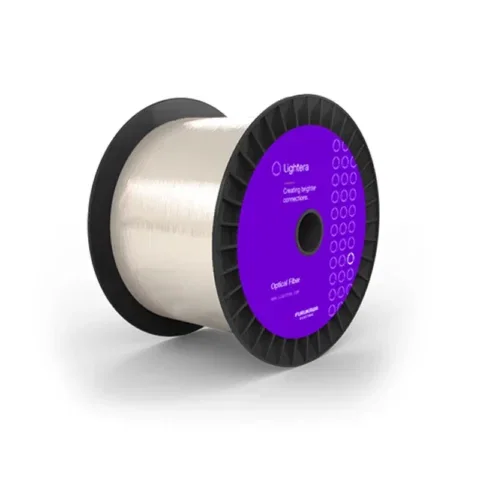
HCS® 1500 µm 0.37 NA Step-Index Low OH Optical Fibre
- Technology
- Speciality fibre
- Partner
- Lightera (formerly OFS)
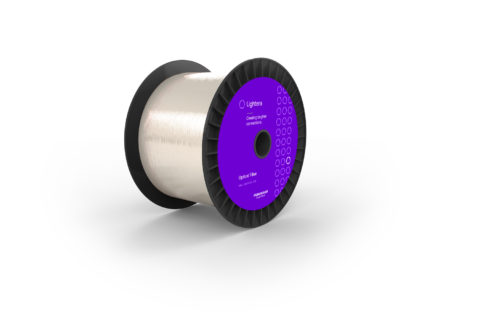
The HCS® 1500 µm Low OH Optical Fibre is a specialty step-index multimode fibre designed for demanding environments where robustness and easy light coupling are essential. Its extremely large 1.5 mm silica core and 0.37 numerical aperture make alignment more forgiving and support efficient coupling from lower-cost emitters and laser sources. The hard-clad silica construction combines a pure silica core with a rugged polymer cladding for improved mechanical strength and easier handling than conventional glass fibres. A durable ETFE buffer increases abrasion and chemical resistance while helping technicians install and terminate the fibre more easily. The low OH core composition supports broad transmission performance, especially around 650 nm and 850 nm and into the near-infrared. This makes the fibre suitable for industrial communications, avionics, medical laser delivery, scientific sensing, and other short-to-medium distance optical links. With a 2 mm buffered diameter and wide operating temperature range, it offers a practical balance of optical throughput, durability, and installation convenience.
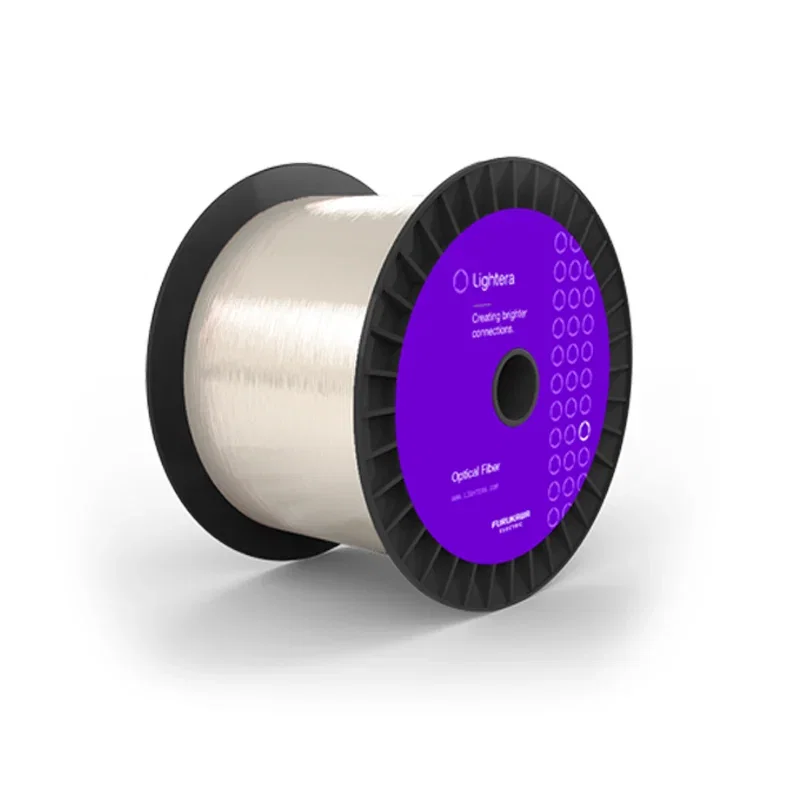
The CF01493-62 HCS® 1500 µm optical fibre is built for applications that demand both high optical throughput and strong mechanical resilience. Its step-index multimode design combines a 1500 µm pure silica core, 0.37 NA, hard polymer cladding, and a tough ETFE buffer to create a fibre that is far easier to handle than conventional delicate glass fibres.
This fibre is especially well suited to industrial automation, aerospace systems, medical laser delivery, sensing, and scientific instrumentation where reliable performance is required under vibration, bending, temperature variation, or challenging installation conditions. The low OH composition also supports efficient transmission across visible red and near-infrared wavelengths.
Range features
A high level overview of what this range offers
- 1500 µm large core diameter – Captures more light and greatly simplifies alignment for easier coupling from LEDs, lasers, and other light sources
- 0.37 numerical aperture – Accepts light over wider input angles, supporting efficient coupling and forgiving installation tolerances
- Hard-Clad Silica construction – Combines a pure silica core with rugged polymer cladding for strong mechanical durability in harsh environments
- Low OH silica core – Reduces near-infrared absorption and supports broad wavelength use, especially around 850 nm and beyond
- ETFE buffer protection – Adds abrasion resistance, chemical resistance, and practical handling benefits during routing and installation
- Rugged industrial suitability – Designed for demanding applications involving vibration, bending, and mechanical stress
- Wide temperature capability – Operates from -65 °C to +125 °C for use in industrial, aerospace, and outdoor conditions
- Easier handling and termination – The 2 mm buffered construction is more convenient to strip, route, and integrate than standard thin optical fibres
Downloads
for HCS® 1500 µm 0.37 NA Step-Index Low OH Optical Fibre
What’s in this range?
All the variants in the range and a comparison of what they offer
Specification | Value |
Product Description | 1500 µm 0.37 NA Low OH |
Core Diameter | 1500 ± 15 µm |
HCS Cladding Diameter | 1535 ± 15 µm |
ETFE Buffer Diameter | 2000 ± 50 µm |
Core/Clad Offset | ≤ 12.0 µm |
Crimp & Cleave Compatible | Yes |
Cladding Material | HCS fluoroacrylate |
Buffer Material | ETFE |
Fibre Type | Step-index multimode |
Numerical Aperture (NA) | 0.37 |
Attenuation @ 850 nm | ≤ 15 dB/km |
Water Content | Low OH |
Operating Temperature | –65 °C to +125 °C |
Short-Term Bend Radius | ≥ 182 mm |
Long-Term Bend Radius | ≥ 295 mm |
Proof Test Level | ≥ 75 kpsi (0.517 GPa) |
Part Number | CF01493-62 |
FAQs
for HCS® 1500 µm 0.37 NA Step-Index Low OH Optical Fibre
An HCS optical fibre uses a silica glass core with a hard polymer cladding rather than a fully glass cladding structure. This makes it more robust in practical use, with better resistance to handling stress, bending, and demanding industrial conditions. It is also generally easier to terminate and integrate in the field. Compared with standard communication fibres, HCS fibre prioritises durability, easier handling, and practical short-to-medium distance performance.
A 1500 µm core can collect and transmit far more light than smaller-core fibres, making light injection much easier. It is more tolerant of alignment error, vibration, and less precise optics, which helps reduce system complexity and cost. The very large core also lowers optical power density, making it useful for higher-power laser delivery applications.
Low OH means the silica core contains very low hydroxyl content, reducing absorption in the near-infrared region. This improves transmission performance at wavelengths above roughly 700 nm, particularly around 850 nm and other near-IR bands. As a result, the fibre is well suited to data transmission, sensing, spectroscopy, and laser delivery applications that operate beyond the visible range.
Yes. The fibre is well suited to high-power laser delivery because its large core spreads optical energy across a much larger area, reducing power density and helping limit thermal stress. Its rugged HCS cladding and ETFE buffer also improve mechanical durability in systems where flexible laser transmission is needed, such as industrial processing or medical laser equipment.
The specified attenuation is ≤ 15 dB/km at 850 nm. This is higher than telecom fibre, but it is typical for a very large-core step-index design optimised for ruggedness and easy coupling. In practice, the fibre is appropriate for short-to-medium distance links, from short runs of a few metres or hundreds of metres up to a few kilometres depending on wavelength, source power, and receiver sensitivity.
This fibre is rugged, but it should still be routed with broad curves rather than tight bends. The specified minimum bend radius is 182 mm short-term and 295 mm long-term. That means it handles practical installation stresses better than delicate standard fibres, while still requiring sensible cable management for long-term reliability.
Because of its size, this fibre requires connectors intended for large-core optical fibre, rather than standard telecom connectors such as LC or SC. Depending on the application, suitable options may include larger ferrule-based connectors, ruggedised industrial terminations, or custom fixtures. The thick 2 mm buffered construction makes handling easier during termination, but connector selection should always match the fibre dimensions and application requirements.
Typical applications include industrial automation, factory communications, aerospace and defence systems, medical laser delivery, scientific instrumentation, and optical sensing. It is especially valuable wherever users need a combination of high optical throughput, mechanical durability, easier coupling, and reliable performance in tough environments.