PbSe Detectors
- Technology
- Infrared photodetectors
- Partner
- IR Materials
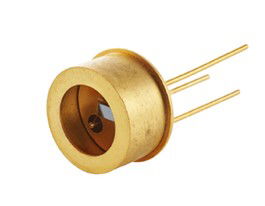
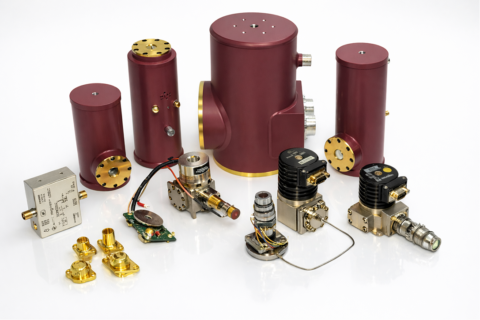
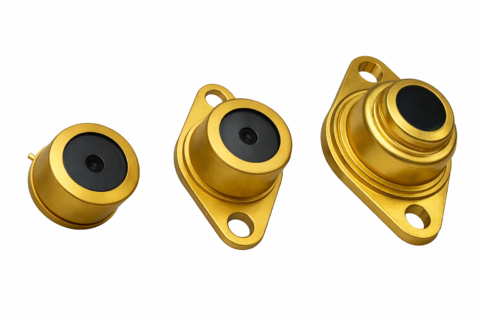
PbSe detectors are photoconductive quantum infrared sensors for the mid-wave infrared range of approximately 1 µm to 5.5 µm. They generate an electrical signal through a change in semiconductor conductivity when exposed to infrared radiation. A key advantage is effective room-temperature operation, enabling compact and cost-effective IR sensing without mandatory cooling. For higher sensitivity and lower noise, thermoelectrically cooled versions are available and can cool the detector element to around -50 °C. The range includes multiple active area sizes from about 1×1 mm to 10×10 mm and several package formats to suit different integration, sensitivity, and speed requirements. Available versions include flat-plate detectors, ambient packaged detectors, lens-enhanced detectors, and TE-cooled assemblies. Multi-channel configurations are also offered for simultaneous multi-wavelength or multi-gas detection. Typical applications include NDIR gas analysis, environmental monitoring, flame and combustion detection, moisture measurement, medical gas sensing, and mid-IR instrumentation.
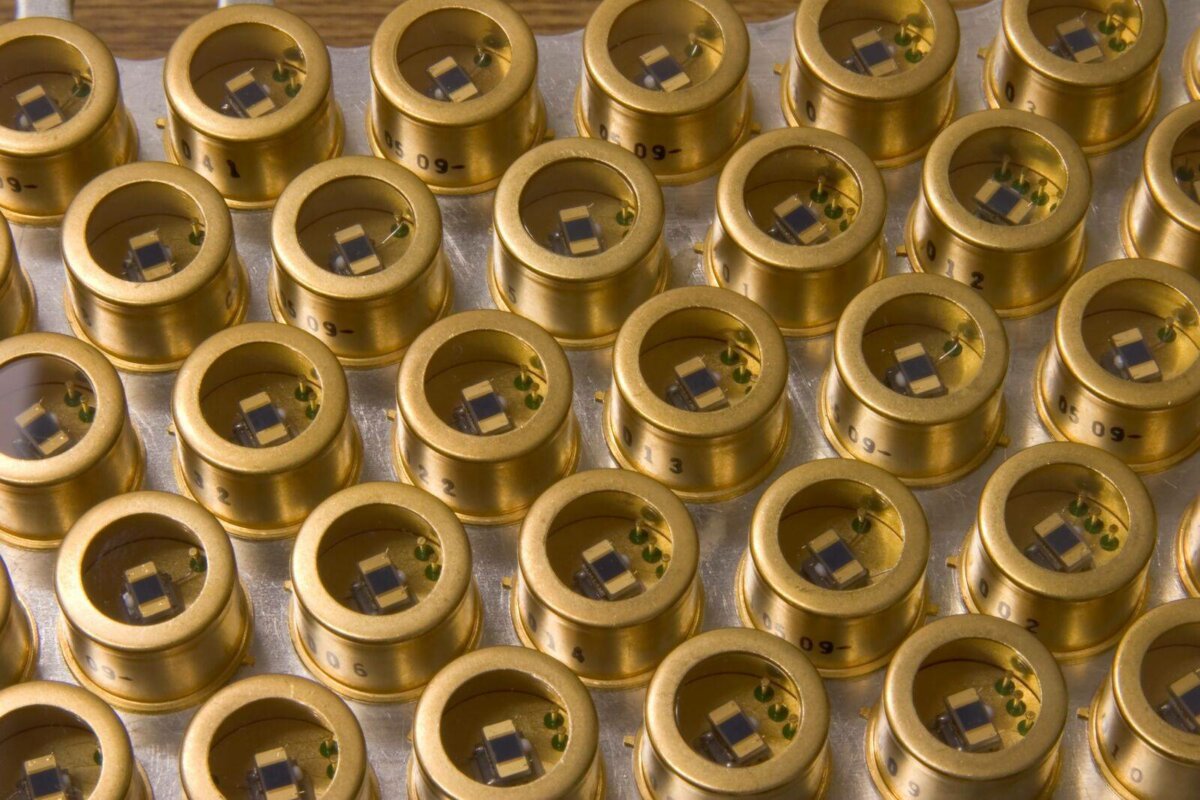
PbSe infrared detectors are lead selenide photoconductive sensors designed for mid-wave infrared detection from approximately 1 µm to 5.5 µm. They offer a practical combination of high sensitivity, fast response, compact size, and room-temperature operation, making them well suited to demanding measurement tasks where both performance and integration flexibility matter.
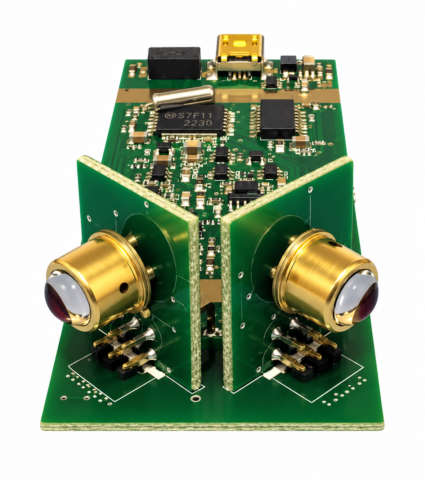
The product range includes ambient detectors, packaged versions, lens-enhanced models, and thermoelectrically cooled detectors for applications that need lower noise and improved detectivity. Multi-channel configurations are also available for simultaneous sensing of multiple wavelength bands in compact gas analysis instruments.
Range features
A high level overview of what this range offers
- Broad spectral response (1–5.5 µm): Covers an important portion of the MWIR band, including key absorption wavelengths used in gas sensing.
- High detectivity: Supports sensitive detection of low-level infrared radiation in demanding analytical systems.
- Fast response time: Typical response can be as fast as a few microseconds, ideal for real-time and rapidly changing IR signals.
- Room-temperature operation: Standard uncooled models simplify system design, lower power demand, and reduce overall cost.
- Thermoelectric cooling options: 2 W and 3 W cooled versions improve sensitivity and lower noise for weak-signal applications.
- Multi-channel detector assemblies: Quad-channel configurations enable simultaneous multi-gas or multi-wavelength measurement in one package.
- Hermetically sealed metal packages: TO-style housings with IR windows provide robust performance in industrial environments.
- Optional built-in optical filters: Narrow-band filter integration supports selective sensing for gases such as CO₂ and CO.
- Compact form factors: Small active areas and miniature packages ease integration into portable and space-constrained devices.
Uncooled flexibility Ambient PbSe detectors can operate effectively at room temperature, making them attractive for compact and energy-efficient IR instruments.
Enhanced cooled performance TE-cooled versions reduce detector temperature to improve detectivity and reduce noise where low-level signal measurement is critical.
Application-ready formats Available as flat-plate, packaged, lens-enhanced, and multi-channel assemblies to match a wide range of optical and mechanical requirements.
Downloads
for PbSe Detectors
What’s in this range?
All the variants in the range and a comparison of what they offer
| Detector Category | Typical Cooling Power at/near Max Cooling | Model Number | Element Size (mm) | Wavelength Peak Signal (μm) | D* (λpk, 1050 Hz, 1 Hz) (cm Hz¹ᐟ² W⁻¹) | Responsivity Minimum (V/W) | Responsivity Typical (V/W) | Dark Resistance (MΩ) | Time Constant (μsec) | Operating Temperature (°C) | ΔT at Maximum Cooling (°C) | Standard Package Options |
|---|---|---|---|---|---|---|---|---|---|---|---|---|
Flatplate Detectors | Not applicable | B1 | 1x 1 | 3.8 typ | 1.2×10¹⁰ min; 1.8×10¹⁰ typ | 20000 | 40000 | 0.1–3.5; 0.8 typ | 2 typ; 5 max | 25 | N/A | Flatplate |
Flatplate Detectors | Not applicable | B2 | 2x 2 | 3.8 typ | 1.2×10¹⁰ min; 1.8×10¹⁰ typ | 10000 | 20000 | 0.1–3.5; 0.8 typ | 2 typ; 5 max | 25 | N/A | Flatplate |
Flatplate Detectors | Not applicable | B3 | 3x 3 | 3.8 typ | 1.2×10¹⁰ min; 1.8×10¹⁰ typ | 6500 | 13000 | 0.1–3.5; 0.8 typ | 2 typ; 5 max | 25 | N/A | Flatplate |
Flatplate Detectors | Not applicable | B6 | 6x 6 | 3.8 typ | 9.0×10⁹ min | 3250 | 6500 | 0.1–3.5; 0.8 typ | 2 typ; 5 max | 25 | N/A | Flatplate |
Flatplate Detectors | Not applicable | B10 | 10x 10 | 3.8 typ | 7.5×10⁹ min | 1950 | 3900 | 0.1–3.5; 0.8 typ | 2 typ; 5 max | 25 | N/A | Flatplate |
Ambient Packaged Detectors | Not applicable | B1-5 | 1x 1 | 3.8 typ | 1.4×10¹⁰ min; 2.0×10¹⁰ typ | 22000 | 44000 | 0.1–3.5; 0.8 typ | 2 typ; 5 max | 25 | N/A | TO-5 |
Ambient Packaged Detectors | Not applicable | B2-5 | 2x 2 | 3.8 typ | 1.4×10¹⁰ min; 2.0×10¹⁰ typ | 11250 | 22500 | 0.1–3.5; 0.8 typ | 2 typ; 5 max | 25 | N/A | TO-5 |
Ambient Packaged Detectors | Not applicable | B3-5 | 3x 3 | 3.8 typ | 1.4×10¹⁰ min; 2.0×10¹⁰ typ | 7400 | 14800 | 0.1–3.5; 0.8 typ | 2 typ; 5 max | 25 | N/A | TO-5 |
Ambient Packaged Detectors | Not applicable | B6-8 | 6x 6 | 3.8 typ | 1.2×10¹⁰ min | 3700 | 7400 | 0.1–3.5; 0.8 typ | 2 typ; 5 max | 25 | N/A | TO-8 |
Ambient Packaged Detectors | Not applicable | B10-3 | 10x 10 | 3.8 typ | 1.0×10¹⁰ min | 2200 | 4400 | 0.1–3.5; 0.8 typ | 2 typ; 5 max | 25 | N/A | TO-3 |
Ambient Lens Detectors | Not applicable | B1-5(M)-L | 1x 1 | 3.8 typ | 4.5×10¹⁰ min | 100000 | 150000 | 0.1–3.5; 0.8 typ | 2 typ; 5 max | 23 | N/A | 1/2 ball Lens /TO-5 header |
Ambient Lens Detectors | Not applicable | B1-5(M)-LF | 1x 1 | 3.8 typ | 1×10¹¹ min | 320000 | 480000 | 0.1–3.5; 0.8 typ | 2 typ; 5 max | 23 | N/A | Full Ball Lens / TO-5 Header |
2 Watt TE Cooled Detectors | 0.9 volts @ 1.2 amps | B1-7C3T | 1x 1 | 4.3 typ | 1.6×10¹⁰ min; 3.0×10¹⁰ typ | 66000 | 100000 | 1.0–15.0; 5.0 typ | 9 typ; 20 max | -35 | 55 min; 60 typ | TO-37 |
2 Watt TE Cooled Detectors | 0.9 volts @ 1.2 amps | B2-7C3T | 2x 2 | 4.3 typ | 1.6×10¹⁰ min; 3.0×10¹⁰ typ | 33000 | 50000 | 1.0–15.0; 5.0 typ | 9 typ; 20 max | -35 | 55 min; 60 typ | TO-37 |
2 Watt TE Cooled Detectors | 0.9 volts @ 1.2 amps | B3-7C3T | 3x 3 | 4.3 typ | 1.6×10¹⁰ min; 3.0×10¹⁰ typ | 22000 | 33000 | 1.0–15.0; 5.0 typ | 9 typ; 20 max | -35 | 55 min; 60 typ | TO-37 |
3 Watt TE Cooled Detectors | 1.8 volts @ 1.2 amps | B1-8C4T | 1x 1 | 4.5 typ | 2.0×10¹⁰ min; 3.5×10¹⁰ typ | 126000 | 190000 | 1.0–20.0; 6 typ | 12 typ; 25 max | -50 | 70 min; 75 typ | TO-8, TO-66 |
3 Watt TE Cooled Detectors | 1.8 volts @ 1.2 amps | B2-8C4T | 2x 2 | 4.5 typ | 2.0×10¹⁰ min; 3.5×10¹⁰ typ | 63000 | 95000 | 1.0–20.0; 6 typ | 12 typ; 25 max | -50 | 70 min; 75 typ | TO-8, TO-66 |
3 Watt TE Cooled Detectors | 1.8 volts @ 1.2 amps | B3-8C4T | 3x 3 | 4.5 typ | 2.0×10¹⁰ min; 3.5×10¹⁰ typ | 38000 | 56000 | 1.0–20.0; 6 typ | 12 typ; 25 max | -45 | 70 min; 75 typ | TO-8, TO-66 |
3 Watt TE Cooled Detectors | 1.8 volts @ 1.2 amps | B6-8C2T | 6x 6 | 4.5 typ | 1.6×10¹⁰ min | 18000 | 27000 | 1.0–20.0; 6 typ | 12 typ; 25 max | -25 | 50 min; 55 typ | TO-8, TO-66 |
Available detector formats
- Flat-plate detectors
- Ambient packaged detectors
- Ambient lens detectors
- 2 W TE-cooled detectors
- 3 W TE-cooled detectors
Key performance ranges
- Spectral range: approximately 1–5.5 µm
- Active areas: 1×1 mm to 10×10 mm
- Fast time constants down to about 2 µs
- Cooling options down to approximately -50 °C
- High responsivity options for compact gas sensing systems
FAQs
for PbSe Detectors
PbSe photoconductive detectors are sensitive across roughly 1 µm to 5.5 µm. This covers the mid-wave infrared region and includes important absorption bands such as the approximately 4.26 µm CO₂ band and other key MWIR spectral lines.
Both are lead-salt photoconductive detectors, but PbSe is optimized for mid-infrared sensing while PbS is used for shorter wavelengths. PbSe typically covers about 1–5.5 µm and offers very fast response, whereas PbS is commonly used in the ~1–3 µm range.
No. Standard PbSe detectors can operate effectively at room temperature. Cooling is optional and mainly used to improve detectivity and reduce noise in low-signal applications.
PbSe detectors are very fast. Uncooled devices typically respond in the 1–5 µs range, with ~2 µs being a common figure. TE-cooled versions also maintain fast response for dynamic IR measurements.
These detectors are available in hermetically sealed TO-style packages including TO-5, TO-8, TO-37, and TO-66, depending on model and cooling configuration. They use infrared-transparent windows to protect the detector while passing the required IR wavelengths.
A quad-channel PbSe detector integrates four detector elements in one package, typically each with its own optical filter. This allows simultaneous sensing of multiple wavelength bands, which is especially useful in multi-gas NDIR analyzers.
Typical applications include NDIR gas analysis, flame and combustion monitoring, environmental emissions monitoring, moisture measurement, medical gas sensing, and mid-infrared instrumentation requiring fast detection in the 3–5 µm region.
A 2 W TE-cooled PbSe detector typically cools the sensor to about -35 °C, while a 3 W TE-cooled version can reach about -50 °C. The stronger cooler reduces detector temperature further, improving sensitivity and lowering noise, though it requires more power.