Jasper Micro Compact All-Fibre Femtosecond Laser
- Technology
- Fibre lasers
- Partner
- Fluence Technology
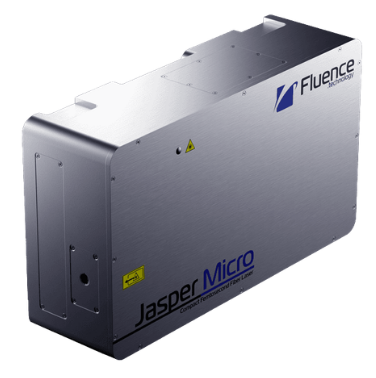
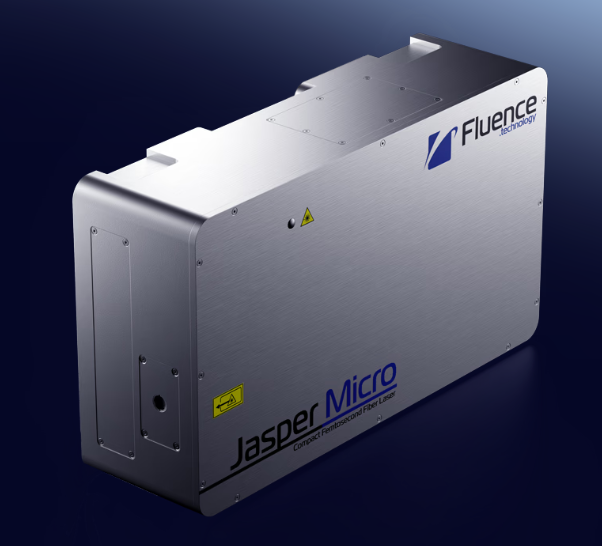
The Jasper Micro compact femtosecond fibre laser is designed for engineers integrating an ultrafast source into space-constrained industrial and laboratory equipment. Its all-fibre, SESAM-free architecture combines a 1030 ± 5 nm fundamental output with pulse-width adjustment, pulse picking and optional burst functions. The standard pulse tuning range extends from below 250 fs to 8 ps, with an extended range to 20 ps available on request. A 400 × 230 × 116 mm laser head can be mounted horizontally, vertically or sideways to suit different machine layouts.
Passive air cooling removes the requirement for a chiller, while the separate power supply fits a 4U 19-inch rack. USB, RS232, TTL and analogue interfaces provide several routes for commissioning and automated control. Typical applications include micromachining, glass processing, security marking, waveguide writing, 3D printing, surface modification and ophthalmic equipment.
Range features
A high level overview of what this range offers
- More than 7 W average power – Supports industrial ultrafast processing across a broad repetition-rate range.
- More than 5.0 µJ at 1.4 MHz – Provides selectable pulse energy for precision material-processing trials.
- Pulse width below 250 fs at 5.0 µJ – Can support low-thermal-impact processing when parameters are matched to the material.
- Pulse tuning from below 250 fs to 8 ps – Helps engineers optimise the interaction between pulse duration and workpiece response.
- Extended tuning to 20 ps on request – Broadens the available process-development range.
- Single-shot to 20 MHz operation – Accommodates isolated pulses, low-rate processing and high-repetition-rate scanning.
- Pulse picker below 2 MHz – Provides additional control over delivered pulse frequency and energy.
- Optional burst and Custom Envelope Burst modes – Allow pulse sequences and individual pulse amplitudes to be adjusted.
- M² below 1.2 – Supports controlled focusing through suitable beam-delivery optics.
- Power stability below 0.5% over 72 hours – Aids process consistency under stable environmental conditions.
- All-fibre, SESAM-free architecture – Reduces routine maintenance requirements within the laser head.
- Passive, fanless laser-head cooling – Removes the need for an external chiller.
- Three mounting orientations – Provides flexibility when arranging compact OEM workstations.
- Multiple software and hardware interfaces – Supports local control, serial commands and external timing signals.
- Optional 515 nm and 343 nm harmonic outputs – Extends wavelength selection for materials with different absorption behaviour.
- Five-year oscillator and two-year complete-laser warranties – Defines the standard warranty coverage for the principal assemblies.
Downloads
for Jasper Micro Compact All-Fibre Femtosecond Laser
What’s in this range?
All the variants in the range and a comparison of what they offer
| Category | Specification | Value |
|---|---|---|
General | Model | JM7-5 |
Output | Central wavelength | 1030 ± 5 nm |
Output | Average power | More than 7 W; typical maximum 7.5 W |
Output | Maximum pulse energy | More than 5.0 µJ at 1.4 MHz; typical maximum 5.5 µJ |
Output | Pulse width | Below 250 fs at 5.0 µJ |
Output | Standard tuning range | Below 250 fs to 8 ps |
Output | Extended tuning range | Below 250 fs to 20 ps upon request |
Output | Peak power | More than 20 MW |
Pulse control | Pulse repetition rate | Single-shot to 20 MHz; maximum 20.0 ± 0.5 MHz |
Pulse control | Pulse picker | Below 2 MHz |
Pulse control | Burst mode | Optional; MHz burst option available upon request |
Pulse control | Custom Envelope Burst | Optional adjustment of the burst envelope and individual pulse amplitudes |
Beam | Beam quality | M² below 1.2; 1.1 typical |
Beam | Beam circularity | More than 87% |
Beam | Beam diameter | 2.5 ± 0.5 mm at 1/e², measured at 1 m |
Beam | Beam divergence | Below 1 mrad |
Beam | Polarisation | Linear vertical; PER above 28 dB |
Stability | Beam-pointing stability | Below 25 µrad over 24 hours; RMS after one-hour warm-up under stable environmental conditions |
Stability | Long-term power stability | Below 0.5% over 72 hours; NRMSD under stable environmental conditions |
Stability | Pulse-to-pulse energy stability | Below 1% over 24 hours; NRMSD under stable environmental conditions |
Mechanical | Laser-head dimensions | 400 × 230 × 116 mm |
Mechanical | Laser-head weight | 18 kg |
Mechanical | Mounting options | Horizontal, vertical or sideways |
Mechanical | Power-supply dimensions | 4U 19-inch rack unit; 495 × 449 × 177 mm |
Mechanical | Power-supply weight | 12 kg |
Mechanical | Umbilical length | 2.5 m; other lengths upon request |
Environmental | Cooling | Passive air cooling; fanless laser head |
Environmental | Chiller | Not required |
Environmental | Operating ambient temperature | 15–30 °C |
Environmental | Relative humidity | 10–80%, non-condensing |
Environmental | Warm-up time | Below 30 minutes from a cold start |
Electrical | Electrical input | 100–240 V AC, single phase, 50–60 Hz |
Electrical | Power consumption | Below 300 W |
Control | Laser control software | Included |
Control | Triggering | Internal or external |
Control | Pulse functions | Internal or external analogue modulation, pulse picker and pulse-on-demand |
Control | Pulse-on-demand jitter | Below 750 ns; function based on the pulse picker |
Control | Interfaces | GUI via USB, SCPI via RS232, TTL via BNC and analogue via BNC |
Options | Additional functions | Automated mechanical shutter, burst mode and Custom Envelope Burst |
Options | Harmonic wavelengths | Optional harmonic modules for 515 nm and 343 nm |
Warranty | Oscillator | Five years |
Warranty | Complete laser | Two years |
FAQs
for Jasper Micro Compact All-Fibre Femtosecond Laser
Yes, provided that the separate power supply and airflow requirements are included in the mechanical design. The laser head measures 400 × 230 × 116 mm, weighs 18 kg and can be mounted horizontally, vertically or sideways, which gives the integrator several layout choices. The 12 kg power supply occupies a 4U 19-inch rack space measuring 495 × 449 × 177 mm, while the standard umbilical is 2.5 m. Passive air cooling removes the need for a chiller, but the enclosure must maintain 15–30 °C and avoid restricting natural airflow. In practice, reserve service access around both units and confirm any non-standard umbilical length before freezing the workstation layout.
The pulse structure can be configured across both duration and repetition rate, which is useful when developing different material interactions. The shortest pulse width is below 250 fs at 5.0 µJ, with a standard tuning range from below 250 fs to 8 ps and an extended range to 20 ps available on request. Repetition rate runs from single-shot operation to 20 MHz, while the pulse picker covers rates below 2 MHz. Optional burst operation and Custom Envelope Burst control allow the pulse amplitudes within a burst to be adjusted. This means one platform can support process-window studies involving pulse duration, spacing and burst shape without changing the fundamental laser source.
The beam parameters indicate suitability for optical systems that require controlled focusing and stable delivery. Beam quality is below M² 1.2, with 1.1 typical, while circularity exceeds 87% and divergence remains below 1 mrad. The beam diameter is 2.5 ± 0.5 mm at 1/e², measured at 1 m, and 24-hour pointing stability is below 25 µrad after the defined warm-up period. Output is vertically linearly polarised with a polarisation extinction ratio above 28 dB. The focusing lens, scanner aperture, beam expander and alignment tolerances should therefore be selected around these beam dimensions rather than around nominal wavelength alone.
Plan for standard mains power, controlled ambient conditions and sufficient ventilation around the system. Electrical input is 100–240 V AC, single phase at 50–60 Hz, with consumption below 300 W. The laser head uses passive air cooling and does not require a chiller, but operation is limited to 15–30 °C and 10–80% relative humidity without condensation. A cold start takes less than 30 minutes, although the 24-hour pointing-stability rating uses a one-hour warm-up in a stable environment. For production equipment, temperature monitoring and an interlock strategy should therefore be considered separately from the laser’s basic power and control connections.
Yes, the available interfaces cover local setup, serial control and hardware-level timing. A GUI is included over USB, SCPI commands are available through RS232, and TTL and analogue connections are presented on BNC connectors. Triggering may be internal or external, while pulse control supports internal or external analogue modulation, pulse picking and pulse-on-demand operation. Pulse-on-demand is based on the pulse picker and has jitter below 750 ns, so the required process synchronisation should be checked against that timing figure. In practice, use the GUI for commissioning and select SCPI, TTL or analogue control according to the workstation PLC, motion platform and required response time.
The standard laser output is centred at 1030 ± 5 nm, while 515 nm and 343 nm are available through optional harmonic modules. Wavelength selection should be based on the absorption behaviour of the workpiece, the required feature size and the compatibility of downstream optics. Output power and pulse energy at the harmonic wavelengths are not specified, so the fundamental ratings of more than 7 W and more than 5.0 µJ should not be assumed at 515 nm or 343 nm. Scanner mirrors, lenses, windows, diagnostics and laser safety equipment must all be rated for the selected wavelength. Before selecting a harmonic configuration, obtain the wavelength-specific output data and confirm the process window on representative samples.
The stability figures support evaluation of energy repeatability and beam placement over extended runs. Long-term power stability is below 0.5% over 72 hours, pulse-to-pulse energy stability is below 1% over 24 hours, and beam-pointing stability is below 25 µrad over 24 hours. These values apply under stable environmental conditions, using NRMSD for power and energy and RMS for pointing after a one-hour warm-up. The separate cold-start time of below 30 minutes indicates operational readiness, not necessarily the condition used for the full stability rating. A production qualification should therefore reproduce the intended enclosure temperature, duty cycle, optics and warm-up procedure before acceptance limits are set.
The performance and control modes align with several precision-processing tasks rather than one single application. Typical areas include security marking and anti-counterfeiting features, glass welding, waveguide writing, 3D printing, surface modification, ophthalmic equipment, trimming, scribing and repair. The combination of more than 5.0 µJ pulse energy, a pulse width below 250 fs, adjustable repetition rate and optional burst shaping can support process development across materials with different thermal and absorption behaviour. Actual results will still depend on focusing optics, scan speed, pulse overlap, material composition and wavelength. Engineers should establish a measured process window for quality, throughput and component life before fixing the production recipe.