NT240 series broadly tunable kHz pulsed DPSS lasers
- Technology
- DPSS lasers
- Partner
- Ekspla
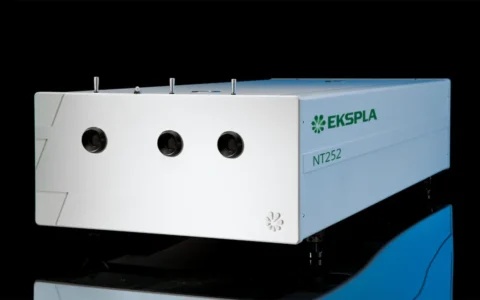
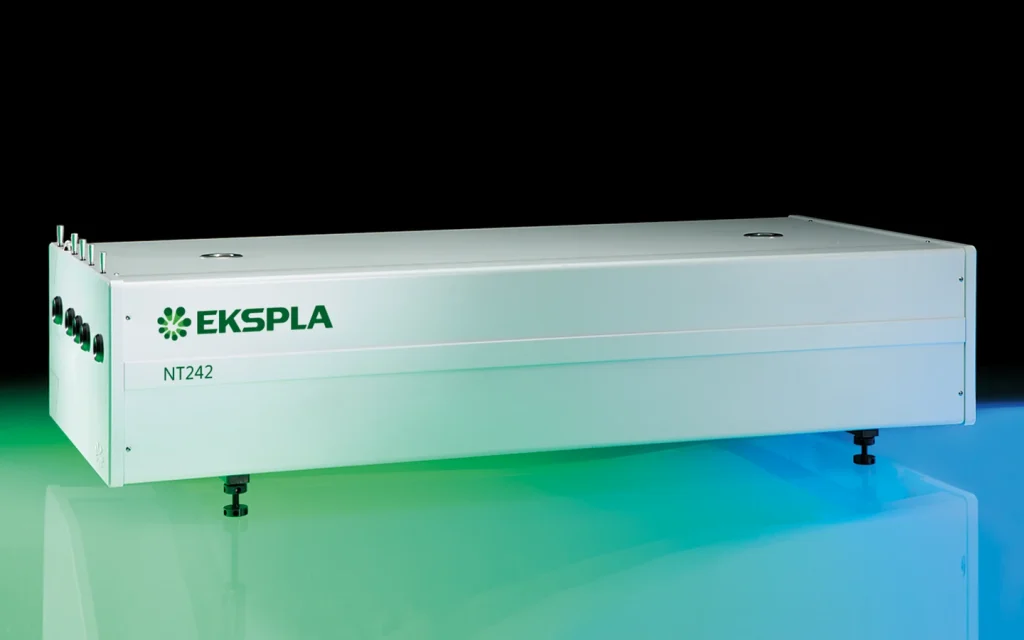
The NT240 broadly tunable kHz pulsed DPSS laser integrates a diode-pumped Q-switched Nd:YAG pump laser and optical parametric oscillator in one nanosecond platform. A configured system provides hands-free, no-gap tuning from 210 to 2600 nm, with signal and idler outputs covering 405 to 2600 nm and optional frequency conversion extending operation into the UV. Its 1000 Hz repetition rate supports repeated measurements and automated wavelength scans. The NT242 model delivers 3–6 ns pulses and up to 450 µJ peak OPO pulse energy. Remote keypad and computer control simplify integration into automated laboratory equipment.
Applications include luminescence, pump-probe and time-resolved spectroscopy, photoacoustic microscopy, photobiology, metrology and remote sensing. An air-cooled chiller and built-in OPO pump-energy monitoring support practical laboratory operation. Optional fibre coupling, attenuation, spectral filtering and harmonic outputs allow the system to be adapted to different beam-delivery and optical-layout requirements.
Range features
A high level overview of what this range offers
- Configured 210–2600 nm tuning range: Supports UV, visible and near-infrared experiments from one laser platform.
- Hands-free, no-gap wavelength tuning: Reduces manual optical adjustment during scans.
- 1000 Hz pulse repetition rate: Supports faster data collection in repeated measurements.
- Up to 450 µJ peak OPO pulse energy: Provides nanosecond excitation for spectroscopy and imaging applications.
- 3–6 ns pulse duration: Suits pump-probe, photoacoustic and time-resolved measurements.
- Below 5 cm⁻¹ linewidth: Supports wavelength-selective measurements across the signal and idler ranges.
- Integrated DPSS pump laser and OPO: Reduces the number of separate laser assemblies required in the optical setup.
- Programmable automatic scanning: Enables repeatable multi-wavelength measurement sequences.
- USB, RS232, LAN and WLAN interfaces: Support computer control and integration with laboratory equipment.
- Built-in pump-energy monitoring: Allows pump performance to be checked without an external power meter.
- Optional fibre coupling, attenuation and spectral filtering: Provide additional beam-delivery and output-conditioning choices.
What’s in this range?
All the variants in the range and a comparison of what they offer
NT242 specifications
| Specification | NT242 value |
|---|---|
Laser architecture | Diode-pumped Q-switched Nd:YAG pump laser with integrated OPO |
Signal wavelength range | 405–710 nm |
Idler wavelength range | 710–2600 nm |
Optional SH wavelength range | 210–300 nm |
Optional SF wavelength range | 300–405 nm |
Optional combined SH/SF range | 210–405 nm |
OPO pulse energy | 450 µJ at peak |
Optional SH pulse energy | 40 µJ at peak |
Optional SF pulse energy | 60 µJ at peak |
Optional combined SH/SF pulse energy | 60 µJ at peak |
Pulse repetition rate | 1000 Hz |
Output pulse duration | 3–6 ns |
Linewidth | <5 cm⁻¹; <8 cm⁻¹ from 210–405 nm |
Minimum signal tuning step | 1 cm⁻¹ |
Minimum idler tuning step | 1 cm⁻¹ |
Minimum SH, SF or SH/SF tuning step | 2 cm⁻¹ |
Signal polarisation | Horizontal |
Idler polarisation | Vertical |
SH, SF or SH/SF polarisation | Vertical |
Typical beam diameter | 3 × 4 mm |
Pump wavelength | 355 nm |
Typical pump pulse energy | 3 mJ |
Pump pulse duration | 4–6 ns at 1064 nm |
Laser unit dimensions, W × L × H | 456 × 1040 × 297 mm |
Configuration-dependent laser length | Up to 1233 mm |
Power supply dimensions, W × L × H | 520 × 400 × 286 mm |
Chiller dimensions, W × L × H | 430 × 360 × 176 mm |
Umbilical length | 3 m |
Cooling | Air-cooled chiller |
Operating temperature | 18–27 °C |
Relative humidity | 20–80%, non-condensing |
Power input | 100–240 V AC, single phase, 50/60 Hz |
Power consumption | <1.5 kW |
Room cleanliness | Not worse than ISO Class 9 |
Control | Remote keypad or computer control |
Communication interfaces | USB, RS232, LAN and WLAN |
Automatic wavelength scan | Programmable |
Laser classification | Class IV |
Unless otherwise stated, the values apply at 450 nm to the basic configuration without options. Pulse-energy figures are peak values, while parameters identified as typical can vary between individual systems. Pulse duration is measured at the FWHM level, and beam diameter is measured at 450 nm at the 1/e² level.
Accessories and optional items
| Option | Function |
|---|---|
-SH | Extends tuning into the 210–300 nm UV range through second-harmonic generation |
-SF | Extends tuning into the 300–405 nm range through sum-frequency generation |
-SH/SF | Combines second-harmonic and sum-frequency outputs for 210–405 nm coverage |
-SCU | Adds spectral filtering to improve pulse spectral purity |
-H, -2H, -3H | Provide separate 1064, 532 and 355 nm outputs |
-FC | Provides fibre-coupled output across 350–2000 nm |
-ATTN | Adds output attenuation across 210–2600 nm |
Ordering example: NT242-SH-H-2H-SCU identifies the NT242 model with a 210–300 nm SH extension, separate 1064 and 532 nm outputs, and the spectral-filtering accessory.
Nanosecond tunable laser range comparison
| Specification | NT260 | NT230 | NT240 | NT250 | NT270 | NT340 |
|---|---|---|---|---|---|---|
Output wavelength range | 192–2600 nm | 192–2600 nm | 210–2600 nm | 335–2600 nm | 2500–4475 nm | 192–4400 nm |
Repetition rate, up to | 10 kHz | 100 Hz | 1000 Hz | 1000 Hz | 1000 Hz | 20 Hz |
Pump technology | Diode-pumped solid-state | Diode-pumped solid-state | Diode-pumped solid-state | Diode-pumped solid-state | Diode-pumped solid-state | Flash-lamp pumped |
Distinguishing characteristic | Narrow-linewidth kHz operation | Up to 15 mJ OPO pulse energy | Broad tuning at 1 kHz | UV–NIR wavelength coverage | NIR–IR wavelength coverage | Application-specific modification options |
Available ranges and outputs depend on the selected configuration, and not every listed output is available simultaneously.
FAQs
for NT240 series broadly tunable kHz pulsed DPSS lasers
The base OPO does not cover the entire 210–2600 nm span by itself. Its signal output covers 405–710 nm and its idler output covers 710–2600 nm, while the UV region is supplied by optional frequency conversion: -SH for 210–300 nm, -SF for 300–405 nm, or -SH/SF for the combined 210–405 nm range. A configured system can therefore provide hands-free, no-gap tuning across the full stated range. Automatic wavelength scanning is programmable, reducing manual adjustment during multi-wavelength measurements. If an experiment must cross from UV into visible or infrared operation, specify the required extension when defining the order code and optical layout.
Peak OPO pulse energy is specified at 450 µJ, but that figure should not be treated as constant across the entire tuning range. The optional SH output is rated at 40 µJ at peak, while the SF and combined SH/SF configurations are rated at up to 60 µJ at peak. Actual energy changes with wavelength, pump optimisation and individual system behaviour. In practice, size the experiment around the minimum usable energy at the wavelengths that matter rather than the peak figure alone. Detector dynamic range, sample fluence and attenuation requirements should be checked across the planned scan.
For signal and idler operation, the linewidth is below 5 cm⁻¹ and the minimum tuning step is 1 cm⁻¹. In the 210–405 nm frequency-converted range, the linewidth is below 8 cm⁻¹ and the minimum tuning step is 2 cm⁻¹. These figures support wavelength-selective spectroscopy, but the corresponding wavelength increment in nanometres varies across the spectrum because the control increment is expressed in wavenumbers. The 3–6 ns pulse duration also suits experiments that need nanosecond excitation rather than continuous-wave illumination. When resolving closely spaced features, compare the sample’s spectral structure with both the linewidth and tuning step at the intended wavelength.
Remote operation is available through the keypad or a connected computer, and automatic wavelength scans can be programmed. Interface choices include USB, RS232, LAN and WLAN, while protocol availability depends on the ordered configuration; available methods include REST API and ASCII-command control. This allows the laser to be coordinated with detectors, translation stages or acquisition software without manual wavelength changes. Engineers should confirm the required interface and command method before finalising the control architecture. The integration plan should also account for scan completion, error handling and synchronisation within the wider experiment.
Output polarisation depends on the active branch: the signal is horizontal, while the idler and frequency-converted SH/SF outputs are vertical. Typical beam diameter is 3 × 4 mm at 450 nm, measured at the 1/e² level, and it can vary with pump pulse energy. Optional fibre coupling covers 350–2000 nm, while the attenuator option covers 210–2600 nm; separate 1064, 532 and 355 nm ports are also available. Downstream optics must therefore be selected for the wavelength, polarisation and fluence of each planned output path. Fibre delivery cannot be assumed for the complete 210–2600 nm tuning span.
The system requires 100–240 V AC, single-phase 50/60 Hz power and consumes less than 1.5 kW. Recommended ambient conditions are 18–27 °C and 20–80% relative humidity without condensation, with room cleanliness no worse than ISO Class 9. Installation planning should include ventilation and space for the 456 × 1040 × 297 mm laser unit, 520 × 400 × 286 mm power supply and 430 × 360 × 176 mm air-cooled chiller. A 3 m umbilical links the equipment, and the laser length can reach 1233 mm depending on configuration. Continuous mains connection is required; an outage longer than one hour can lead to a warm-up period of several hours.
At 1000 Hz, the NT240 broadly tunable kHz pulsed DPSS laser is suited to experiments that benefit from repeated nanosecond excitation and automated wavelength sweeps. The 3–6 ns pulse duration and broad configured tuning range align with photoacoustic microscopy, laser-induced luminescence, pump-probe spectroscopy, time-resolved spectroscopy, photobiology, calibration and remote sensing. Suitability still depends on whether the available pulse energy at the chosen wavelength produces enough signal without exceeding the sample’s fluence limit. The optional attenuator can help manage delivered energy, while fibre coupling may simplify routing over 350–2000 nm. For system selection, evaluate wavelength coverage, per-pulse energy, detector bandwidth and scan rate together.
The configured NT240 series is a Class IV laser system with visible and invisible nanosecond radiation across a potential 210–2600 nm range. Its outputs can reach 450 µJ per pulse, and optional fixed harmonic ports may add 1064, 532 or 355 nm beams. Installation therefore requires a site-specific laser safety assessment addressing direct, reflected and scattered radiation from every enabled output. Protective eyewear, beam enclosures, stops and access controls must be chosen for the actual wavelengths and pulse conditions in use. Safety provisions should be reviewed whenever the wavelength-conversion configuration or beam-delivery path changes.