Supercontinuum Source (White Light Laser)
- Technology
- DPSS lasers
- Partner
- CNI
The FL-SC-OEM is an all-fibre white light laser providing broad spectral coverage from visible wavelengths into the short-wave infrared. It is designed for optical laboratories, instrument developers and industrial inspection integrators that require a broadband pulsed source. Four average-power classes cover 1–200, 200–350, 350–500 and 500–1,000 mW. Pulse duration and repetition rate are matched to the selected power class, ranging from approximately 350 ps at 2 or 4 MHz to nanosecond options at lower fixed repetition frequencies. An M² value below 1.1 and RMS power-stability choices below 2% or 1% support controlled optical measurements.
FC/APC fibre delivery with a standard 1 m PVC-jacketed fibre provides a defined interface for compatible optical assemblies. Applications include nanophotonics, fluorescence spectroscopy and microscopy, OCT, photocurrent measurement, fibre-component characterisation, fibre sensing and semiconductor inspection. Air-cooled operation and a 12 V DC input support installations where a water-cooling loop is not preferred.
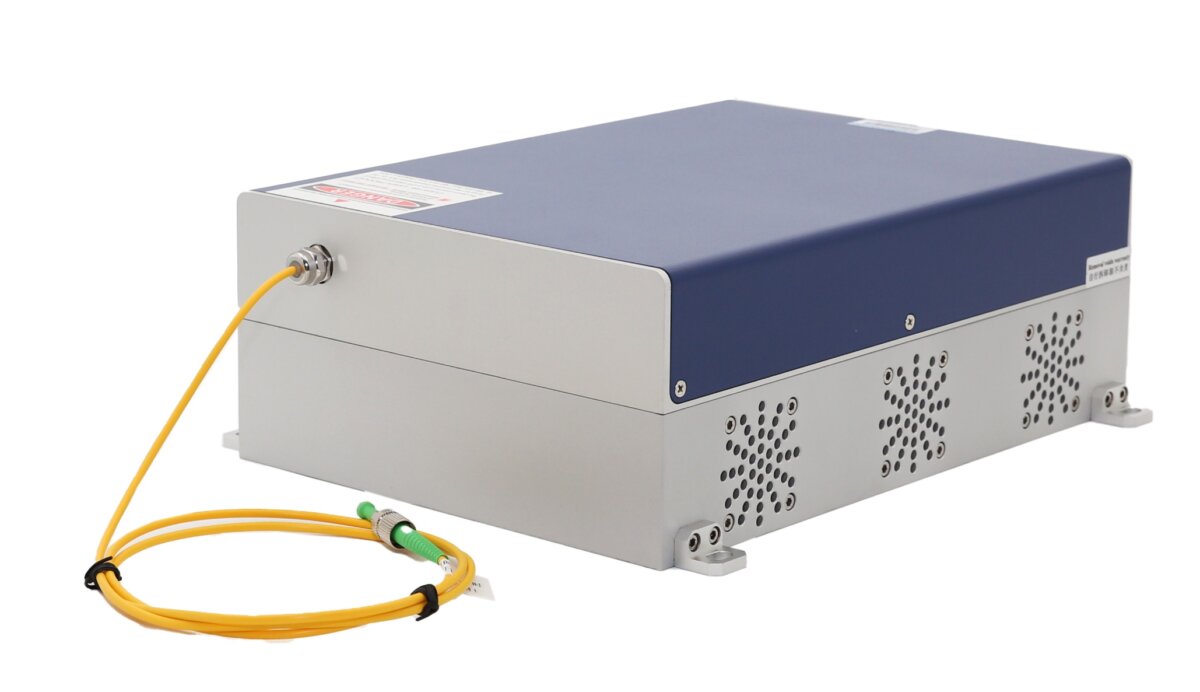
Range features
A high level overview of what this range offers
- 470–2400 nm spectral range – Covers visible, near-infrared and short-wave infrared bands with one broadband source.
- 1–1,000 mW average-power range – Provides four power classes for different optical-throughput requirements.
- Picosecond and nanosecond pulse options – Support different sampling, exposure and detector-timing conditions.
- Multiple fixed repetition rates – Offers 50–200 kHz, 1 MHz, 2 MHz or 4 MHz configurations selected around the intended measurement method.
- RMS power stability below 2% or 1% – Supports repeatable measurements over four-hour operating periods.
- M² below 1.1 – Helps maintain controlled beam propagation and fibre-to-optics coupling.
- FC/APC fibre connector – Provides an angled physical-contact interface that can help limit connector back-reflections.
- 1 m PVC-jacketed delivery fibre – Supports instrument integration, with other fibre lengths available on request.
- Air-cooled, 12 V DC operation – Removes the need for a water-cooling circuit within the specified operating environment.
- Multiple laser-head formats – Offers Mini, I and II enclosure choices for different installation spaces.
- Warm-up time below 15 minutes – Defines the stabilisation period to allow before precision measurements.
- Expected lifetime above 10,000 hours – Provides a basis for service and maintenance planning.
Downloads
for Supercontinuum Source (White Light Laser)
What’s in this range?
All the variants in the range and a comparison of what they offer
Optical and operating specifications
| Specification | 1–200 mW class | 200–350 mW class | 350–500 mW class | 500–1,000 mW class |
|---|---|---|---|---|
Spectral range | 470–2400 nm | 470–2400 nm | 470–2400 nm | 470–2400 nm |
Operating mode | Pulsed | Pulsed | Pulsed | Pulsed |
Average power | 1–200 mW | 200–350 mW | 350–500 mW | 500–1,000 mW |
Power stability | <2% or <1%, RMS over 4 hours at ±3 °C | <2% or <1%, RMS over 4 hours at ±3 °C | <2% or <1%, RMS over 4 hours at ±3 °C | <2% or <1%, RMS over 4 hours at ±3 °C |
Pulse duration | Approximately 350 ps | Approximately 350 ps | 1 ns, 3 ns, 5 ns or 10 ns | 1.5 ns |
Repetition rate | 2 MHz | 4 MHz | One fixed value from 50–200 kHz, or 1 MHz | 1 MHz |
M² | <1.1 | <1.1 | <1.1 | <1.1 |
Fibre connector | FC/APC | FC/APC | FC/APC | FC/APC |
Fibre length | 1 m; other lengths on request | 1 m; other lengths on request | 1 m; other lengths on request | 1 m; other lengths on request |
Fibre jacket | PVC | PVC | PVC | PVC |
Polarisation | Random | Random | Random | Random |
Warm-up time | <15 minutes | <15 minutes | <15 minutes | <15 minutes |
Cooling method | Air cooled | Air cooled | Air cooled | Air cooled |
Operating temperature | 15–35 °C | 15–35 °C | 15–35 °C | 15–35 °C |
Operating input | 12 V DC / 11.5 A | 12 V DC / 11.5 A | 12 V DC / 11.5 A | 12 V DC / 11.5 A |
Expected lifetime |
|
|
|
|
Mechanical configuration comparison
| Specification | FL-SC-OEM-Mini, optional | FL-SC-OEM-I | FL-SC-OEM-II | Optional AC power supply |
|---|---|---|---|---|
Configuration | Driver-integrated laser head | Driver-integrated laser head | Driver-integrated laser head | 100–240 V AC supply |
Dimensions, L × W × H | 178 × 189 × 50 mm | 286 × 190 × 95 mm | 324 × 282 × 109.5 mm | 350 × 185 × 60 mm |
Mass | 1.7 kg | 4 kg | 8.5 kg | 0.7 kg |
The FL-SC-OEM-Mini requires customer-provided heat dissipation. The precise pairing between the output-power class and enclosure should be defined in the order specification before mechanical integration is finalised.
FAQs
for Supercontinuum Source (White Light Laser)
Select the output class by balancing the required optical flux against detector linearity, sample exposure and measurement timing. The 1–200 and 200–350 mW classes use approximately 350 ps pulses at 2 and 4 MHz respectively. The 350–500 mW class uses 1, 3, 5 or 10 ns pulses and a fixed rate selected from 50–200 kHz or 1 MHz, while the 500–1,000 mW class uses 1.5 ns pulses at 1 MHz. Higher average power can compensate for losses in filters, fibres and spectrometers, but it may also require attenuation or a wider detector dynamic range. Define the required power at the sample and permitted peak exposure before choosing the class.
The 470–2400 nm figure defines the overall output envelope rather than guaranteeing equal optical power at every wavelength. It extends from the visible region through the near-infrared and into the short-wave infrared, enabling several spectral bands to be addressed from one source. Spectral flatness and wavelength-resolved power values are not defined, so uniform intensity across the full range should not be assumed. Mirrors, lenses, fibres, filters, spectrometers and detectors must each be checked for transmission or response across the band actually being used. Where a minimum power level is required at a specific wavelength, include wavelength-resolved acceptance data in the purchasing and test specification.
The pulse format is associated with the selected power class rather than described as continuously adjustable during operation. The approximately 350 ps versions run at 2 or 4 MHz, providing closely spaced pulses for rapid sampling and repeated excitation. The 350–500 mW class offers longer 1–10 ns pulses and either a fixed 50–200 kHz value or 1 MHz, while the 500–1,000 mW class operates at 1 MHz with 1.5 ns pulses. At the same average power, a lower repetition rate generally produces more energy per pulse, which can affect detector saturation and sample loading. Synchronisation electronics should therefore be designed around the fixed rate chosen for the final configuration.
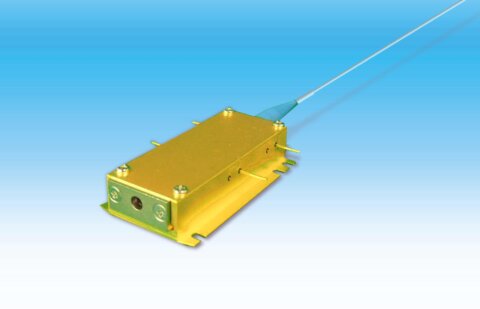
Yes, the FL-SC-OEM supercontinuum source laser provides an FC/APC fibre interface and a standard 1 m PVC-jacketed delivery fibre. Other fibre lengths can be requested where the source must be mounted away from the optical bench or measurement head. The angled connector can help limit back-reflections, but the mating component must use a compatible FC/APC interface. Output polarisation is random, so polarisation-sensitive measurements may require downstream control, monitoring or calibration. The complete optical path should also be checked for broadband transmission, connector cleanliness and suitable power handling throughout the intended wavelength range.
The electrical design should accommodate a 12 V DC input at 11.5 A, equivalent to a nominal 138 W before allowing an appropriate engineering margin. An optional 100–240 V AC power supply is available where a regulated DC rail is not already provided by the host system. Cooling is by air, and the specified ambient operating range is 15–35 °C. The Mini enclosure requires the integrator to provide heat dissipation, so heatsinking, airflow direction and recirculation inside the host enclosure need to be considered. Allow the stated warm-up period of less than 15 minutes before precision measurements and validate thermal performance in the final installed orientation.
The series provides RMS power-stability choices below 2% or below 1% over four hours under a ±3 °C condition. Quantitative spectroscopy, OCT and photocurrent measurements should use the selected stability grade in their uncertainty and drift budgets rather than assuming the tighter value applies automatically. The M² value below 1.1 indicates limited departure from an ideal Gaussian beam, which can support repeatable coupling and focusing. A warm-up period of less than 15 minutes should be included before collecting critical data. Where the measurement requires lower residual drift, an optical reference channel and tighter environmental control can be added at system level.
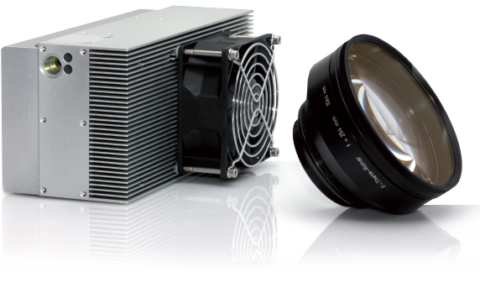
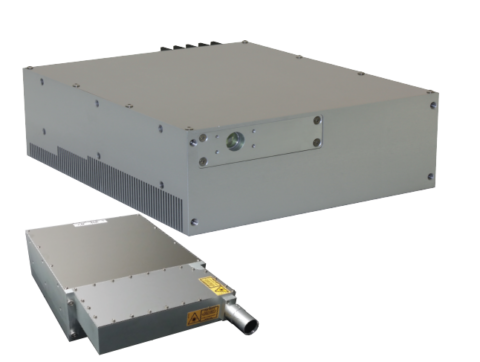
The enclosure choice should be based on available volume, mounting arrangement, mass and thermal design. The optional FL-SC-OEM-Mini measures 178 × 189 × 50 mm and weighs 1.7 kg, making it the smallest documented format. FL-SC-OEM-I measures 286 × 190 × 95 mm at 4 kg, while FL-SC-OEM-II measures 324 × 282 × 109.5 mm at 8.5 kg. The optional AC power supply adds a separate 350 × 185 × 60 mm unit weighing 0.7 kg. Because the Mini requires customer-provided heat dissipation and the enclosure-to-power-class pairing is not fully defined, both items should be confirmed before releasing the mechanical and electrical design.
Suitability depends on the available spectrum within the working band, the detector response and the pulse format required by the measurement. For OCT, confirm the spectral shape, usable bandwidth and resulting axial-resolution requirement, as spectral flatness and coherence length are not quantified. Fluorescence systems should account for excitation-band selection, filter blocking, detector gating and sample exposure at the chosen repetition rate. Photocurrent and semiconductor-inspection systems should verify detector linearity, spectral responsivity and saturation limits against the selected output class. Because the output includes both visible and invisible infrared wavelengths, the final installation also requires suitable enclosure, interlock and eye-protection measures for its actual configuration.