NT270 series Tunable Wavelength NIR-MIR Range DPSS Lasers
- Technology
- DPSS lasers
- Partner
- Ekspla
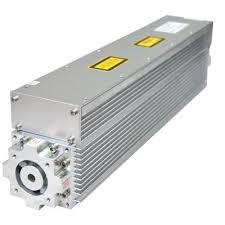
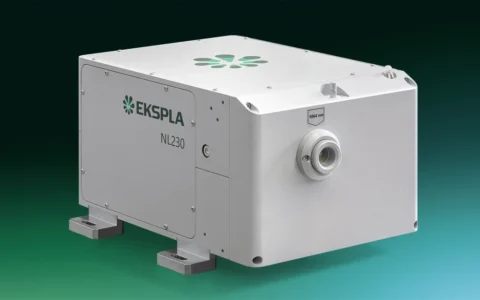
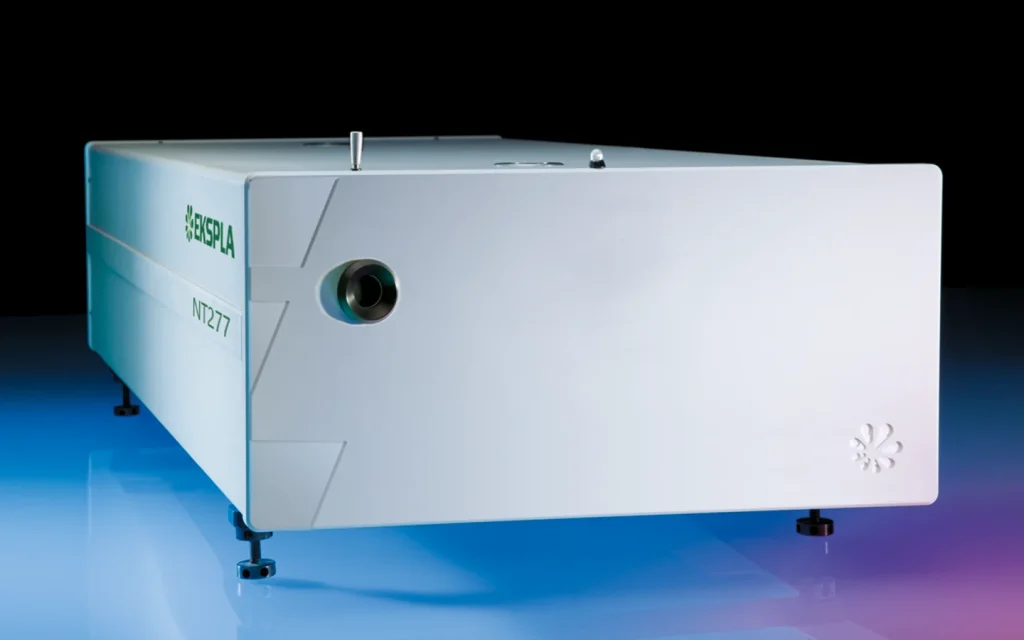
The NT270 tunable DPSS laser is an integrated wavelength source for automated measurements in the 2500–4475 nm region. Its NT277 configuration combines a Q-switched 1064 nm diode-pumped solid-state laser and nanosecond Optical Parametric Oscillator within a single housing. The idler output operates at 1 kHz with 5–7 ns pulses and typical pulse energy of 80 µJ at 3000 nm. Motorised tuning allows wavelength selection from a control pad or PC, while automatic scanning removes the need for manual optical adjustment during a measurement sequence.
Separate pump and OPO ports provide access to both beams while retaining an integrated conversion system. Air cooling avoids the need for an external water circuit, simplifying installation and maintenance planning. Typical applications include scanning near-field optical microscopy, single-molecule vibrational spectroscopy, infrared spectroscopy and gas spectroscopy.
Range features
A high level overview of what this range offers
- 2500–4475 nm idler tuning: Covers a wide infrared interval with one laser system.
- Motorised tuning with automatic scanning: Enables programmed wavelength sweeps without manual optical adjustment.
- 1 kHz repetition rate: Supports repeated acquisition during scanning measurement sequences.
- 5–7 ns OPO pulses: Delivers 80 µJ typical idler pulse energy at the 3000 nm reference wavelength.
- Linewidth below 10 cm⁻¹: Supports measurements requiring controlled spectral selectivity.
- Optional higher-energy mode: Provides a 10–150 cm⁻¹ linewidth configuration where pulse energy is prioritised over narrow linewidth.
- Integrated DPSS pump laser and OPO: Eliminates the need for a separately aligned pump-to-OPO arrangement.
- Separate pump and OPO output ports: Provides independent access to the 1064 nm pump and tuned idler beams.
- Air-cooled construction: Removes the requirement for an external water-cooling loop.
- Keypad and PC operation: Supports local control, remote wavelength selection and automatic scans.
- Multiple interface options: USB, RS-232, LAN and WLAN accommodate laboratory control integration, depending on configuration.
- Stable pump output: Pulse-energy stability is below 0.5% standard deviation.
- Laboratory-compatible power requirements: Operates from 100–240 V AC while consuming less than 0.5 kW.
- Two-year warranty: Establishes the standard warranty period for the system.
What’s in this range?
All the variants in the range and a comparison of what they offer
NT277 Specifications
| Specification | NT277 |
|---|---|
Wavelength range, idler | 2500–4475 nm |
Pulse energy, idler | 80 µJ at 3000 nm |
Pulse duration | 5–7 ns |
Pulse repetition rate | 1000 Hz |
Linewidth | <10 cm⁻¹ |
Minimum tuning step, idler | 1 cm⁻¹ with manual PC input |
Polarisation, idler | Vertical |
Typical beam diameter | 4 mm |
Pump wavelength | 1064 nm |
Typical pump pulse energy | 1.9 mJ |
Pump pulse duration | <10 ns |
Beam quality | Fit to Gaussian >90% |
Pulse-energy stability | <0.5% standard deviation |
Laser unit size, W × L × H | 305 × 701 × 270 mm |
Power supply size, W × L × H | 449 × 376 × 140 mm |
Umbilical length | 2.5 m |
Cooling | Air cooled |
Room temperature | 18–27 °C |
Relative humidity | 20–80%, non-condensing |
Power input | 100–240 V AC, single phase, 50/60 Hz |
Power consumption | <0.5 kW |
Room cleanliness | Not worse than ISO Class 9 |
Nanosecond Tunable Laser Range Comparison
| Specification | NT260 | NT230 | NT240 | NT250 | NT270 | NT340 |
|---|---|---|---|---|---|---|
Output wavelength range | 192–2600 nm | 192–2600 nm | 210–2600 nm | 335–2600 nm | 2500–4475 nm | 192–4400 nm |
Repetition rate, up to | 10 kHz | 100 Hz | 1000 Hz | 1000 Hz | 1000 Hz | 20 Hz |
Pump laser | Diode-pumped solid-state | Diode-pumped solid-state | Diode-pumped solid-state | Diode-pumped solid-state | Diode-pumped solid-state | Flashlamp-pumped laser |
Series distinction | Narrow-linewidth operation at kHz rates | OPO pulse energy up to 15 mJ | Broadly tunable kHz pulsed system | UV–NIR tuning range | Infrared tuning at 1 kHz | Multiple modification options for specific applications |
Specification notes
- Unless stated otherwise, optical specifications apply at 3000 nm to the basic system without options.
- Typical parameters are indicative and can vary between individual units.
- A custom infrared option with tuning up to 12 µm is available for discussion.
- Pulse duration is measured at the FWHM level using a photodiode with 1 ns rise time and a 300 MHz bandwidth oscilloscope.
- The optional higher-energy configuration has a linewidth of 10–150 cm⁻¹ and cannot operate in the narrow-linewidth mode below 10 cm⁻¹.
- PC wavelength entry supports a 1 cm⁻¹ minimum step; keypad control has a stated resolution of 1 nm.
- Beam diameter is measured at the 1/e² level and varies with wavelength.
- Pump pulse energy is adjusted for OPO performance and can vary between units.
- The laser should remain connected to mains electricity. A power interruption longer than one hour requires a warm-up period of several hours before operation.
- Not all maximum values and options are available simultaneously. The required parameter combination must be confirmed as a complete configuration.
FAQs
for NT270 series Tunable Wavelength NIR-MIR Range DPSS Lasers
The standard NT270 tuning range is 2500–4475 nm, corresponding to approximately 4000–2235 cm⁻¹. When wavelengths are entered manually from a PC, the minimum tuning step is 1 cm⁻¹; from the keypad, the stated tuning resolution is 1 nm. Motorised tuning and automatic scanning allow a sequence to run without physical adjustment of the OPO. For spectroscopy, the target absorption band should therefore be checked against both the wavelength span and the required spectral step. A custom infrared configuration extending to 12 µm can be discussed, but its exact output parameters should be confirmed for the intended wavelength.
At 3000 nm, the NT277 idler output is 80 µJ typical per pulse, with a 5–7 ns pulse duration and 1000 Hz repetition rate. A simple calculation gives 80 mW nominal average optical power at that reference point and approximately 11–16 kW pulse power when energy is divided by the stated duration. These calculated figures do not include pulse-shape effects or losses in downstream optics. Output energy changes across the tuning range, so 80 µJ should not be used as a universal value for every wavelength. Detector range, sample exposure and attenuation should be sized using the required operating wavelength and a suitable engineering margin.
Standard operation provides a linewidth below 10 cm⁻¹. A higher-energy option is available with a linewidth of 10–150 cm⁻¹ across the 2500–4475 nm range, and the narrow-linewidth mode cannot be used with that option. The choice is therefore a direct trade-off between spectral selectivity and the higher-energy configuration. Measurements intended to separate closely spaced absorption features will generally favour the narrower mode, whereas experiments driven by pulse energy may suit the alternative. Pulse energy at each target wavelength should be confirmed during configuration because the trade-off is wavelength-dependent rather than represented by one universal value.
The OPO idler is vertically polarised and has a typical 4 mm beam diameter at the wavelength used for the 3000 nm pulse-energy specification. Beam diameter is defined at the 1/e² level and varies with wavelength, so apertures and focusing optics should not be designed around a fixed 4 mm value alone. The 1064 nm pump output is available through a separate port, with 1.9 mJ typical pulse energy, pulse duration below 10 ns and a Gaussian fit above 90%. Pump pulse-energy stability is below 0.5% standard deviation. Both beam paths require wavelength-appropriate optics, attenuation, detection and Class IV laser safety controls.
Motorised tuning can be commanded from the local keypad or a PC, and automatic wavelength scans are supported. Interface choices include USB, RS-232, LAN and WLAN, although the available interface and protocol depend on the selected configuration. PC entry provides a 1 cm⁻¹ tuning step, while the keypad uses 1 nm resolution, so the chosen control route affects how a scan is programmed. Supplied PC drivers support software integration. Before ordering, define the required interface, command method, scan sequence and synchronisation with detectors or acquisition hardware operating at the 1 kHz pulse rate.
The NT277 is air cooled and does not require a water loop. It is intended for room temperatures of 18–27 °C, relative humidity of 20–80% without condensation, and room cleanliness no worse than ISO Class 9. Electrical input is 100–240 V AC, single phase, 50/60 Hz, with power consumption below 0.5 kW. The laser unit measures 305 × 701 × 270 mm, the power supply measures 449 × 376 × 140 mm, and the connecting umbilical is 2.5 m long. Installation planning should reserve airflow, cable routing and service access around both units.
The system should remain connected to mains electricity continuously. If mains power is unavailable for longer than one hour, a warm-up period of several hours is required before the laser is switched on for operation. This affects facilities planning because an extended outage cannot be followed by immediate measurement start-up. Laboratories with strict availability requirements should include the warm-up delay in operating procedures and consider how planned shutdowns will be managed. Any backup-power arrangement must be sized for the stated input range and power consumption and reviewed against the site’s laser safety and electrical requirements.
The NT270 series is intended for s-SNOM, single-molecule vibrational spectroscopy, infrared spectroscopy and gas spectroscopy. Its standard wavelength span corresponds to roughly 2235–4000 cm⁻¹, so the first selection step is to confirm that the molecular or material feature of interest lies inside this region. The next checks are required linewidth, pulse energy at the exact wavelength, detector response and compatibility of coatings, windows and fibres with the infrared band. For scanning measurements, the 1 kHz repetition rate and motorised tuning can support automated acquisition. Overall system performance will still depend on focusing optics, sample interaction, detection bandwidth and timing integration.