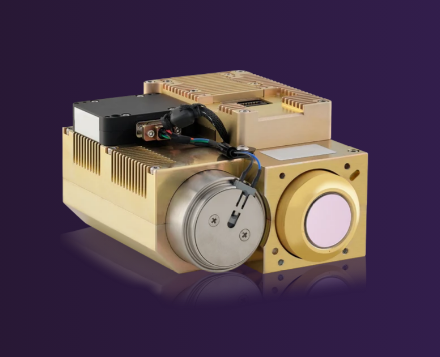
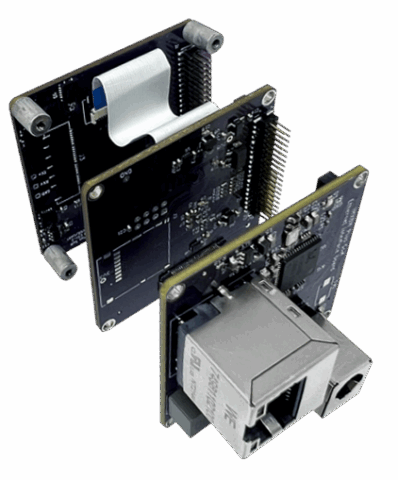
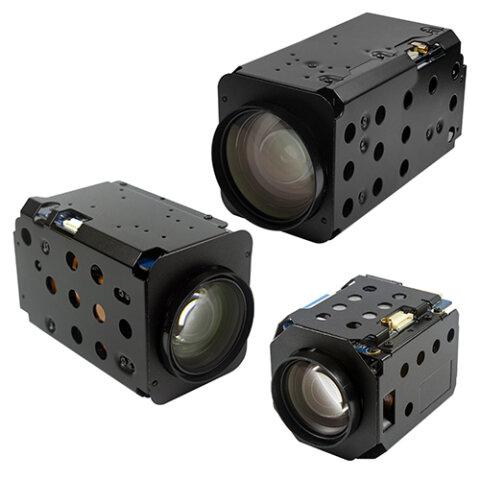
Fujinon SX400 Long Range Multi-Purpose Camera
- Technology
- Visible camera modules
- Partner
- Fujifilm
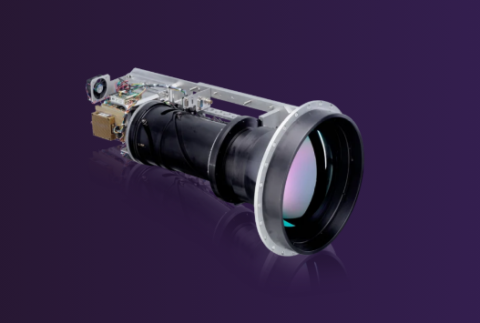
The SX400 long-range camera combines a 32× optical zoom lens and camera electronics within a single assembly. Its 12.5 mm wide-angle setting supports general observation, while the 400 mm telephoto endpoint enables detailed monitoring of distant subjects. The lens maintains an f/2.8 maximum aperture from 12.5 to 200 mm and provides an f/5.2 aperture at 400 mm. Optical and electronic image stabilisation can be used separately or together to address movement caused by wind, supporting structures or mobile platforms.
Engineers can integrate the camera through ONVIF-compatible Ethernet, RS-485 with Pelco-D or Pelco-P, or direct HDMI, HD-SDI and composite video connections. Typical applications include border and port monitoring, infrastructure inspection, construction sites, event venues, vehicles and vessels. The integrated optical and camera assembly removes the need to fit a separate lens or perform flange-back and optical-axis adjustments during installation.
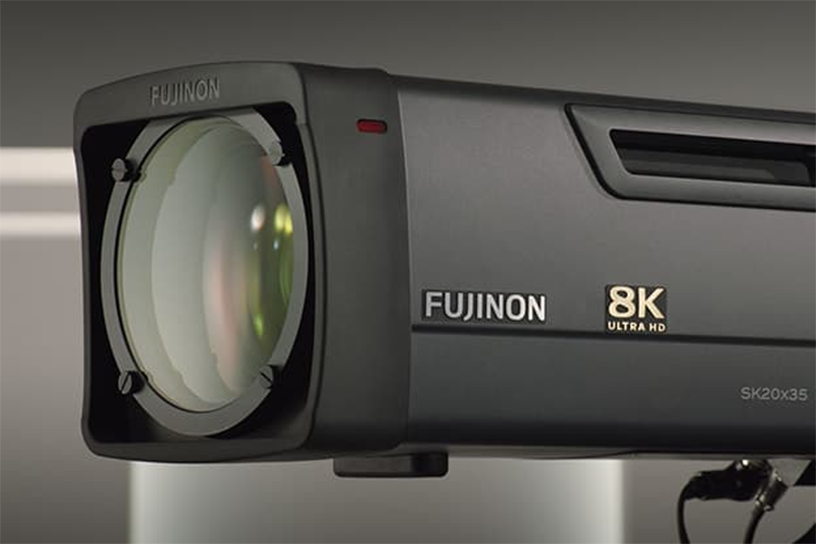
The SX400 integrates a long-range zoom lens, full HD camera electronics and remote-control interfaces in one installation-ready assembly. Its combination of wide-area observation, 400 mm telephoto reach, low-light performance and stabilisation supports surveillance and inspection from fixed sites, temporary installations and mobile platforms.
Range features
A high level overview of what this range offers
- 12.5–400 mm focal range: Supports wide-area observation and long-range telephoto imaging with one camera.
- 32× optical zoom: Allows remote framing without relying on digital enlargement.
- f/2.8 aperture from 12.5–200 mm: Supports image capture in low-light operating conditions.
- Autofocus time as short as 0.1 seconds: Helps acquire moving or newly framed subjects after zoom adjustment.
- Flexible focusing: Continuous AF, Quick AF and manual focus accommodate changing, fixed or operator-controlled subjects.
- Combined OIS and EIS: Compensates for image movement caused by wind, platform vibration or mobile deployment.
- Atmospheric image processing: Selectable heat haze, fog and noise reduction supports imaging in difficult conditions.
- Visible and infrared operation: Provides settings for visible light and IR illumination at 808, 850, 940 or 950 nm.
- ONVIF Profile S and Pelco-D/P: Enables integration with IP video and serial control systems.
- Multiple direct outputs: HDMI, HD-SDI and composite connections support local monitoring and stand-alone operation.
- Local recording: SDHC and SDXC media can store MOV recordings encoded using H.264 or MJPEG.
- Integrated lens and camera: Avoids separate lens fitting, optical-axis alignment and flange-back adjustment.
- Compact long-range platform: The 121 × 134 × 302 mm body weighs approximately 3.9 kg for fixed, transportable and vehicle-mounted configurations.
Downloads
for Fujinon SX400 Long Range Multi-Purpose Camera
What’s in this range?
All the variants in the range and a comparison of what they offer
SX400 specifications
| Specification | SX400 value |
|---|---|
Product type | Lens-integrated long-range multi-purpose camera |
Image sensor | CMOS |
Effective sensor size | 1/1.8-inch |
Focal length | 12.5–400 mm |
Optical zoom | 32× |
Digital zoom | 1.25×, 1.5×, 1.75×, 2× |
Maximum aperture | f/2.8 at 12.5–200 mm; f/5.2 at 400 mm |
Manual aperture range | f/2.8–f/16 |
Minimum object distance | 10 m from the foremost part of the front lens |
Angle of view at 12.5 mm | 31.8° × 18.4°, horizontal × vertical, 16:9 |
Angle of view at 400 mm | 1.00° × 0.57°, horizontal × vertical, 16:9 |
Minimum illumination, colour | 0.00014 lux at f/1.2; 0.0008 lux at f/2.8 |
Minimum illumination, black and white | 0.0001 lux at f/1.2; 0.00053 lux at f/2.8 |
Focus modes | Continuous AF, Quick AF, manual focus |
Minimum autofocus time | Approximately 0.1 seconds |
Metering | Average |
Shutter speed | Auto with selectable 1/8–1/125-second minimum; manual 1–1/32000 second |
Gain | AGC, Hyper AGC, manual ISO 400–819200 |
Day/night selection | Auto, scheduled, auto and scheduled, day, night |
Supported wavelengths | Visible light, 808 nm, 850 nm, 940 nm, 950 nm |
Optical filter options | Day: IRC or visible-light cut; night: clear or visible-light cut |
Image stabilisation | Auto OIS and EIS, OIS, EIS, off |
Wide dynamic range | Two selectable levels |
Backlight compensation | Two selectable levels |
Heat haze reduction | Three selectable levels |
Fog reduction | Three selectable levels |
Noise reduction | Three selectable levels |
Shooting presets | Surveillance, movie production |
Image adjustment | Brightness, contrast, saturation and sharpening; 100 levels each |
White balance | Auto, auto white priority, Custom 1, Custom 2, fine, shade, 3000 K, 5000 K or 9000 K |
Frame sizes | 1920 × 1080, 1280 × 720, 640 × 480 NTSC, 768 × 576 PAL |
Video standards | NTSC: 1080p, 720p, 480p; PAL: 1080p, 720p, 576p |
Image output connectors | HDMI, HD-SDI, composite BNC |
Encoding | H.264, MJPEG |
Recording container | MOV |
Bit-rate control | CBR, VBR |
Bit-rate range | 1–18 Mbps |
H.264 frame rate | 1–30 fps NTSC; 1–25 fps PAL |
MJPEG frame rate | 1–15 fps NTSC; 1–13 fps PAL |
I-frame interval | 0.5 or 1 second |
Audio input impedance | 40 kΩ |
Audio output impedance | 200 Ω |
Ethernet | 10BASE-T, 100BASE-TX, RJ45 |
Network protocols | ICMP, ARP, TCP/IP, UDP/IP, HTTP, RTSP, RTP, DHCP, DNS, RTP/RTCP, SNTP |
ONVIF | Profile S; port 8080 |
Video delivery count | One video |
RS-485 communication | Half-duplex or full-duplex |
RS-485 protocols | Pelco-D and Pelco-P, including extended commands |
RS-485 baud rates | 115200, 38400, 19200, 9600, 4800 or 2400 bps |
RS-485 device ID | 1–31 |
External trigger | Day/night input |
Operating modes | IP, RS-485, stand-alone |
Network authentication | RTSP: disabled, Basic or Digest; Digest supports MD5 or SHA-256; HTTP supports Basic or Digest |
Default IPv4 address | 192.168.1.10 |
Default subnet mask | 255.255.255.0 |
Supported operating system | Windows 11 |
Supported browsers | Google Chrome 142 or later; Microsoft Edge 142 or later |
Memory card | SDHC or SDXC, UHS-I compatible, 8 GB or larger, Speed Class 10 or higher |
Power supply | 12 V DC |
Power consumption | 15 W |
Dimensions, H × W × L | 121 × 134 × 302 mm |
Weight | Approximately 3.9 kg |
Operating temperature | −10 to +50 °C; operation below freezing requires uninterrupted power |
Operating humidity | 10–80% RH, no condensation |
Tilt limit | ±45° from level with the base down |
Base mounting points | Eleven 1/4-20 UNC threaded holes |
Maximum thread engagement | 5.5 mm |
Mounting tightening torque | 240–300 N·cm |
Required orientation | Base down |
Weather protection | Not waterproof; outdoor use requires a suitable protective housing |
Compliance statements | EU RoHS Directive 2011/65/EU, EU EMC Directive 2014/30/EU, FCC Part 15 Class A, CAN ICES(A)/NMB(A), CISPR 32 Class A |
SX Series range comparison
| Specification | SX400 | SX800 | SX1600 |
|---|---|---|---|
Optical zoom | 32× | 40× | 40× |
Digital zoom | 1.25×, 1.5×, 1.75×, 2× | 1.25×, 1.5×, 1.75×, 2× | 1.25×, 1.5×, 1.75×, 2× |
Focal length | 12.5–400 mm | 20–800 mm | 40–1600 mm |
Maximum aperture | f/2.8 at 12.5–200 mm; f/5.2 at 400 mm | f/4 at 20 mm; f/7.4 at 800 mm | f/8 at 40 mm; f/14.8 at 1600 mm |
Minimum object distance | 10 m | 10 m at 20–400 mm; 20 m at 401–800 mm | 10 m at 40–800 mm equivalent; 20 m at 801–1600 mm equivalent |
Wide-end angle of view | 31.8° × 18.4° at 12.5 mm | 21.0° × 11.8° at 20 mm | 10.5° × 5.9° at 40 mm equivalent |
Telephoto angle of view | 1.00° × 0.57° at 400 mm | 0.55° × 0.31° at 800 mm | 0.27° × 0.15° at 1600 mm equivalent |
Effective sensor size | 1/1.8-inch | 1/1.8-inch | 1/1.8-inch to 1.1-inch |
Minimum colour illumination at native maximum aperture | 0.0008 lux at f/2.8 | 0.0017 lux at f/4 | 0.0064 lux at f/8 |
Minimum black-and-white illumination at native maximum aperture | 0.00053 lux at f/2.8 | 0.0011 lux at f/4 | 0.0042 lux at f/8 |
RS-485 communication | Half- or full-duplex | Half-duplex | Half- or full-duplex |
Power consumption | 15 W | 9.5 W | 15 W |
Dimensions, H × W × L | 121 × 134 × 302 mm | 139 × 156 × 410 mm | 139 × 156 × 450 mm |
Weight | 3.9 kg | 6.4 kg | 7.4 kg |
FAQs
for Fujinon SX400 Long Range Multi-Purpose Camera
Yes, provided the lighting plan matches the lens and filter configuration. The lens remains at f/2.8 from 12.5 to 200 mm and is f/5.2 at 400 mm; the listed minimum illumination at f/2.8 is 0.0008 lux in colour and 0.00053 lux in black and white. Day/night modes can switch automatically, follow a schedule or respond to an external trigger, while selectable wavelengths cover visible light plus 808, 850, 940 and 950 nm. In practice, an external IR illuminator should be matched to one of these wavelength settings and tested at the required range. The visible-light-cut and clear filter choices must also be coordinated with the selected day/night mode.
The optical range is 12.5–400 mm, giving 32× zoom and a 16:9 angle of view from 31.8° × 18.4° to 1.00° × 0.57°. This allows a relatively wide establishing view before narrowing onto distant assets, vessels or infrastructure. The minimum object distance is 10 m from the front lens, so the camera is not intended for close-up inspection inside that distance. Digital zoom settings from 1.25× to 2× can enlarge the displayed image, but they do not add optical detail. Engineers should therefore base identification and inspection calculations on the 400 mm optical endpoint and use digital zoom only as a viewing aid.
Yes, but the mount, enclosure and vibration environment must be engineered as part of the complete system. The camera weighs approximately 3.9 kg and measures 121 × 134 × 302 mm, while combined OIS and EIS can compensate for movement caused by wind or a mobile platform. The base provides eleven 1/4-20 UNC mounting points, with 5.5 mm maximum thread engagement and a specified tightening torque of 240–300 N·cm. It must be installed base-down, and its stated tilt limit is ±45° from level. The unit is not waterproof, so vehicles, vessels and outdoor stations require a suitable housing that does not obstruct the optical boundary area.
The SX400 can be integrated through IP, serial or stand-alone video paths. Ethernet supports 10BASE-T and 100BASE-TX with ONVIF Profile S, HTTP and RTSP, while RS-485 operates in half- or full-duplex using Pelco-D or Pelco-P, including extended commands. Local monitor connections are available through HDMI, HD-SDI and composite BNC, and an external day/night trigger is provided through the eight-pin interface. This combination allows the camera head, remote pan-tilt mount and video management layer to be selected separately. For network deployment, use a protected LAN, check the single-video delivery limit against the VMS architecture and confirm that the intended command set is covered by the relevant Pelco protocol document.
Plan for a regulated 12 V DC supply, a protected mounting environment and correctly routed signal cabling. Power consumption is 15 W, the operating range is −10 to +50 °C at 10–80% relative humidity without condensation, and operation below freezing assumes that power remains uninterrupted. A Category 5 or better shielded twisted-pair cable is required for LAN connections, and cables should be separated from fluorescent-light wiring, motors, transformers and other interference sources. The unit must be secured to a structure capable of carrying the camera and all associated hardware without vibration or deformation. Outdoor installations also need a housing that protects against rain, wind, dust and direct sunlight while preserving the required optical clearance.
The camera supports network streaming alongside local recording and direct video workflows. IP encoding is available as H.264 or MJPEG, with CBR or VBR operation, a 1–18 Mbps bit-rate range and H.264 frame rates up to 30 fps for NTSC or 25 fps for PAL. Recordings use the MOV container, while SDHC or SDXC media must be UHS-I compatible, at least 8 GB and Speed Class 10 or higher. HDMI, HD-SDI and composite BNC outputs support stand-alone monitoring without a network client. Storage capacity, network bandwidth and retention should be calculated from the selected codec, frame rate and bit rate rather than from resolution alone.
Commissioning should begin on an isolated engineering network before the camera is connected to the operational system. The default IPv4 address is 192.168.1.10 with subnet mask 255.255.255.0, and initial account creation requires a user name and password of 8–15 characters. RTSP authentication can be disabled or set to Basic or Digest, with MD5 or SHA-256 available for Digest; HTTP supports Basic or Digest authentication. Browser setup requires Windows 11 with Chrome 142 or later or Edge 142 or later. Engineers should change credentials immediately, select the stronger supported authentication option, restrict network access, document port assignments and keep camera, system and lens firmware aligned.